Executive Summary
- Australian banks replacing legacy core platforms are treating "cloud-native" as shorthand for de-risked. The two are not the same claim, and conflating them is now a named problem in the market - "cloudwashing" - not a theoretical risk.
- A SaaScada survey of 150 UK banking innovation leaders found 57% are "sick of cloudwashing," 39% say they bought a "cloud" core that turned out to lack genuine cloud capability, and 23% cannot reliably tell whether a platform is genuinely cloud-native. This is vendor-commissioned research, cited here with that caveat explicit, not as independently verified fact.
- The lock-in that matters is not deployment location. It is whether a bank's data model and workflows can actually leave the platform. Comments filed with the US Office of the Comptroller of the Currency in early 2026 - from the American Bankers Association, MX Technologies and Braid Technologies, reported independently by PYMNTS - describe core providers treating APIs "as a premium feature rather than baseline infrastructure" and terms that create "high switching costs that effectively prevent core migration," regardless of where the platform is hosted.
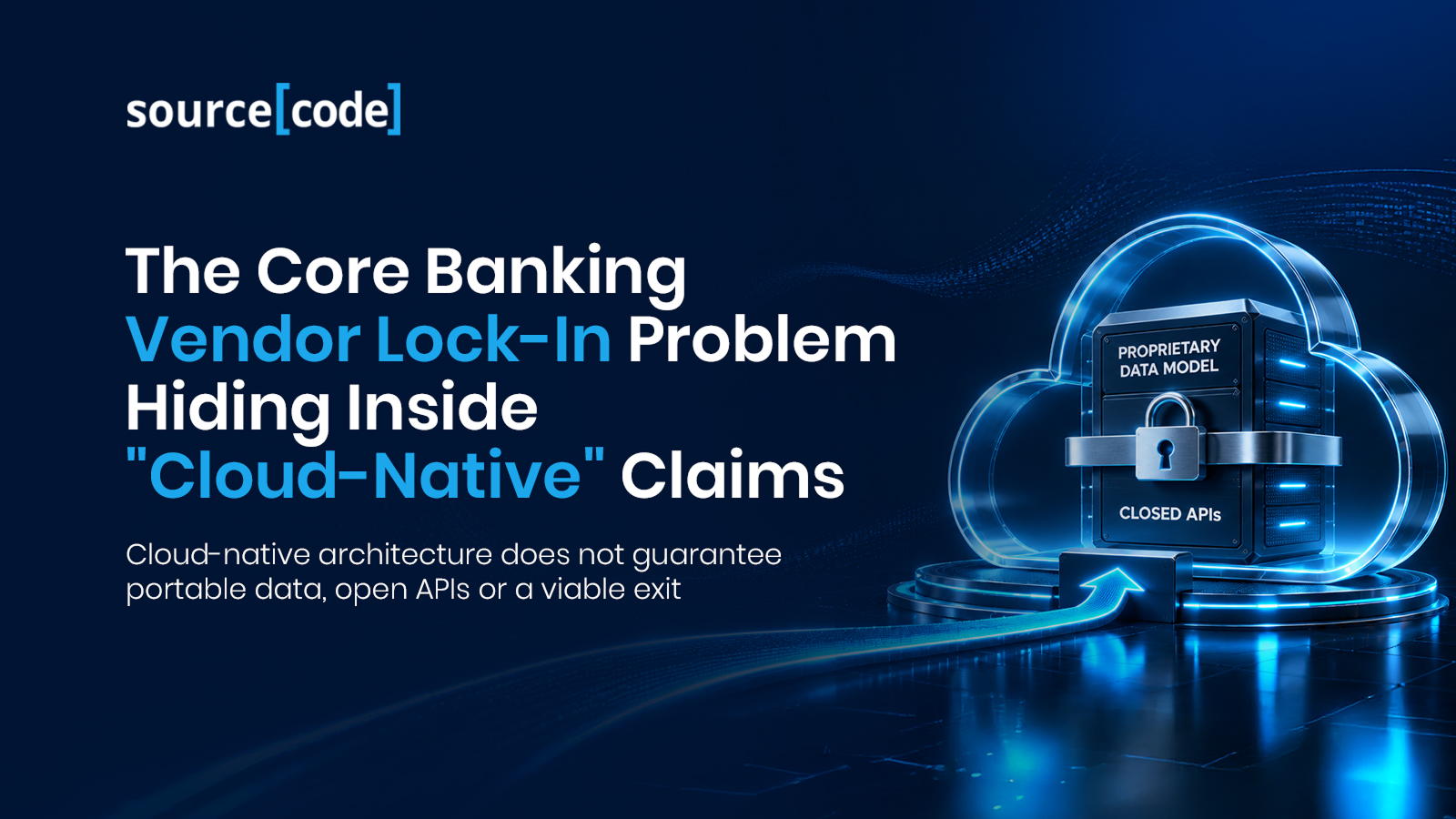
- A platform can be genuinely cloud-native in its architecture and still be closed in exactly the way a legacy mainframe core was closed - through a proprietary data model and a vendor-controlled API surface - which means the due-diligence question a bank needs answered before signing differs from the one most RFPs currently ask.
- sourceCode's Portability Stress Test gives CTOs and CDOs a way to check, before signing, whether data and workflows can actually be extracted from a shortlisted "cloud-native" core platform, rather than finding out at the next migration.
Introduction
Every core banking replacement programme now runs through the same gate: is the shortlisted platform cloud-native. For most Australian bank technology leaders, a "yes" has quietly become shorthand for a second, larger claim - that the platform carries less structural risk than the legacy core it replaces, because it was built for modern infrastructure rather than retrofitted onto it.
That shorthand is doing more work than it has earned. "Cloud-native" is a claim about how a platform is deployed and architected - containerised, horizontally scalable, built on modern infrastructure rather than lifted onto it. It says nothing, by itself, about whether the bank that adopts it can get its own data and workflows back out again on terms it controls. Those are two separate questions, and the market has spent the past eighteen months discovering that a platform can answer the first one honestly and the second one badly.
This matters for a CTO or CDO running a platform evaluation right now, because the core replacement cycle Australian banks are in the middle of - CBA, Bank of Sydney, BoQ and Queensland Country Bank have all announced or completed core migrations to cloud-hosted platforms over the past two years - is exactly the moment this distinction gets collapsed under deadline pressure. A demo that shows modern deployment, elastic scaling and a slick cloud console answers the architecture question convincingly. It does not, on its own, answer whether the data model underneath is open enough, or the API surface permissive enough, for the bank to leave on reasonable terms if it needed to. Few RFPs ask that second question with the same rigour they apply to the first.
"Cloud-Native" Is a Claim About Deployment, Not About Portability
The clearest evidence that this conflation is a market-wide problem, not a theoretical one, is that the market has given it a name: cloudwashing. A SaaScada survey of 150 UK banking innovation leaders - CTOs, chief innovation officers and digital transformation heads at banks with balance sheets from £0.5 billion to £100 billion, fielded in March 2025 - found that 95% had migrated, or planned to migrate, core workloads to the cloud, but 57% described themselves as "sick of cloudwashing," saying much of what is marketed as cloud-native core technology is legacy software with a new label. Thirty-nine percent said they had personally procured a "cloud" system that lacked genuine cloud capability, and 23% could not reliably distinguish a genuinely cloud-native platform from a relabelled legacy one during evaluation.
That data needs a direct caveat: SaaScada is itself a core banking vendor competing for the same deals, with a commercial interest in positioning rivals as cloudwashed and its own platform as the genuine article. The figures are evidence that senior banking technologists widely perceive a cloudwashing problem, not an independently audited measurement of how many platforms actually are cloudwashed. Separately, a 2024 study of 206 IT decision-makers at tier I and tier II banks across the UK, US, Australia and South Africa - commissioned by core vendor 10x Banking, fielded by research agency Vitreous World - found 55% named limitations in their existing core as the biggest obstacle to their transformation goals, and that a share of respondents already running newer "neo core" platforms reported new challenges emerging from them, unspecified. That study is also vendor-commissioned, by a company selling a competing cloud-native core.
What both pieces of vendor-sourced research agree on, regardless of whose commercial interest they serve, is that "cloud-native" has become a label banks cannot currently verify at face value during an RFP - a claim a buying committee cannot independently check is one a vendor can make cheaply and a bank can only test expensively, after the contract is signed.
Where the New Lock-In Actually Lives: Proprietary Data Models and Closed APIs
If deployment architecture is not where the real risk sits, the next question is where it does. The most credible evidence available - because it comes from parties with competing, not aligned, commercial interests, filed in response to a formal regulatory request rather than published as vendor marketing - is a set of comments filed with the US Office of the Comptroller of the Currency in early 2026, reported independently by PYMNTS, responding to the OCC's request for information on how banks work with core processors and other technology third parties.
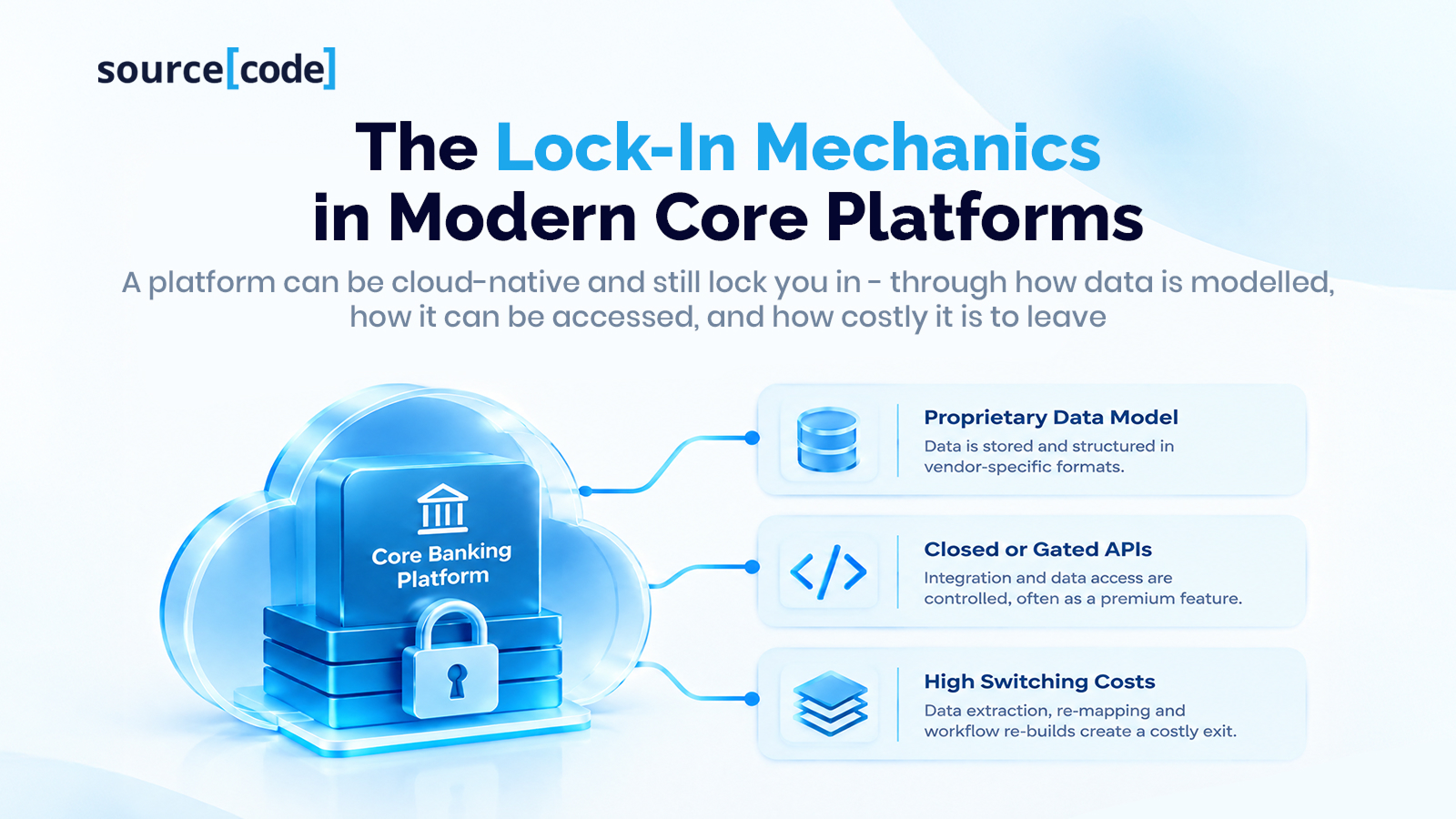
The American Bankers Association told the OCC that some core providers "treat APIs as a premium feature rather than baseline infrastructure" - meaning the degree to which a bank's own data can be reached programmatically is a commercial upsell, not a default. MX Technologies said community banks remain "almost entirely controlled by their legacy core service providers" on integration. Braid Technologies described "contractual limits on interoperability and data portability" creating "high switching costs that effectively prevent core migration" in practice, regardless of whether the platform runs on a mainframe or a modern cloud region. None of these submissions distinguish legacy from cloud-native when describing the mechanism - the closed API surface and the proprietary data model are the lock-in, independent of where the servers sit.
This is the structural point the cloud-native framing obscures: a platform rebuilt for cloud infrastructure can still choose, as a commercial decision, to expose only a narrow, metered API, to store customer and transaction data in a schema the vendor does not publish, and to charge for the connectors a bank would need to extract that data elsewhere. None of that requires legacy technology - it requires a vendor with an incentive to raise switching costs, which every vendor has, and a buyer who evaluated architecture without separately testing portability. PYMNTS reporting in April 2026 on banking technology contracts noted that "as the importance of AI increases, so does the risk of being locked into a single provider's ecosystem," citing the Dutch central bank's reported move away from a hyperscale cloud provider toward a homegrown alternative, driven substantially by data sovereignty concerns - a real, named instance of an institution treating portability as a risk worth re-architecting around, not a hypothetical.
It Is Reasonable to Ask Whether This Overstates the Risk of Modern Platforms
The strongest objection is that this risks painting every modern core vendor with the same brush as the processors the OCC complaints were filed against, most of which are decades-old legacy providers, not the cloud-native entrants banks are evaluating today. A genuinely modern platform, this argument goes, is built on open standards, documented schemas and REST or event-driven APIs almost by default - a large part of what "cloud-native, API-first" is supposed to mean. Treating every cloud-native vendor as a lock-in risk equivalent to a legacy mainframe core is, on this view, an overcorrection that could make CTOs unnecessarily risk-averse about the modernisation the industry needs.
That is fair as a description of what a well-built cloud-native platform can be. It is not a fair description of what every platform marketed as cloud-native actually is, which is precisely the gap the cloudwashing data points to - a meaningful share of senior banking technologists say they cannot reliably tell the difference during evaluation. The failure mode here is not "assume every modern platform is a trap." It is "do not accept architectural modernity as proof of portability without testing it specifically," because the two have no necessary relationship. Being API-first in marketing material is a claim about intent. Whether a bank can extract its full data model, synchronise with a third party without a premium licence, or migrate off the platform within a defined cost and timeline is a claim about contract terms and implementation - testable before signing, not just discoverable after.
Who Is Actually Deciding This
The decision to accept a vendor's cloud-native claim at face value, rather than testing it, does not sit with one role, which is part of why it so often goes untested.
The CTO or CDO typically owns the platform evaluation and the RFP's architecture criteria, and is usually the person who has to explain, years later, why a platform chosen for its modern architecture still took eighteen months and an unbudgeted project to leave.
Heads of core banking and enterprise architecture own the technical due diligence meant to catch this gap, but their criteria are frequently weighted toward what the platform can do once installed, not what it costs to remove - a different question needing its own scorecard line.
Procurement and vendor management negotiate the commercial terms that actually determine portability - API tiering, export formats, termination assistance periods - and are best placed to insist those terms are specified in the contract rather than left to standard terms, but only if told portability is a negotiating priority, not an afterthought.
Risk and operational resilience functions, under APRA's CPS 230 requirement for tested exit plans for critical operations, inherit the consequence if portability was never tested during procurement, since a core platform chosen without a tested exit plan is precisely the dependency CPS 230 was written to surface.
The Portability Stress Test: Four Questions Before You Sign
Can you export your complete data model, not just a data dump? A CSV export of transaction records is not data portability. The test is whether the full relational structure - account relationships, product configurations, workflow states, customer linkage logic - can be extracted in a documented, non-proprietary format a new platform could actually ingest, not just archive.
Can a third party integrate without the vendor's commercial sign-off or a premium-tier fee? If every integration - to a fraud system, a data warehouse, a new channel - requires the vendor's paid API tier or discretionary approval, the bank does not control its own integration roadmap. That is a commercial lock-in mechanism dressed as a technical limitation, and it is visible during a trial if anyone asks to test it specifically, rather than taking the sales team's description on trust.
What does exit actually cost, in time and dollars, and has the vendor priced it in writing? Most shortlisted vendors describe their onboarding timeline in detail. Few are asked to put a termination assistance period, a data-return format and an estimated offboarding cost in writing before signing. A vendor confident in its own portability claims should commit to specific exit terms; reluctance to do so is itself a signal worth weighing against the architecture demo.
Is the "cloud-native" claim actually about deployment, or used as a proxy for openness? These are different claims, and a platform can satisfy the first while failing the second. The test is asking the vendor to demonstrate - not describe - a full data extraction and a third-party integration during evaluation, using the bank's own representative data structures, before any contract is signed.
sourceCode’s Perspective
This is our disclosed point of view, built from our own delivery and integration work with banks mid-migration, not an independently published industry survey - we name that distinction directly rather than presenting it as something it is not. We built the Portability Stress Test because we kept seeing the same sequence: a bank chooses a cloud-native core on the strength of its architecture and roadmap, signs a multi-year contract, and only discovers the real shape of its data model and API constraints two or three years in, when a merger, a new channel or a regulatory requirement forces an integration the vendor's standard terms were never designed to make easy or cheap.
The Portability Stress Test is not a replacement for architectural due diligence - a platform still has to be genuinely capable and fit for the bank's workloads. It is the missing second half of that due diligence: a structured check, run during evaluation rather than after signature, of whether the bank's own data and workflows can actually leave the platform on terms it understands in advance. Banks that run it before signing negotiate from a position where the vendor still wants the deal. Banks that discover the answer when the next migration becomes necessary negotiate from a position where they have nowhere else to go - the precise condition the word "lock-in" describes.
>> Request a Portability Stress Test on a shortlisted platform before your next signature, not after your next migration
Conclusion
The build decision Australian bank CTOs are working through right now - which modern core platform to shortlist, and on what evidence - has quietly inherited a shortcut that deserves scrutiny: reading "cloud-native" as a proxy for "de-risked," when the two claims answer entirely different questions. A platform can be genuinely, defensibly cloud-native in its architecture and still recreate the same proprietary, closed-API lock-in that made the legacy core expensive to leave in the first place.
The market has already named this pattern - cloudwashing - and regulators are already hearing complaints about its mechanism, in the form of closed APIs and switching costs that function the same way regardless of where the platform is hosted.
The question worth asking before the next signature is not whether the shortlisted platform is cloud-native. It is whether anyone has actually tested whether the bank could leave it.
FAQ
Q1. What does "cloud-native" actually mean for a core banking platform, and why doesn't it guarantee low lock-in?
It describes how a platform is built and deployed - typically containerised, horizontally scalable, and designed for cloud infrastructure rather than retrofitted onto it. It is a claim about architecture, not about whether a bank's data model and workflows can be extracted on reasonable terms. A platform can satisfy the first claim fully while restricting API access and using a proprietary, undocumented schema - a separate commercial decision a vendor makes independently of its architecture.
Q2. What is "cloudwashing," and how common is it in core banking?
Marketing a platform as cloud-native when it is substantially legacy technology rehosted on cloud infrastructure rather than rebuilt for it. A SaaScada-commissioned survey of 150 UK banking leaders found 57% sick of cloudwashing and 39% had bought a "cloud" system that lacked genuine cloud capability - vendor-sourced findings evidencing a widely perceived problem, not an audited measurement.
Q3. Where does lock-in actually come from in a modern core platform, if not from legacy technology?
From two testable mechanisms: a proprietary data model not published or portable in a standard format, and an API surface the vendor restricts or gates behind a premium tier. Comments filed with the US Office of the Comptroller of the Currency in early 2026 describe exactly this - APIs treated as "a premium feature rather than baseline infrastructure" and terms creating switching costs high enough to "effectively prevent core migration."
Q4. What is the Portability Stress Test, and when should a bank run it?
sourceCode's framework for checking, during evaluation and before signing, whether a shortlisted "cloud-native" core actually allows full data model export, third-party integration without vendor gatekeeping, and a defined, costed exit path - alongside standard architecture due diligence, not instead of it.
Q5. How does this relate to APRA's CPS 230 operational resilience requirements?
CPS 230 requires tested, not merely documented, exit plans for critical operations, and a core banking platform is almost always a critical operation under that standard. A bank that selected its platform without testing portability is likely to find the exit plan cannot be executed as assumed when CPS 230 compliance requires one tested - making portability a resilience requirement as well as a commercial one.
Reference List
American Bankers Association (2026) Comments to the Office of the Comptroller of the Currency on core service provider relationships, as reported in PYMNTS (2026) FinTechs and community banks tell OCC to open the data pipes, 3 February. Available at: https://www.pymnts.com/bank-regulation/2026/fintechs-and-community-banks-tell-occ-to-open-the-data-pipes/ (Accessed: 17 November 2026).
Braid Technologies (2026) Comments to the Office of the Comptroller of the Currency on core service provider relationships, as reported in PYMNTS (2026) FinTechs and community banks tell OCC to open the data pipes, 3 February. Available at: https://www.pymnts.com/bank-regulation/2026/fintechs-and-community-banks-tell-occ-to-open-the-data-pipes/ (Accessed: 17 November 2026).
MX Technologies (2026) Comments to the Office of the Comptroller of the Currency on core service provider relationships, as reported in PYMNTS (2026) FinTechs and community banks tell OCC to open the data pipes, 3 February. Available at: https://www.pymnts.com/bank-regulation/2026/fintechs-and-community-banks-tell-occ-to-open-the-data-pipes/ (Accessed: 17 November 2026).
PYMNTS (2026) Banks confront the cloud contracts built for yesterday, 28 April. Available at: https://www.pymnts.com/news/banking/2026/everything-is-ai-now-and-its-reshaping-banking-core-cloud-contracts/ (Accessed: 17 November 2026).
SaaScada (2025) Cloudwashing survey of 150 UK banking innovation leaders, as reported in FF News (2025) More than half of banking innovation leaders say they're sick of cloudwashing, 20 August. Available at: https://ffnews.com/newsarticle/fintech/more-than-half-of-banking-innovation-leaders-say-theyre-sick-of-cloudwashing/ (Accessed: 17 November 2026).
10x Banking (2024) Core Banking without Compromise, conducted by Vitreous World, 25 September. Available at: https://10xbanking.com/news/core-technology-holding-us-back-say-55-percent-of-banks-new-10x-banking-research-reveals (Accessed: 17 November 2026).