Key Takeaways
- Singapore's Monetary Authority of Singapore (MAS) published AI Risk Management Guidelines on 7 October 2026 that are explicitly "principles-based and risk-proportionate," requiring financial institutions to assess the risk materiality of each AI use case and apply controls proportionate to that materiality - with the Guidelines taking effect on 7 October 2027 and a further phase following on 7 October 2028 (Monetary Authority of Singapore, 2026).
- The US Federal Reserve, OCC and FDIC's revised interagency guidance on model risk management, SR 26-2, issued 17 April 2026, sets out the same structural principle for any US banking organisation it reaches: validation rigour and ongoing monitoring intensity should scale with a model's materiality, with vendor-sourced models expected to meet the same model risk management principles as models built in-house - while explicitly excluding generative and agentic AI models from its current scope, and carrying no enforceable penalty for non-compliance (Board of Governors of the Federal Reserve System, Office of the Comptroller of the Currency and Federal Deposit Insurance Corporation, 2026).
- In the Gulf, the UAE Central Bank's Guidance Note on Consumer Protection and the Responsible Adoption and Use of Artificial Intelligence names underwriting outcomes, pricing decisions, claims assessments and coverage determinations directly as "high-impact" AI decisions requiring calibrated human oversight, structured governance, enhanced documentation and demonstrable oversight of outcomes (Al Tamimi & Company, 2026).
- Three different regulators, writing independently, have converged on the same structural idea: the depth of validation, monitoring and documentation an AI underwriting system requires is not fixed - it rises with how materially consequential that system's decisions are, and underwriting sits near the top of that materiality scale by name in at least one of the three regimes.
- The practical implication for a CFO building the business case for AI-assisted underwriting: an ROI model that captures the loss-ratio or cycle-time improvement but prices validation, monitoring and documentation at a flat, one-time cost is modelling the wrong shape of expense. That cost is not flat, and it does not end at deployment.
Introduction
The business case for AI-assisted underwriting is, by now, a familiar document inside most insurers and banks active in APAC and the Gulf: faster triage, more consistent pricing, fewer manual referrals, a measurable improvement in loss ratio or cycle time. What is far less often in that document is a realistic accounting of what it now costs, on an ongoing basis, to keep that system inside the risk management expectations that three major regulators have each, independently, tightened in 2026.
The three regimes described in this article were not coordinated with each other, and they are not identical. Singapore's MAS has issued principles-based guidelines with a phased effective date. The US interagency SR 26-2 is supervisory guidance, not a binding rule, and it is explicit that it does not yet cover agentic or generative AI. The UAE Central Bank's guidance speaks the language of consumer protection rather than model risk management, and names underwriting directly as a high-impact use case. What all three share is a structural idea that most AI underwriting ROI cases do not yet price correctly: the validation and monitoring burden is not a fixed cost paid once at launch. It is a cost that scales with materiality, and it recurs for as long as the system is in production.
Three Regulators, One Structural Principle
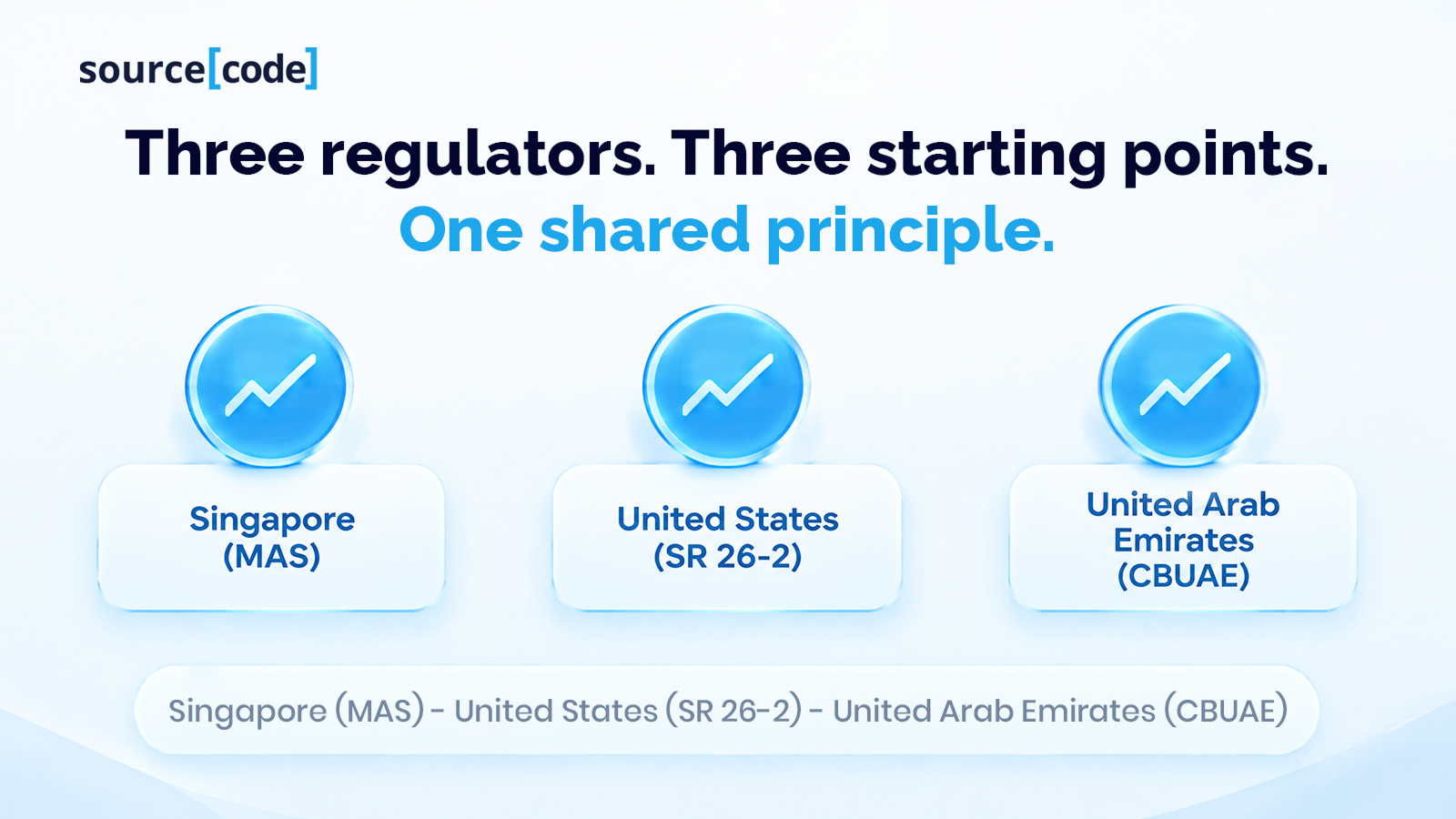
Singapore: risk-proportionate by design, with a phased clock already running. MAS's AI Risk Management Guidelines, published 7 October 2026 following a November 2025 industry consultation, apply to "all FIs and all forms of AI technologies," and ask each institution to "assess the risk materiality of AI use cases, and apply proportionate controls across the AI life cycle" (Monetary Authority of Singapore, 2026). Where poor AI performance or unavailability is unlikely to have a material impact, MAS explicitly allows institutions to run "basic policies and procedures" - but the inverse is equally explicit: "the extent and sophistication of the controls should depend on FIs' risk exposure" (Monetary Authority of Singapore, 2026). The Guidelines take effect on 7 October 2027, with a further set of expectations phasing in by 7 October 2028, and MAS's own release is direct that institutions "remain accountable for AI used in the services they deliver," including AI developed, operated or provided by third parties - with an expectation that institutions obtain "sufficient assurance from third-party providers" or apply compensating controls where that assurance cannot be obtained (Monetary Authority of Singapore, 2026).
The United States: a materiality-based validation standard, explicitly not yet extended to agentic AI. SR 26-2, the revised interagency supervisory guidance on model risk management issued jointly by the Federal Reserve, the OCC and the FDIC on 17 April 2026, replaces SR 11-7 (2011) and SR 21-8 (2021), and is "expected to be most relevant to banking organizations with over $30 billion in total assets" (Board of Governors of the Federal Reserve System, Office of the Comptroller of the Currency and Federal Deposit Insurance Corporation, 2026). Its core principle is explicit: "the nature and rigor of validation generally align with the model's approach, use, and materiality," with testing rigour "commensurate with model complexity and materiality" (Board of Governors of the Federal Reserve System, Office of the Comptroller of the Currency and Federal Deposit Insurance Corporation, 2026). On vendor-sourced models, the guidance states that "the principles of model risk management remain applicable" to vendor products, with validation expected "either by internal or outside parties" and an expectation that institutions develop a genuine understanding of a vendor model's conceptual soundness, design, data and performance rather than relying on a vendor's own attestation. It is important to be precise about what SR 26-2 does not yet do: a footnote states plainly that "generative AI and agentic AI models are novel and rapidly evolving" and "are not within the scope of this guidance," and the guidance itself "does not set forth enforceable standards or prescriptive requirements" - non-compliance carries no formal supervisory criticism (Board of Governors of the Federal Reserve System, Office of the Comptroller of the Currency and Federal Deposit Insurance Corporation, 2026). SR 26-2 is therefore best read, for an APAC or Gulf institution, as an indicator of where supervisory thinking on AI model materiality is heading - not as a rule that currently reaches agentic underwriting tools or binds institutions outside the US.
The Gulf: underwriting named directly as a high-impact decision. The UAE Central Bank's Guidance Note on Consumer Protection and the Responsible Adoption and Use of Artificial Intelligence by Licensed Financial Institutions takes a different framing - consumer protection rather than model risk management - but arrives at a closely related place. It defines a "high-impact decision" as "any AI-driven determination that materially affects a customer's access to financial products or services," and states directly that "in the insurance context, this will typically capture underwriting outcomes, pricing decisions, claims assessments, and coverage determinations" (Al Tamimi & Company, 2026). For decisions in that category, human oversight "must be calibrated to the level of risk posed by each AI application," and the Guidance Note sits alongside the CBUAE's 2021 Guidelines for Financial Institutions Adopting Enabling Technologies, which "establish baseline requirements around governance, model design, validation, monitoring, and accountability" (Al Tamimi & Company, 2026). The practical requirements this generates - bias testing with documented remediation, enhanced documentation, demonstrable oversight of outcomes, and third-party AI due diligence with audit rights - are not one-time deliverables. They are an operating cadence.
What Most AI Underwriting ROI Cases Get Wrong
The common thread across all three regimes is proportionality: none of them impose a flat, one-size-fits-all compliance cost, and none of them treat validation as a box ticked once at go-live. Each explicitly ties the depth of control to how materially consequential the AI system's decisions are - and in at least the UAE's framing, underwriting is named as a category that sits at the high-impact end of that scale by default, not by exception.
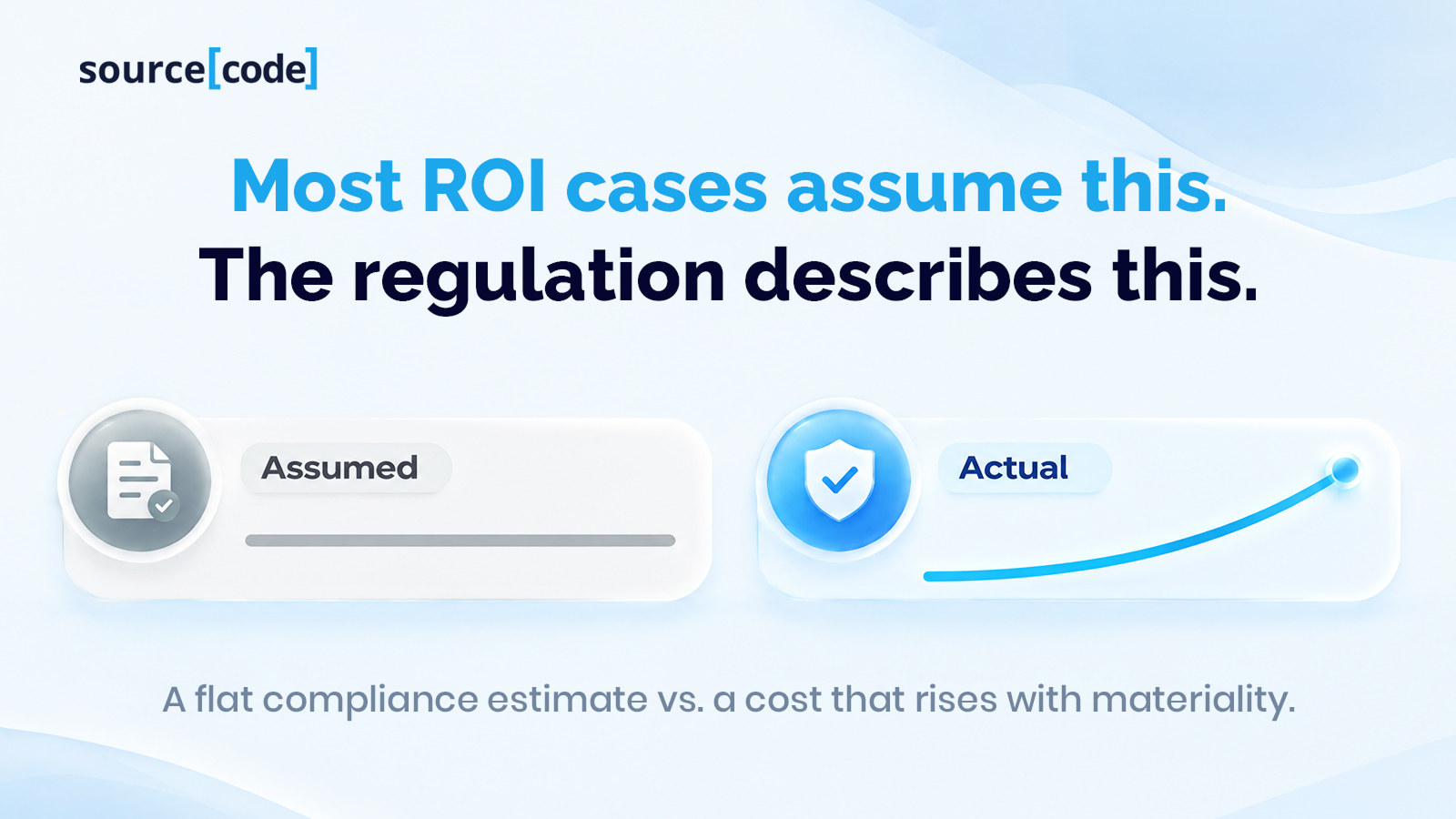
Set against that, the typical AI underwriting ROI case inside an insurer or bank in this region still tends to model two cost lines: a build cost (data, integration, model development) and an ongoing "run" cost that is usually a rough proxy for compute and a support headcount allocation. Validation, monitoring and documentation rarely appear as their own line, and when they do, they are usually estimated once, at a flat rate, as if the underwriting AI's materiality - and therefore the regulatory expectation on it - were fixed for the life of the system. It is not. A model that starts in a narrow, advisory role and is later given more autonomous decision authority over bind-or-refer outcomes has, in regulatory terms, moved up the materiality scale, and the validation and monitoring effort that MAS's and SR 26-2's own principles describe should move with it. An ROI case that does not anticipate that shift will understate the system's true cost to run at exactly the point where the system is delivering the most value - because expanded autonomy and higher materiality tend to arrive together.
What This Means for the Buying Committee
For the CFO, the task is to treat validation, monitoring and documentation as a recurring, materiality-linked operating cost in the ROI model - not a one-time implementation line - and to explicitly model what happens to that cost if the system's role expands from advisory to more autonomous over its lifetime.
For the CRO or Head of Compliance, the task is to establish, before the business case is approved, where the proposed AI underwriting use case sits on each applicable regime's own materiality or impact scale - explicitly, in writing - rather than discovering the answer after a regulator or an internal audit asks.
For the CTO or CDO, the task is architectural: building the system so that validation evidence, monitoring output and decision documentation are produced as instrumented by-products of how the model runs, rather than reconstructed after the fact - because the cost of reconstruction rises faster than the cost of native instrumentation as materiality increases.
For Procurement and Vendor Management, any vendor-sourced underwriting AI model needs to demonstrate - per SR 26-2's own stated principle - a genuine understanding of its conceptual soundness, design, training data and performance, not merely a vendor attestation; a vendor's "trust us" is not evidence any of the three regimes described above treats as sufficient.
The sourceCode Perspective
From our experience delivering technology for BFSI institutions, the organisations that get caught out here are rarely the ones ignoring AI model risk altogether - they are the ones who built a genuinely good business case for the AI itself and then under-costed what it takes to keep running it inside a tightening regulatory expectation. The fix is not a bigger compliance budget line added after the fact; it is building the validation and monitoring instrumentation into the underwriting pipeline from the first release, scaled deliberately to the materiality tier the use case actually sits at today - with a clear, costed plan for what changes if that tier moves.
This is also where the ROI conversation and the delivery conversation should happen together, not sequentially: an insourced or ODC-based delivery model that owns this instrumentation directly can adjust it as a use case's materiality shifts, rather than renegotiating a vendor contract each time the regulatory expectation catches up with what the AI is now actually being trusted to decide.
For organisations currently building or refreshing an AI underwriting business case, it is worth pricing the validation and monitoring cost at the materiality tier the system will plausibly reach within its planning horizon - not only the tier it starts at.
Conclusion
Three regulators, working independently and from different starting points, have each tightened AI model risk expectations in 2026 around the same underlying idea: the depth of validation, monitoring and documentation an AI system requires should scale with how materially consequential its decisions are, not stay fixed from launch. MAS's Guidelines take effect from October 2027. SR 26-2 is already shaping US supervisory expectations, even where it does not yet bind agentic AI or reach beyond US institutions. The UAE's Guidance Note already names underwriting directly as a high-impact category. An AI underwriting ROI case built on today's efficiency numbers and yesterday's flat compliance estimate will be wrong in a specific, predictable direction: it will understate cost exactly as the system's role - and its materiality - grows.
The institutions that get this right are the ones pricing the compliance cost curve into the business case now, not discovering its shape after the system has already earned the autonomy that moved it up the scale.
Frequently Asked Questions
Do MAS's AI Risk Management Guidelines name underwriting specifically? No. MAS's Guidelines, published 7 October 2026, are principles-based and apply to "all FIs and all forms of AI technologies," asking institutions to assess risk materiality use case by use case rather than naming specific functions such as underwriting (Monetary Authority of Singapore, 2026).
Does SR 26-2 cover agentic AI used in underwriting decisions? No. SR 26-2, the US interagency model risk management guidance issued 17 April 2026, explicitly states that generative AI and agentic AI models "are not within the scope of this guidance" because they are "novel and rapidly evolving." It is also non-enforceable supervisory guidance rather than a binding rule (Board of Governors of the Federal Reserve System, Office of the Comptroller of the Currency and Federal Deposit Insurance Corporation, 2026).
Does the UAE treat AI-assisted underwriting as high risk? The UAE Central Bank's Guidance Note on responsible AI use defines a "high-impact decision" as one that materially affects a customer's access to financial products or services, and states that in insurance this "will typically capture underwriting outcomes, pricing decisions, claims assessments, and coverage determinations" - placing underwriting squarely within that category (Al Tamimi & Company, 2026).
Does a vendor's compliance attestation satisfy model risk management expectations for a vendor-sourced underwriting AI model? Under SR 26-2's stated principle, no. The guidance expects institutions to develop their own understanding of a vendor model's conceptual soundness, design, data and performance, rather than relying solely on a vendor's own assurance (Board of Governors of the Federal Reserve System, Office of the Comptroller of the Currency and Federal Deposit Insurance Corporation, 2026).
What should a CFO ask before approving an AI underwriting business case? At minimum: where does this use case sit on the applicable regime's materiality or impact scale today; what does the validation and monitoring cost look like at that tier, as a recurring cost rather than a one-time line; and what happens to that cost if the system's decision authority expands over its planning horizon.
Reference List
Al Tamimi & Company (2026) AI in Insurance: CBUAE Sets Expectations for Responsible Use, 18 May. Available at: https://www.tamimi.com/law_update_articles/ai-in-insurance-cbuae-sets-expectations-for-responsible-use/ (Accessed: 17 November 2026).
Board of Governors of the Federal Reserve System, Office of the Comptroller of the Currency and Federal Deposit Insurance Corporation (2026) SR 26-2: Revised Guidance on Model Risk Management, 17 April. Available at: https://www.federalreserve.gov/supervisionreg/srletters/SR2602.htm (Accessed: 17 November 2026).
Monetary Authority of Singapore (2026) MAS Sets Out Supervisory Expectations on Responsible AI Adoption by Financial Institutions. Media release, 7 October. Available at: https://www.mas.gov.sg/news/media-releases/2026/mas-sets-out-supervisory-expectations-on-responsible-ai-adoption-by-financial-institutions (Accessed: 17 November 2026).