Key Takeaways:
- For a decade, "digital-first" was shorthand for one assumption in life and health insurance: that apps and direct-to-consumer digital channels would steadily displace the agent. The 2026 evidence across several independent research houses says that assumption has not played out as expected, and the industry's own investment pattern is quietly correcting for it.
- Capgemini's World Life Insurance Report 2026 finds that nearly 70% of consumers still want a human agent rather than a chatbot for insurance decisions - a global figure, not an APAC-specific one, but directionally consistent with what APAC distribution leaders report in their own channel-mix data (Capgemini, as reported by Cafemutual, 2026).
- Trade coverage of the region's agency channel in 2026 describes agents "juggling technology with market pressures" as insurers expand digital platforms around them rather than past them - a framing that treats the agent as the channel being equipped, not the channel being replaced (Insurance Business Asia, 2026).
- McKinsey's longstanding analysis of Asian insurance distribution has argued for a "digitally enabled hybrid" model - technology embedded into the agent's workflow rather than offered as a parallel, competing channel - and GlobalData's research on APAC bancassurance similarly finds digitalisation supporting bank-channel sales growth rather than displacing the relationship-based model banks already run (McKinsey, n.d.; GlobalData, as reported by futurecio.tech, 2026).
- The practical implication for a Head of Digital or Innovation function: the agent channel is not a legacy system to be sunset. It is the integration point most of this decade's distribution technology investment should be built around - and the insurers treating it that way are better positioned than the ones still funding apps designed to go around it.
The Assumption That Didn't Quite Hold
Ten years ago, a reasonable forecast for life and health insurance distribution in Asia looked something like this: smartphone penetration would keep rising, comparison platforms would make price and product more transparent, a generation of digitally native consumers would reach the age where they buy their first policies, and insurers that built the best direct-to-consumer app would capture that generation before competitors with legacy agency forces caught up.
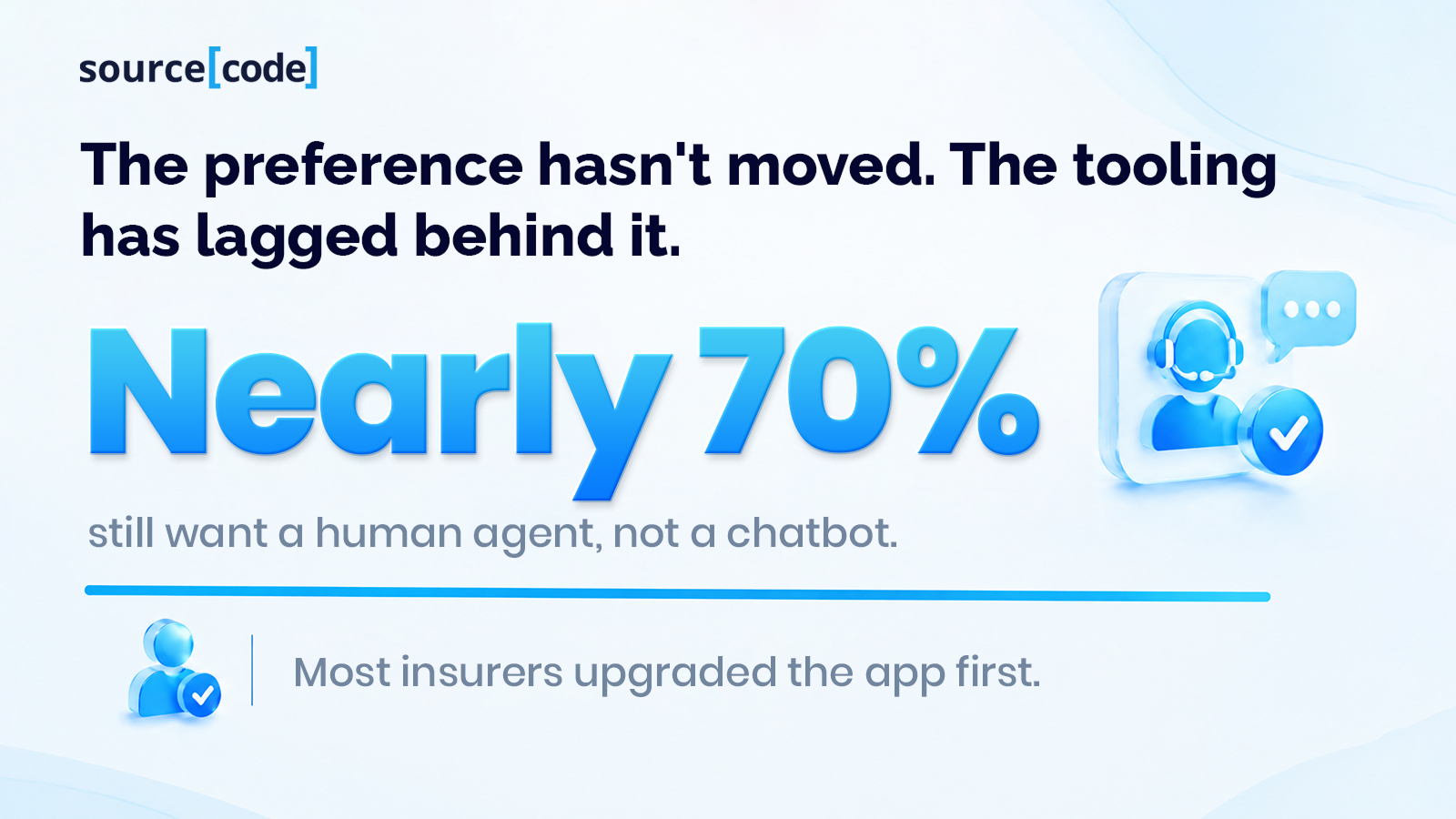 Parts of that forecast were right. Smartphone penetration did rise. Comparison and embedded-distribution channels did grow - materially, as the region's bancassurance and embedded-insurance numbers show. What has not happened at anything like the predicted pace is the wholesale displacement of the human agent by a direct digital channel for complex, advice-driven products like life and health insurance. Capgemini's 2026 research puts a number on the underlying consumer preference: close to 70% of insurance consumers still want a human agent involved rather than a chatbot (Capgemini, as reported by Cafemutual, 2026). That figure is global rather than APAC-specific, and it should be read as a directional signal rather than a precise regional measurement - but it is consistent with what the region's own distribution leaders have been saying in trade coverage throughout 2026: agents are not disappearing, they are being asked to do more, with more tools, under more scrutiny (Insurance Business Asia, 2026).
This matters for how a digital or innovation budget gets allocated. An organisation that is still implicitly building toward "the app replaces the agent" is optimising for a transition that the evidence increasingly says is not the one actually happening. An organisation that reads the same evidence and concludes "the agent gets augmented" ends up making a different, and apparently better-targeted, set of technology decisions.
What "Augmented, Not Replaced" Actually Looks Like
The distinction matters because it is not simply a rhetorical reframing - it changes what gets built.
A distribution strategy still organised around eventual agent displacement tends to fund a consumer-facing app, a direct quote-and-bind flow, and a customer data platform optimised for self-service conversion, with the agent channel treated as a separate, often technologically neglected, legacy track running in parallel. A distribution strategy organised around agent augmentation funds something structurally different: tools that sit inside the agent's own workflow - lead qualification that reaches the agent before a customer has fully self-served away, underwriting pre-fill that removes paperwork from the point of sale, e-policy issuance that closes the gap between a conversation and a bound policy, and servicing tools that keep the agent, rather than a call centre, as the system of record for the relationship.
McKinsey's analysis of Asian insurance distribution has argued for exactly this kind of model for several years now: a "digitally enabled hybrid" approach in which technology is embedded into the agent's own process rather than offered as a competing self-service alternative (McKinsey, insurance blog, "How Asian insurers can build a digitally enabled hybrid distribution model"; publication date not independently confirmed in this run, cited for its framework rather than as a dated 2026 data point). The direction of that argument has, if anything, been reinforced by the region's bancassurance data: GlobalData's research finds that digitalisation in Asia-Pacific bancassurance is supporting growth in the bank channel's online life insurance sales - functioning as a complement to the existing relationship-based distribution model banks run, not a parallel channel competing to replace it (GlobalData, as reported by futurecio.tech, 2026). The pattern recurs across the region's distribution channels: digital investment correlates with channel strength when it is built into the existing relationship, and struggles to gain traction when it is built to bypass it.
Why the Original "Apps Will Replace Agents" Thesis Undersold the Agent's Actual Job
It is worth being specific about what the displacement thesis got wrong, because the answer shapes where investment should go next.
Life and health insurance, more than most consumer financial products, is sold against ambiguity rather than against a known need. A customer rarely wakes up certain they need a critical-illness rider with a specific sum insured; they need to be walked, by someone they trust, from a vague sense of exposure to a specific, bindable product. An app can execute a transaction efficiently once a customer already knows what they want. It is much weaker at the earlier, harder part of the job - building the trust and the specificity that gets a customer to "I know what I need" in the first place. That earlier part of the job is what an agent actually does, and it is also the part hardest to disintermediate with a self-service interface, however well designed.
ANZIIF's own professional analysis of life insurance distribution across the region makes a related point: distribution model choices in Asia-Pacific reflect deep, durable differences in how insurance is sold and trusted across markets, not a single regional trajectory toward any one channel (ANZIIF, "Life Insurance Distribution Across Asia-Pacific," undated journal article, cited for its framing rather than a specific statistic). That heterogeneity is itself a reason to be cautious about any single-channel prediction, including the original app-replaces-agent one.
The Honest Counter-Argument
The fair objection here is that this reframing is convenient for an industry reluctant to disrupt its own agency-force cost base, and that direct digital channels are still growing faster in percentage terms than the agency channel in several APAC markets, even if agents remain dominant in absolute volume. Both of those things can be true at once, and neither undermines the core argument.
Growth rate and channel importance are different measurements. A direct digital channel growing from a small base can post a high percentage growth rate while still representing a small share of new business premium, particularly for the advice-intensive products - critical illness, whole-of-life, complex health covers - where trust and product complexity matter most. The GlobalData bancassurance finding is instructive here precisely because it is not an either/or result: digital growth and channel-relationship strength are rising together in the data that research actually measured, not trading off against each other (GlobalData, as reported by futurecio.tech, 2026). The practical reading is not "ignore direct digital distribution." It is "build direct digital capability as a complement to the agent relationship for the products suited to it, and build the heavier digital investment into the agent's own tools for the products that are not" - which is a more precise allocation decision than either a pure direct-app strategy or a pure status-quo agency strategy would produce.
A Practical Framework: The Agent-Assist Stack
If the agent remains the primary vehicle for advice-driven products, the technology question shifts from "how do we build a better app" to "what does an agent actually need at each stage of a sale, and which of those needs are currently unmet by what we've built."
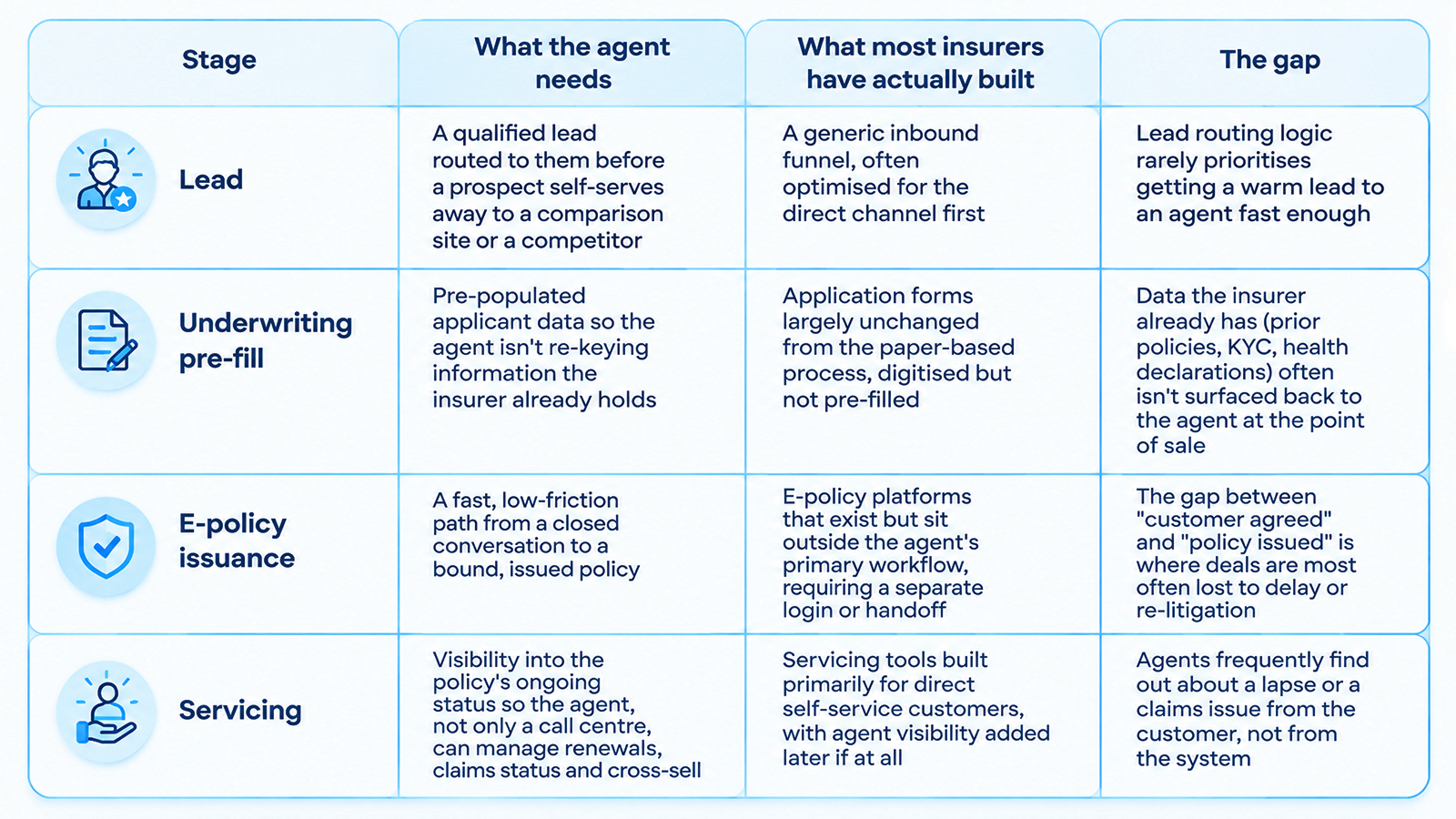
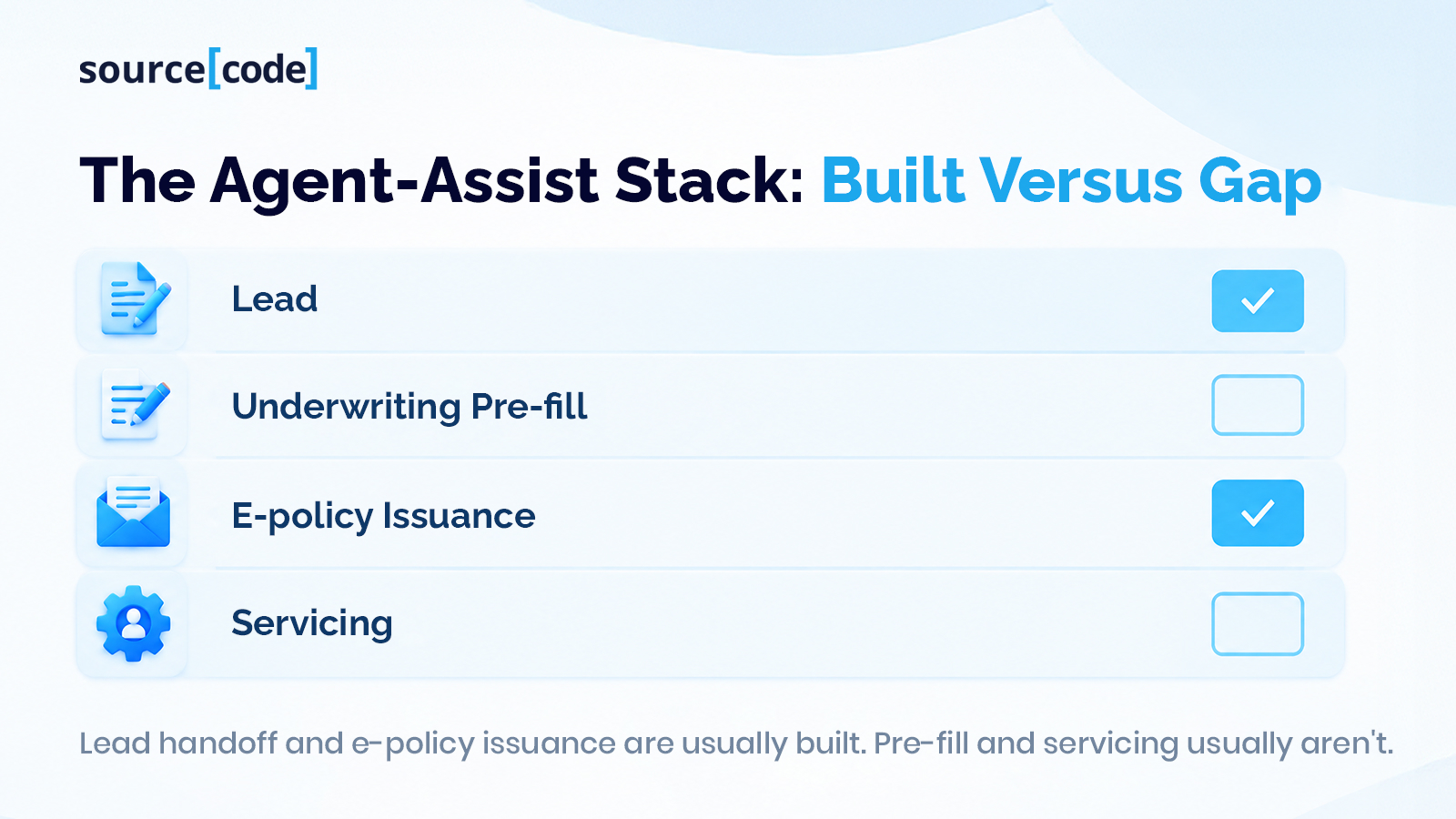 Reading this table against the research cited above, the four stages map closely to what McKinsey's hybrid-distribution framing and the region's bancassurance digitalisation data both point toward: the technology that correlates with stronger distribution outcomes is technology built into the relationship channel's own workflow, not technology built to compete with it.
What This Means by Buying-Committee Role
For the Head of Digital or Innovation, the practical redirection is budget allocation: shifting investment weighting from consumer-facing acquisition apps toward the four-stage agent-assist stack above, measured by agent adoption and time-to-issue rather than app downloads.
For the CTO or CDO, the architecture implication is that agent-facing tools need the same data access as direct-channel tools - underwriting data, KYC, policy history - which in practice means the same backend integration investment either way. The agent-assist stack is not a cheaper alternative to a direct platform; it uses much of the same underlying data layer, pointed at a different front end.
For the Chief Agency Officer, the research gives a concrete argument for a seat at the digital investment table that may previously have gone entirely to the direct-channel team: the agent channel's own tooling gap is now measurable, not merely a retention argument from the field force.
For Head of Bancassurance or equivalent partnership-channel leads, the GlobalData finding is a direct read-across: digital investment inside a relationship-based channel appears to support, rather than cannibalise, that channel's growth, which argues for the same augmentation logic in bank-distributed and agency-distributed books alike.
The sourceCode’s Perspective
We build distribution and servicing platforms for insurers across the region, so we have a direct interest in how this investment gets allocated - which is also why it's worth being specific about where our view is limited. We are not an actuarial or distribution-strategy research house, and the consumer-preference and channel-growth figures above are other organisations' research, read at the level the sources make publicly available, not sourceCode's own survey data.
Where we do have a grounded, delivery-side view is on why the agent-assist stack described above is so often left half-built. The technical reason is usually not unwillingness to invest; it is that underwriting pre-fill and e-policy issuance require the same clean integration with core policy administration and underwriting data that a direct-channel app needs - and once that integration exists for one channel, extending it to the agent's own workflow is a materially smaller build than the market convinces most insurers it will be. The investment logic that treats "agent tools" and "the digital platform" as two competing budget lines, rather than two front ends on the same underlying integration, is, in our experience, the single biggest reason agents are still working from half-digitised processes a decade into this transition.
Conclusion
The forecast that direct digital channels would steadily displace the agent in life and health insurance has not played out at the pace it was once expected to, and the 2026 research base - however read cautiously at the level this article could independently verify - is consistent in pointing the other way: close to seven in ten consumers still want a human agent in the loop, agents are being equipped rather than retired across the region's trade coverage, and the distribution channels with the strongest digital-growth evidence are the ones where digital investment was built into an existing relationship rather than around it. The insurers still funding their distribution technology roadmap on the original displacement assumption are optimising for a transition the evidence does not support.
The ones building the agent-assist stack - lead routing, underwriting pre-fill, e-policy issuance and agent-visible servicing - are optimising for the channel that is actually carrying the business, and for the investment allocation the next phase of APAC life and health distribution technology is likely to reward.
If your distribution technology roadmap still treats the agent channel as a legacy system running in parallel to a direct digital build, the useful next step is a short readiness review: mapping your current agent-facing tooling against the four stages above - lead, underwriting pre-fill, e-policy issuance and servicing - to see where the gap actually sits before the next planning cycle locks in next year's allocation. We run this as a scoping workshop, not a platform demo.
>> Contact us for further discussion here!
FAQ
Are digital channels replacing insurance agents in APAC? Not at the pace once forecast. Capgemini's World Life Insurance Report 2026 finds nearly 70% of consumers still prefer a human agent to a chatbot for insurance decisions - a global figure directionally consistent with 2026 trade coverage of the region's agency channel, which describes insurers expanding digital tools around agents rather than building channels to replace them.
What is an "Agent-Assist Stack"? A set of technology tools built into an agent's own sales and servicing workflow rather than offered as a separate, competing direct-to-consumer channel: qualified lead routing, underwriting data pre-fill, fast e-policy issuance, and servicing visibility so the agent - not only a call centre - can manage a customer's ongoing relationship.
Does this mean direct digital insurance distribution doesn't work in APAC? No - it means direct and agent-assisted channels appear to be growing together rather than trading off, based on GlobalData's research on APAC bancassurance digitalisation. The practical implication is to match channel investment to product complexity: direct digital for simple, well-understood products, and agent-assist technology for advice-intensive products like critical illness and whole-of-life cover.
Why do agent-facing digital tools get underfunded relative to consumer apps? Often because they are treated internally as a separate, lower-priority budget line from the direct-channel platform, even though both usually require the same underlying integration with core policy administration and underwriting data. Once that integration exists for one channel, extending it to the agent's workflow is typically a smaller build than organisations assume.
What should a Head of Digital or Innovation do before the next distribution technology planning cycle? Map current agent-facing tooling against four stages - lead routing, underwriting pre-fill, e-policy issuance and servicing visibility - and identify which stages are underbuilt relative to the direct-channel platform. That gap, not app download numbers, is the more reliable indicator of where the next distribution technology investment should go.
Reference List
ANZIIF (undated) Life Insurance Distribution Across Asia-Pacific, Professional development journal, Volume 44, Issue 2. Available at: https://anziif.com/professional-development/the-journal/volume-44/issue-2/life-insurance-distribution-across-asia-pacific (Accessed: 12 November 2026).
Cafemutual (2026) Global Trends: Nearly 70% of global insurance consumers want human agents over chatbots, reporting on Capgemini's World Life Insurance Report 2026. Available at: https://cafemutual.com/news/insurance/38917-global-trends-nearly-70-of-global-insurance-consumers-want-human-agents-over-chatbots (Accessed: 12 November 2026).
futurecio.tech (2026) APAC banks are better at capturing online insurance opportunities, reporting on GlobalData research on Asia-Pacific bancassurance digitalisation. Available at: https://futurecio.tech/apac-banks-are-better-at-capturing-online-insurance-opportunities/ (Accessed: 12 November 2026).
Insurance Business Asia (2026) Agents juggle technology with market pressures as insurers ramp up digital platforms. Available at: https://www.insurancebusinessmag.com/asia/news/technology/agents-juggle-technology-with-market-pressures-as-insurers-ramp-up-digital-platforms-522802.aspx (Accessed: 12 November 2026).
McKinsey & Company (undated) How Asian insurers can build a digitally enabled hybrid distribution model, insurance blog. Available at: https://www.mckinsey.com/industries/financial-services/our-insights/insurance-blog/how-asian-insurers-can-build-a-digitally-enabled-hybrid-distribution-model (Accessed: 12 November 2026).