Key Takeaways:
- GCC insurance M&A activity is real and accelerating: the GCC Insurance Industry Report (Alpen Capital-IMAP, May 2026) counts around eight completed transactions between 2024 and 2025, concentrated in 2025, including Solidarity Bahrain's USD 208.3 million acquisition of Bahrain National Insurance and MedGulf's USD 88.4 million acquisition of Buruj Cooperative Insurance in Saudi Arabia.
- Moody's Ratings' analysis (via Khaleej Times, December 2024) found ten GCC insurance M&A transactions completed or under way in the prior twelve months, against a backdrop of roughly 190 insurers sharing USD 40 billion in annual premium - a fragmentation level Moody's expects consolidation to compress, with smaller insurers "unable to find acquirers being forced out of the market over time."
- The market these deals are consolidating is itself growing: Alpen Capital projects GCC gross written premium rising from USD 44.7 billion (2024) to USD 61.8 billion by 2030 (a 4.9% CAGR), with the UAE alone reaching USD 25.1 billion by 2030 and Saudi Arabia posting the region's highest growth rate at 5.9%.
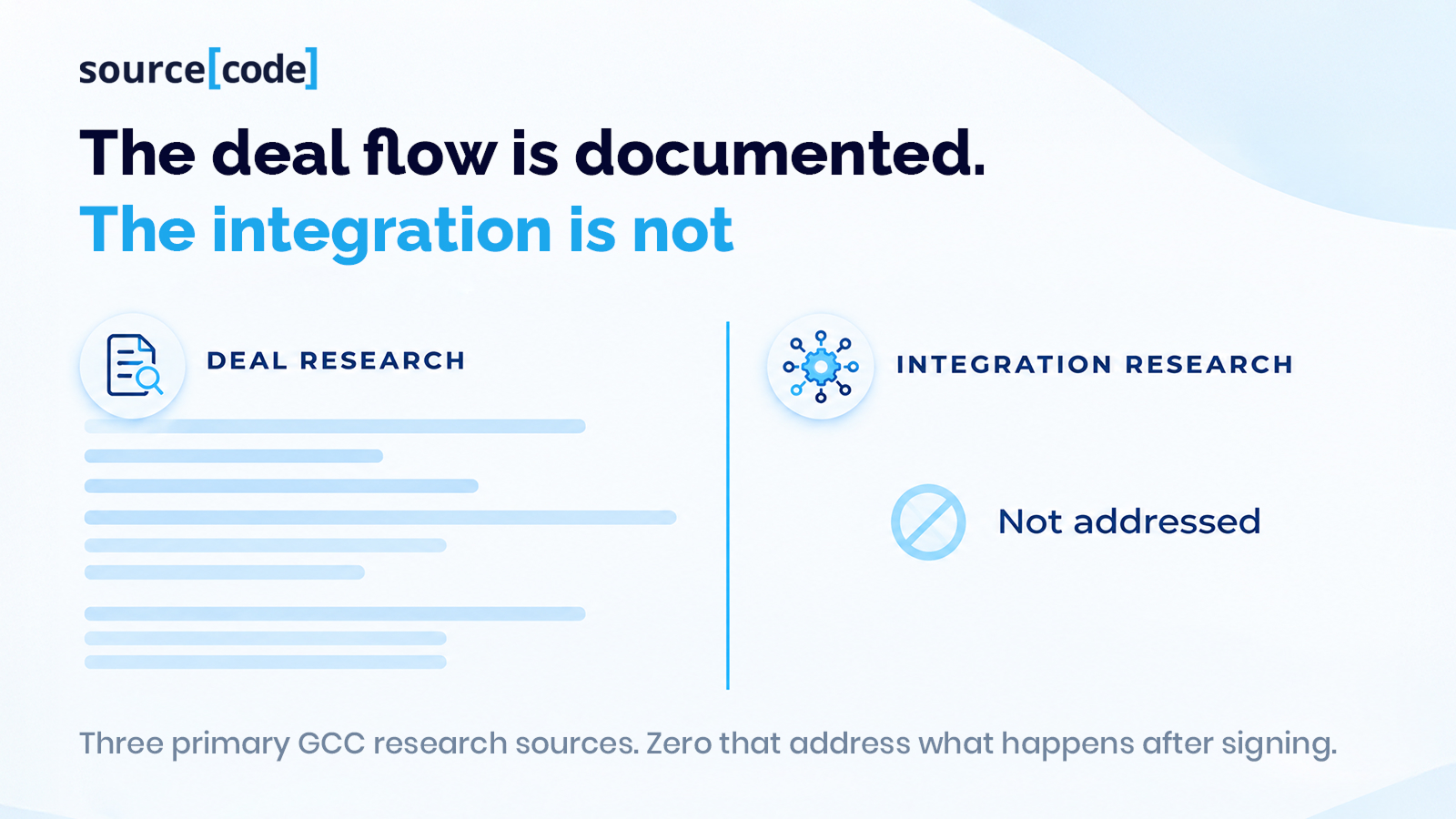
- None of the three primary research sources reviewed for this article - Alpen Capital's market report, the IMAP M&A analysis, or Moody's rating commentary - discusses post-merger integration timelines, policy administration system migration, or the operational mechanics of combining two insurers after signing. The public record on GCC insurance consolidation is dense on why deals happen and almost silent on what happens next.
- Separately, global insurance M&A research (Quantexa, via FinTech Global) attributes a persistent share of failed deal value specifically to "disparate IT systems and data" at the point of integration - a pattern with no reason to be absent in the GCC, and every reason to be sharper here, given the region's mix of legacy policy administration platforms and newer, vendor-hosted ones acquired at different times by different predecessor entities.
The Deal Flow Is Documented. The Integration Is Not.
Search for research on GCC insurance consolidation and the result is, by regional standards, unusually rich. Alpen Capital, the Dubai-registered investment banking advisory firm, publishes a detailed annual GCC Insurance Industry Report tracking market size, growth rates and the macro drivers behind them. IMAP's advisory arm layers an M&A-specific analysis on top of that market data, naming transactions and values. Moody's Ratings has its own independent view, built from a credit-rating lens rather than an advisory one, and reaches a similar conclusion from different evidence: consolidation is under way, and it will have winners and losers.
Read all three together and a consistent picture of the "why" emerges. The GCC insurance market remains fragmented - Moody's counts roughly 190 companies sharing USD 40 billion in annual premium, with the top five insurers in each market taking around half the volume. Smaller insurers face capital pressure, rising reinsurance costs and the mounting cost of digital transformation, which IMAP describes as pushing them "toward combinations that allow them to scale efficiently." Regulatory change is accelerating demand - UAE nationwide mandatory health coverage from January 2025, Saudi Arabia's requirement for health insurance before temporary work-visa issuance - which Alpen Capital calls "the primary engine of growth," and which simultaneously raises the capital and compliance bar smaller players must clear alone. Sovereign capital is an increasingly active participant: the IMAP analysis notes that GCC sovereign wealth funds are "building insurance platforms well beyond the region's borders," pointing to deals such as the Mubadala-led acquisition of Truist Insurance Holdings and the Saudi Public Investment Fund's 23.1% stake in Saudi Reinsurance Company.
What none of this research addresses - not in passing, not as a caveat, not as a single paragraph - is what happens to the two organisations' policy administration systems, claims platforms, data models and operating procedures once the transaction closes. The IMAP report, which is explicitly framed around the M&A opportunity, moves directly from naming a transaction's value to naming the next one in the pipeline. There is no discussion of integration risk, system consolidation timelines, or what determines whether a deal's strategic logic survives contact with two insurers' actual technology estates. For a region where the M&A commentary itself is this detailed, that is a conspicuous silence, and it is the silence this article is about.
What the Gap Actually Costs
The absence of GCC-specific integration research does not mean the problem is absent - it means it is undocumented regionally. Global evidence on insurance M&A gives a reasonably clear picture of where value gets lost after signing, even without naming a single Gulf deal. Research summarised by FinTech Global, drawing on analysis from the enterprise data platform Quantexa, attributes a recurring share of underperforming insurance M&A specifically to "disparate IT systems and data" at integration - not to the strategic rationale for the deal, which is usually sound, but to the mechanics of combining two technology estates that were never designed to be combined. The same analysis notes that conventional approaches - large-scale data migration projects, traditional master data management - are "not built to scale for the high volumes of distributed, disparate data" that M&A generates, and that siloed source systems routinely produce duplicate or incorrectly linked records during consolidation rather than a clean merged view.
There is no reason to expect the Gulf to be exempt from this pattern, and several reasons to expect it to be sharper here. The region's recent M&A activity spans insurers at very different points in their own technology history - some running policy administration platforms installed a decade or more ago, others on newer vendor-hosted or cloud-native systems adopted during the past five to seven years of InsurTech-driven modernisation - and, increasingly, insurers absorbing a specific product line or portfolio carved out of a larger multinational's regional operation, as happened when a UAE-listed insurer completed the acquisition of a UAE life insurance portfolio from a global carrier's regional reinsurance arm in 2024. A portfolio acquisition of that kind brings its own policyholder records, claims history and regulatory reporting obligations into an acquirer's existing systems - a narrower integration than a full-company merger, but not a simpler one, because the acquired data rarely arrives in a format the acquirer's core system was built to ingest directly.
Three structural features of the current GCC wave make the integration layer harder than the deal-count data alone suggests. First, pace: with activity concentrated in 2025 and a stated pipeline including Liva-Malath and Salama-Saudi Enaya evaluations in Saudi Arabia, acquirers are not integrating one deal at a time with years to absorb each - several institutions are running overlapping integration programmes. Second, the regulatory layer: each GCC market runs its own insurance regulator, reporting regime and mandatory product requirements (UAE health mandate, Saudi visa-linked health insurance), so a cross-border consolidation inherits two sets of compliance obligations that a combined system must satisfy simultaneously, not sequentially. Third, the takaful dimension: a material share of GCC insurance - Alpen Capital puts takaful gross written contributions at USD 17.1 billion in 2024 - operates under Sharia-compliant structures with distinct fund segregation that a conventional insurer's core system was not necessarily built to support, which matters directly when a conventional insurer acquires a takaful operator or vice versa.
Why "The Deal Closed" Is the Wrong Finish Line
The language of GCC insurance M&A coverage - Alpen Capital's, IMAP's, the trade press's - treats the signing or completion of a transaction as the event that matters. Moody's framing is more honest about what comes after, even though it does not go into operational detail: it explicitly notes that the credit-positive benefits of consolidation - economies of scale, improved solvency, better profitability - "may take time to manifest" because of "integration, customer retention, and strategy/culture alignment." That is the correct instinct, stated at the level of a rating agency's caution rather than an operating plan.
The operating reality underneath that caution is specific and largely the same regardless of which two Gulf insurers are combining. A policy administration system migration is not a weekend cutover; it has to keep issuing new policies, processing renewals, and paying claims throughout, because an insurer does not get to pause customer service while its systems are consolidated. Data has to be reconciled, not merely copied - two insurers' customer records, claims histories and reinsurance treaties were built against different data models, and a combined view requires resolving conflicts in how each system represented the same underlying facts. Regulatory reporting has to continue, in each jurisdiction the combined entity now operates in, with no grace period because a consolidation project is in progress. And the people who understand both legacy systems well enough to migrate off them safely are frequently the same people under commercial pressure to be rationalised first - a well-documented way integration programmes lose institutional knowledge precisely when they need it most.
None of the three GCC-specific sources reviewed for this piece puts a number on how long this typically takes in the region, and this article does not invent one. What can be said with confidence, from the structure of the problem: an integration programme that treats "systems are technically merged" as its finish line, rather than "the combined entity can issue, service, and report on every product line, in every jurisdiction it now operates in, with one clean data model," will declare victory well before the acquisition's strategic logic has actually been realised.
A Practical Framework: Three Phases, One Real Finish Line
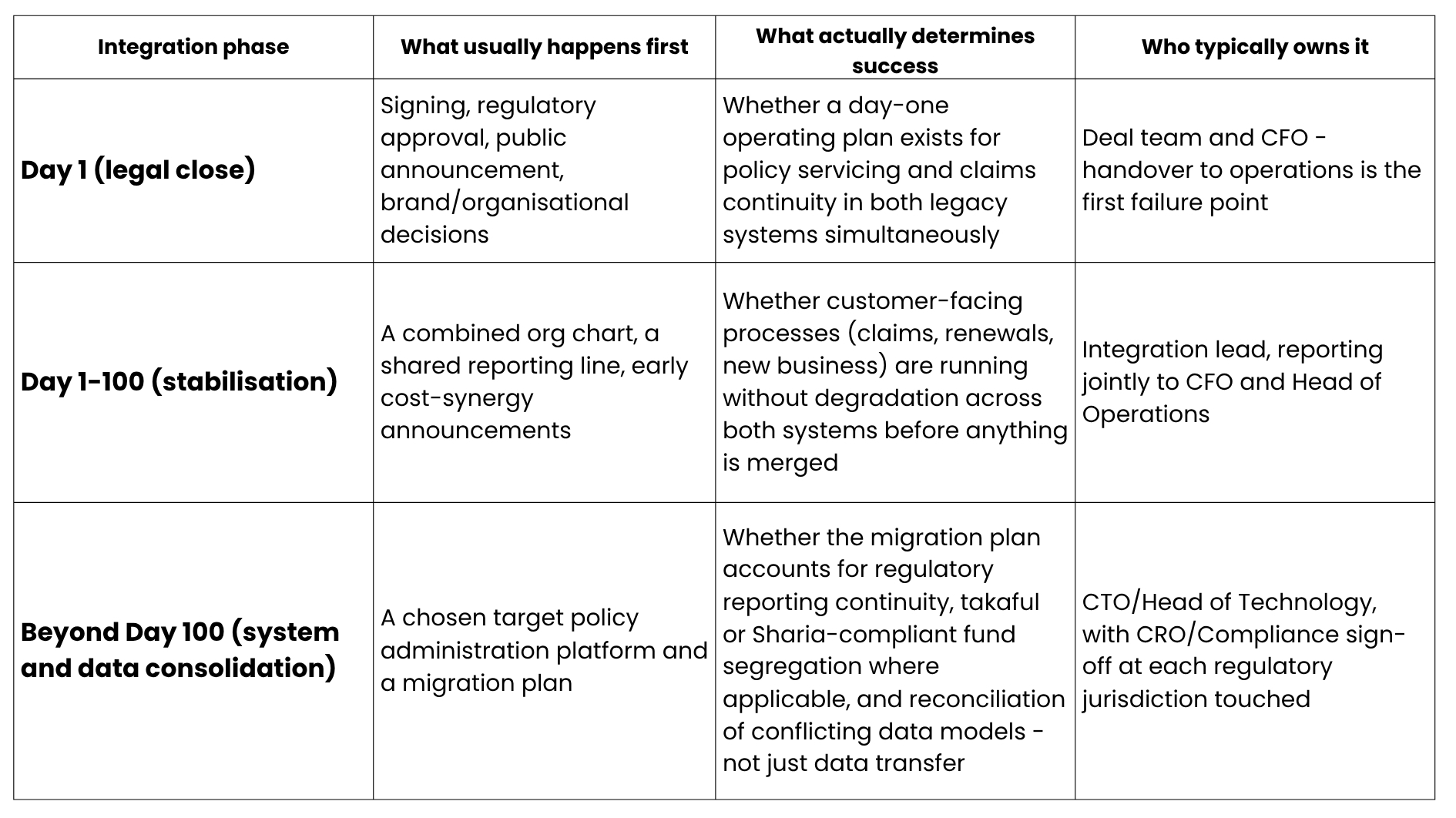
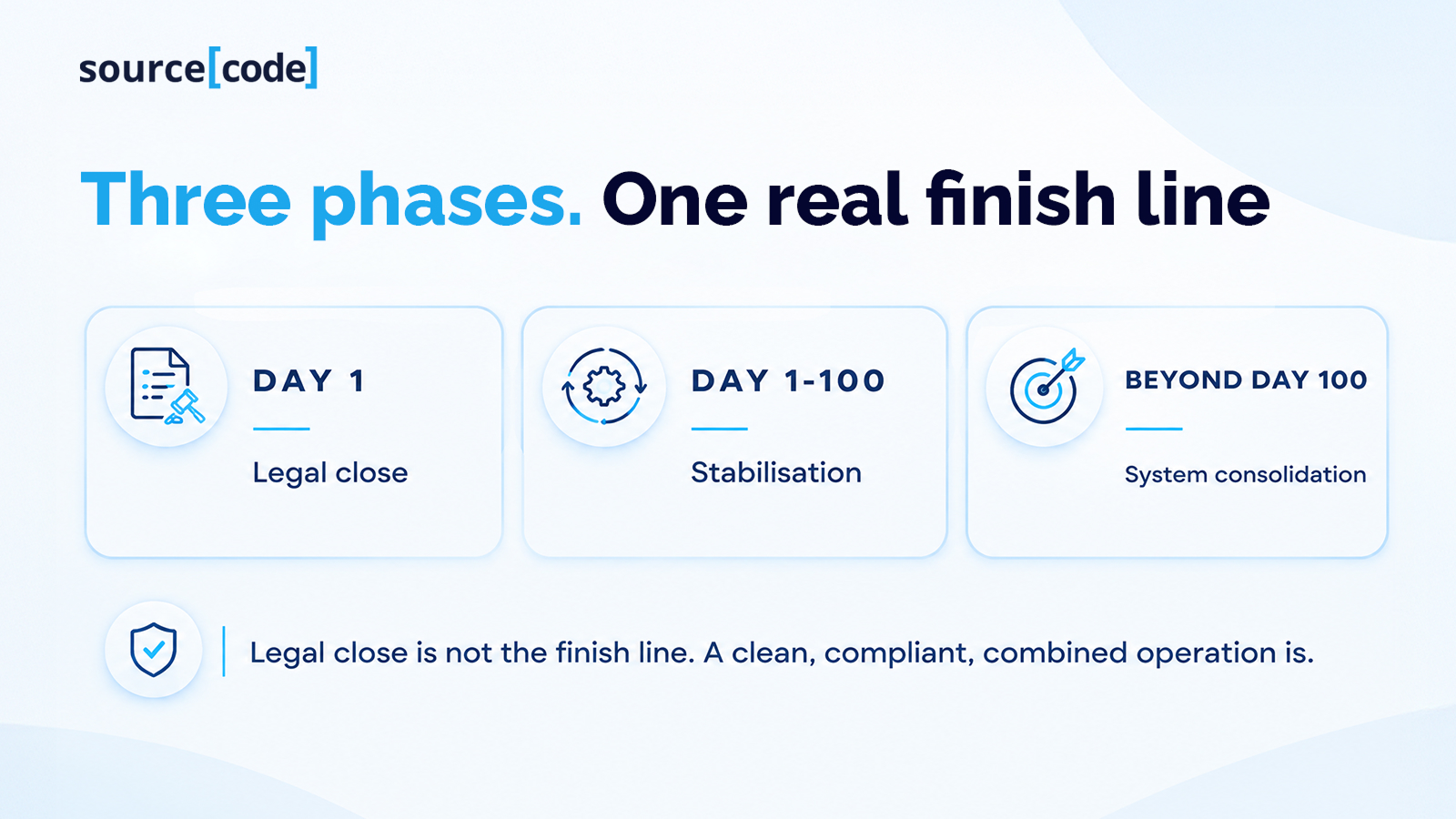
The research reviewed for this article is detailed on the decisions that precede Day 1 and almost silent on everything in the second and third rows. That silence is itself informative: it suggests the GCC market, having built real sophistication in deal sourcing and valuation, has not yet built an equivalent body of shared practice - or at least shared public disclosure - on integration execution.
What This Means by Role
For the CFO, the integration budget should be sized and governed separately from the deal budget, with its own named owner and timeline, rather than folded into "transaction costs" and assumed to resolve itself once the deal closes. The research gap documented above means a CFO cannot benchmark a Gulf integration programme's cost or duration against regional precedent - the data has not been published - which argues for a conservative internal estimate rather than anchoring to a number that does not exist.
For the Integration Lead - a role that, per the framework above, often does not formally exist until well after Day 1 - the priority is defining what "stabilised" means in writing before Day 1: which customer-facing processes must run without degradation, in which systems, for how long, before system consolidation work begins. Without that definition, stabilisation has no measurable end.
For the Head of Claims and Policy Operations, the two entities' claims and policy data rarely describe the same underlying facts the same way - product codes, claims statuses and renewal logic differ even within the same jurisdiction - and reconciling that has to happen before a combined reporting view is trustworthy, not as a side effect of the technical migration.
For the CRO or Head of Compliance, each GCC jurisdiction the combined entity operates in continues to require its own regulatory reporting throughout integration, and - where either entity has a takaful book - fund segregation and Sharia-compliance reporting have to be preserved through consolidation, not treated as a detail to resolve afterward.
For the CTO or Head of Technology, the choice of which legacy system becomes the target platform is a decision with multi-year consequences that deserves evaluation against the specific regulatory and product mix of both entities - not a default assumption that the acquirer's existing system is automatically the right one simply because it belonged to the larger party.
The sourceCode’s Perspective
We build and run engineering teams for insurers and fintechs across the region, including integration and system-migration work, so we have a direct commercial interest in Gulf insurers converting M&A activity into working, consolidated operations - which is also why we think the current research gap matters enough to name plainly rather than talk around.
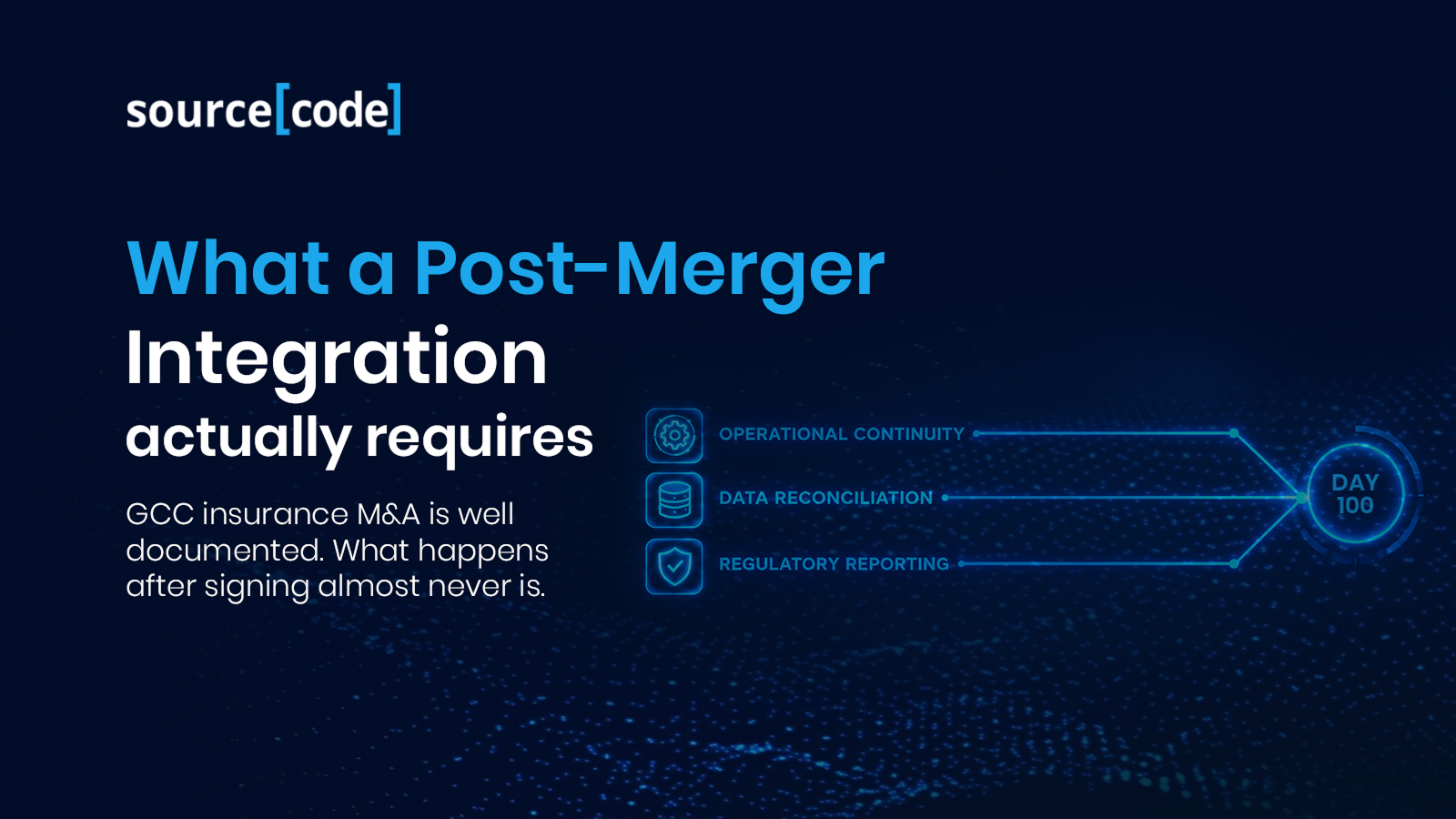
In our experience, the organisations that integrate well treat the three phases in the framework above as genuinely sequential and separately resourced, rather than compressing stabilisation and system consolidation into a single workstream under deal-closing time pressure. We call the discipline of keeping those phases visible and separately governed "the Integration Runway" - three lanes (operational continuity, data reconciliation, and regulatory reporting) that have to run in parallel from Day 1 and converge, deliberately, by a defined point in the programme, rather than being allowed to collide at whatever point the technical migration happens to land.
That framing is our own, built from delivery experience rather than drawn from the research reviewed above - the research does not offer a comparable framework, which is precisely the gap this article has described. Nothing here claims that any specific product or vendor closes this gap on its own; the discipline is organisational and sequencing-based before it is a technology choice.
Conclusion
GCC insurance consolidation is not a forecast - it is already happening, documented in deal counts, deal values and market growth projections from three independent, credible sources. What those same sources do not document is what determines whether any individual deal's strategic logic actually survives the eighteen months after signing: whether policy servicing continues without disruption, whether claims and customer data are reconciled rather than merely copied, and whether regulatory reporting holds across every jurisdiction the combined entity now touches. Global insurance M&A research is clear that disparate IT systems and data are a primary reason deals underperform their own business case. There is no basis for assuming the Gulf is immune to that pattern, and several reasons - overlapping deal timing, multi-jurisdiction regulatory obligations, and the takaful dimension specifically - to expect it to be harder here than the global average the Quantexa research describes.
The institutions treating integration as a governed, three-phase programme with its own budget and ownership - rather than an assumed consequence of a successfully signed deal - are the ones most likely to be the subject of next year's Alpen Capital or IMAP report as a consolidation success story, rather than a transaction whose value never fully materialised. The deal flow is visible to everyone watching this sector. The integration discipline, so far, is visible mainly to the institutions doing it well enough not to need to talk about it.
If your organisation has signed, or is evaluating, a Gulf insurance acquisition, the useful next step is not another valuation model. It is a short integration-readiness review across the three phases above: a written Day 1 operating plan for claims and policy servicing continuity, a defined stabilisation exit criterion, and an honest assessment of whether the target system-consolidation plan accounts for every regulatory jurisdiction and fund structure the combined entity will carry. We run this as a working session, not a sales call - the output is a sequenced integration plan scoped to what your specific deal actually requires.
>> Learn more about sourceCode
FAQ
How much GCC insurance M&A activity has there actually been recently? The GCC Insurance Industry Report (Alpen Capital-IMAP, May 2026) counts around eight completed transactions between 2024 and 2025, concentrated in 2025, including Solidarity Bahrain's USD 208.3 million acquisition of Bahrain National Insurance and MedGulf's USD 88.4 million acquisition of Buruj Cooperative Insurance. Moody's Ratings separately counted ten transactions completed or under way in the twelve months to December 2024, against a backdrop of roughly 190 insurers across the region.
Why is GCC insurance consolidating now? Multiple, independently corroborated pressures: smaller insurers face rising reinsurance costs, capital requirements and the expense of digital transformation; mandatory insurance expansion (UAE nationwide health cover from January 2025, Saudi visa-linked health insurance) is raising the compliance bar for staying independent; and GCC sovereign wealth funds are actively building insurance platforms through direct stakes and acquisitions.
What does the research say about post-merger integration in GCC insurance deals specifically? Very little. None of the three primary sources reviewed for this article - Alpen Capital's market report, IMAP's M&A analysis, or Moody's rating commentary - addresses integration timelines, system migration, or the operational mechanics of combining two insurers after signing. This is a genuine disclosure gap in the regional research, not an indication that integration challenges do not exist.
What typically causes insurance M&A to underperform its own business case? Global research (Quantexa, via FinTech Global) attributes a recurring share of underperformance specifically to disparate IT systems and data at the point of integration, and notes that conventional data migration and master data management approaches are not well suited to the volume and inconsistency of data M&A generates. There is no GCC-specific equivalent study, but no structural reason to expect the region to be exempt from this pattern.
What should a Gulf insurer's leadership team do differently when planning integration after an acquisition? Treat integration as a separately governed, three-phase programme - Day 1 operational continuity, a defined stabilisation period with explicit exit criteria, and system/data consolidation that accounts for every regulatory jurisdiction and any takaful fund-segregation requirements involved - rather than assuming it will resolve itself once the deal legally closes.
Reference List
Alpen Capital and IMAP (2026) GCC Insurance Industry 2026: Growth, Consolidation and the M&A Opportunity. Dubai: Alpen Capital-IMAP GCC. Available at: https://www.imap.com/en/insights/2026/GCC-Insurance-Industry-2026-Growth-Consolidation-and-the-M-and-A-Opportunity~cv (Accessed: 11 November 2026).
Aldah, H. (2026) 'UAE insurance market to grow to $25.1 billion by 2030 amid population growth', Khaleej Times, 20 May. Available at: https://www.khaleejtimes.com/uae-insurance-market-to-grow-to-251-billion-by-2030-amid-population-growth (Accessed: 11 November 2026).
Abbas, W. (2024) 'Insurers in UAE, Gulf region who fail to find buyers could be forced out of the market', Khaleej Times, 3 December. Available at: https://www.khaleejtimes.com/business/insurers-in-uae-gulf-region-who-fail-to-find-buyers-could-be-forced-out-of-the-market (Accessed: 11 November 2026).
FinTech Global (2022) 'Why insurers are failing to meet maximum value from mergers and acquisitions', FinTech Global, 14 January. Available at: https://fintech.global/2022/01/14/why-insurers-are-failing-to-meet-maximum-value-from-mergers-and-acquisitions/ (Accessed: 11 November 2026).
meinsurancereview.com (2024) 'UAE: Major insurer completes transfer of acquired life insurance portfolio', Middle East Insurance Review, 8 September. Available at: https://meinsurancereview.com/News/ViewNewsLetterArticle/id/89357/Type/MiddleEast/UAE-Major-insurer-completes-transfer-of-acquired-life-insurance-portfolio (Accessed: 11 November 2026).