Key Takeaways
- Four separate October 2026 developments this publication has analysed in detail - the UAE's consolidated licensing perimeter, Hong Kong's first regulator-observed sandbox results, a hardening pattern in US AI litigation, and a documented shift in CFO budget priorities - look unconnected by date and jurisdiction, but converge on the same set of Q1 2027 roadmap implications.
- Most technology roadmaps reviewed once a year will not reflect this convergence, because the developments feeding into it were tracked, if at all, by different functions on different timelines: legal watched the UAE law, the innovation team watched Hong Kong's sandbox, risk watched the US litigation, and finance watched its own budget cycle.
- The through-line across all four is provenance and evidence: who can demonstrate what a system did, under what authorisation, with what oversight - not whether the system is capable, which is no longer the live question in any of the four developments.
- A roadmap revisited quarterly against genuinely new regulatory and market developments outperforms one set annually and defended against facts that have since changed - not because quarterly review is inherently superior, but because 2026's pace of regulatory change has made an annual cycle structurally unable to keep up.
- This is a synthesis of developments this publication has already verified individually across four separate pieces this month; nothing here is new primary research, and the value is in the cross-functional connection rather than any single new fact.
Introduction
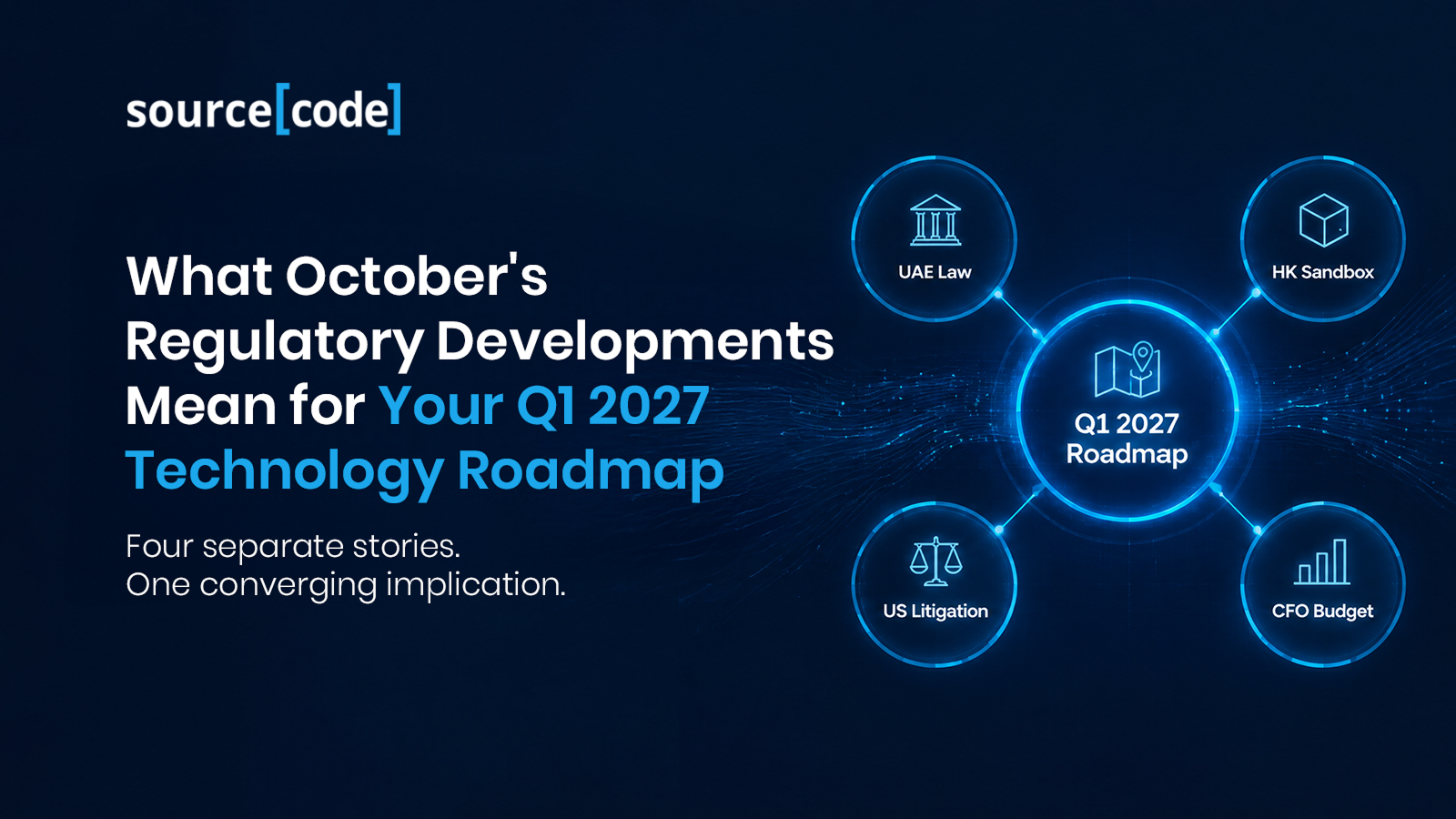
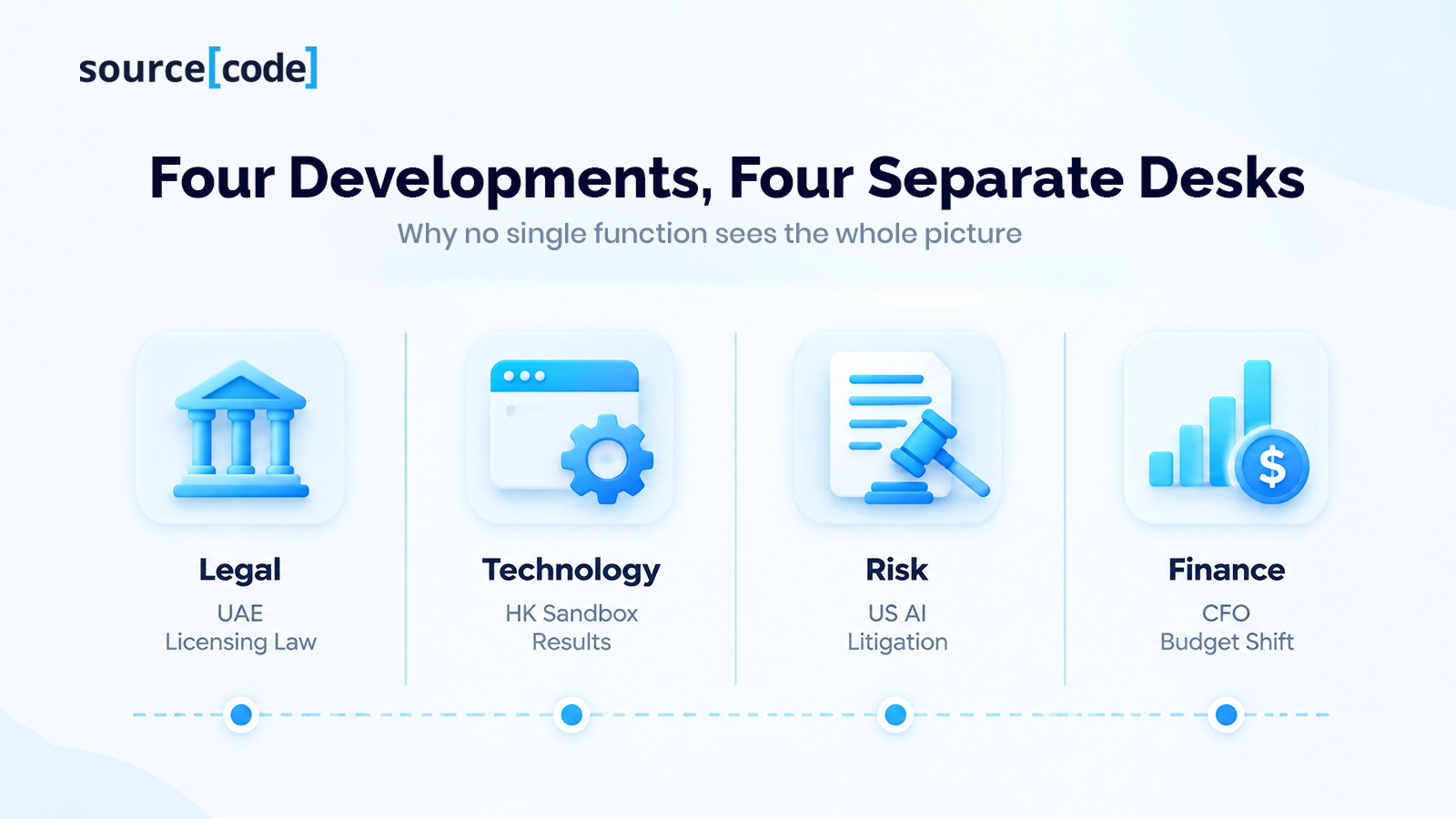
Four developments landed in October 2026 that, read individually, belong to four different desks inside a bank or insurer. The UAE's consolidated central bank law and its technology-licensing perimeter is a legal and compliance story. Hong Kong's banking AI sandbox results are an innovation and CTO story. A hardening pattern in US AI-related litigation is a risk and claims story. A documented shift in CFO budget priorities toward AI is, obviously, a finance story.
Read together, against the same quarter, they are one story: the evidence a BFSI institution can produce about how its AI systems actually behave in production - not what they are capable of in a demo - has become the single most consequential variable across licensing, litigation, vendor selection and budget approval simultaneously. A technology roadmap set at the start of 2026 and defended unchanged into 2027 will not reflect that convergence, because no single function inside most institutions was positioned to see all four developments land in the same month.
The four developments, restated briefly
The UAE's consolidated licensing perimeter. This publication's 1 October analysis found that Federal Decree-Law No. 6 of 2025's Article 62 extends CBUAE licensing to any technology provider facilitating a licensed financial activity, regardless of corporate form - and that most vendor-risk assessments test only whether a vendor's failure would hurt the institution operationally, not whether the vendor's own activity now falls inside a direct licensing perimeter. The 20 October follow-up found the same law names open finance specifically as a licensed activity, with insurers included among the entities "deemed licensed" but still required to notify and seek approval before going live.
Hong Kong's sandbox results. The HKMA's GenA.I. Sandbox++ cohort produced the industry's first substantial body of regulator-observed evidence about which generative and agentic AI use cases actually clear a production bar in a supervised banking environment - distinct from the vendor-listicle content dominating most banking AI discussion, because it reflects what a regulator watched succeed or stall, not what a vendor demonstrated.
US AI litigation as a leading indicator. This publication's 8 October analysis found litigation against algorithmic claims denial has produced court orders compelling AI-development-document disclosure and driven state-level requirements for licensed-physician sign-off and NAIC Model Bulletin adoption across 23 states and DC - defining audit-trail and human-override standards in courtrooms faster than APAC and Gulf regulators have defined them in text.
The CFO budget shift. Gartner's 2026 CFO research, cited in this publication's 6 October analysis, found technology and AI have overtaken headcount as CFOs' top budget-growth priority for 2026 - but that authority is increasingly ring-fenced against a narrow set of provable-return categories, changing what a vendor or internal proposal has to demonstrate to actually clear sign-off.
The through-line: evidence, not capability
None of these four developments is, at its core, a dispute about whether AI systems in BFSI are capable enough. The UAE's licensing perimeter doesn't ask whether a vendor's technology works; it asks whether the vendor can demonstrate it operates within an authorised, accountable structure. Hong Kong's sandbox findings matter precisely because they show which use cases survive regulator observation under real operating conditions, not which demo looked most impressive. The US litigation record centres on whether an institution can produce the documentation - development records, override logs, human-review evidence - a court or regulator demands after the fact. And the CFO budget data shows that even with technology and AI now the top budget priority, the money is increasingly reserved for initiatives that can prove a specific, demonstrable return rather than argue a plausible one.
Every one of the four developments, in other words, is a variant of the same underlying question this publication has returned to repeatedly this year: can the institution demonstrate what its system did, under what authorisation, with what oversight, after the fact - not merely assert that the system is good. A roadmap set against 2025's priorities, when "can we deploy this" was still the dominant question for most institutions, will not have been built to answer a 2027 environment where "can we prove what it did" is the operative one across licensing, litigation, sandbox evaluation and budget approval alike.
What most roadmaps currently get wrong
The practical failure mode is not that institutions are unaware of any single one of these four developments. It is that the developments are tracked by different functions on different cadences, and a roadmap review built around an annual planning cycle rarely has a mechanism for connecting them into a single picture before the next planning cycle begins. Legal counsel reviewing the UAE law's licensing implications is not usually in the same room as the innovation lead evaluating Hong Kong's sandbox findings for the institution's own AI use-case sequencing, who is in turn not usually coordinating with the risk team tracking US litigation patterns for claims-AI implications, who is not usually the one presenting the AI budget case to the CFO. Each function is doing its job correctly. The institution still ends up with a roadmap that reflects, at best, a partial view of what a single quarter actually demonstrated.
>> Read more: How CFOs Are Actually Allocating the 2026 AI Budget
A decision framework for the Q1 2027 review
Rather than treating each development as a separate line item for a separate function to manage, a Q1 2027 roadmap review should ask four cross-functional questions, each mapped to one of October's developments but answered jointly by the functions that own the relevant evidence:
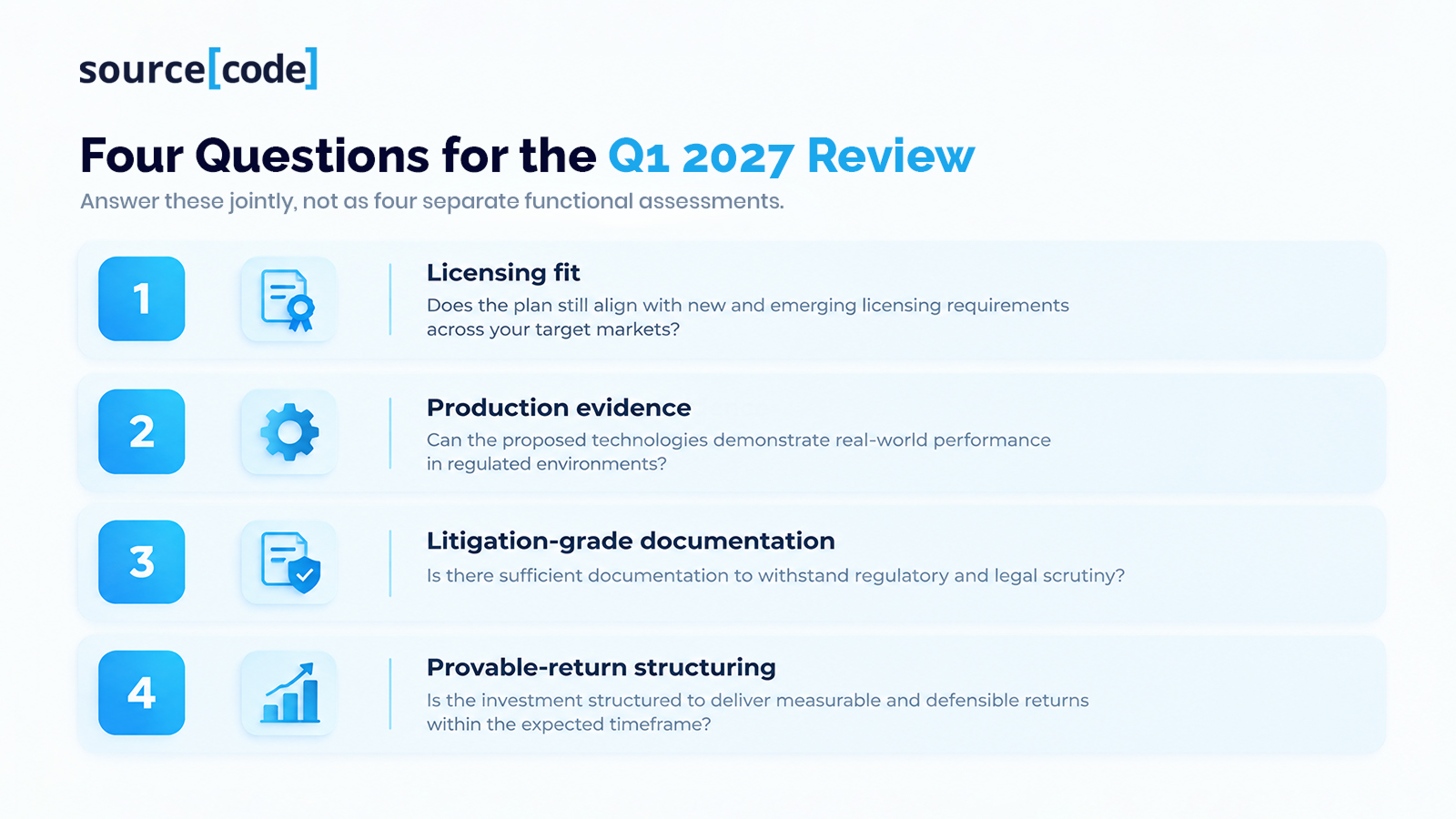
Licensing fit. For every vendor and every internal AI initiative touching a licensed financial activity, can the institution produce the classification analysis - not just the contract - showing whether that relationship falls inside an expanded regulatory perimeter, in every jurisdiction it operates in, not only the UAE?
Production evidence. For every AI use case in the pipeline, does the institution have, or have a credible path to, the kind of regulator-observable evidence Hong Kong's sandbox produced - a documented account of how the system actually performed under supervised real conditions, not only pilot metrics?
Litigation-grade documentation. For every customer-facing automated decision, particularly in claims and underwriting, can the institution produce the audit trail, override log and development-history documentation a court or regulator would plausibly demand, calibrated to the standard the US litigation record is currently setting?
Provable-return structuring. For every initiative seeking budget in the next cycle, is the business case built around a specific, demonstrable return category a CFO operating under 2026's tighter scrutiny can actually approve, rather than a general efficiency or innovation narrative?
An initiative that can answer all four questions with evidence, not assertion, is in a materially stronger position heading into 2027 than one that can only assert capability. An institution that cannot organise a single review to ask all four questions together, because the relevant evidence sits in four different functions, has identified its own Q1 2027 priority before reading any further analysis.
>> Read more: What the First Results From Hong Kong's Bank AI Sandbox Actually Show
A fair counterargument
It would overstate the case to claim every BFSI institution needs to overhaul its roadmap process in response to four developments landing in a single month. Institutions with mature, already-integrated risk, legal, technology and finance governance may already be asking versions of these four questions as a matter of course, and for them this synthesis is confirmation rather than news. The argument here is narrower, and aimed at the more common pattern: institutions where these four functions genuinely do operate on separate tracks, for reasons that made sense when AI capability itself was still the central question. As that question shifts to evidence and provenance, the cost of those separate tracks rises, because the evidence a regulator, a court or a CFO now asks for increasingly spans all four functions' areas of ownership simultaneously.
What leaders should do next
Convene a single Q1 2027 roadmap review that brings legal, risk, technology and finance stakeholders into the same room to answer the four questions above jointly, rather than compiling four separate functional assessments after the fact. Prioritise the initiatives that can answer all four with evidence already in hand, and treat any initiative that cannot as carrying a documented, not merely assumed, gap heading into next year.
And build the review itself as a recurring quarterly discipline rather than a once-a-year exercise, on the basis that 2026's pace of regulatory and market development - four independently significant developments in a single month, on this publication's own count - has made an annual cycle a structurally inadequate instrument for keeping a roadmap current.
The sourceCode’s perspective
Across our delivery work with banks, insurers and insurtechs in Australia, Southeast Asia and the Gulf this year, the institutions furthest ahead heading into 2027 are not the ones with the most ambitious AI roadmaps on paper. They are the ones whose legal, risk, technology and finance functions can sit in the same room and jointly answer the four questions this piece sets out, because they have already built the habit of treating evidence and provenance as a shared, cross-functional deliverable rather than four separate departmental concerns.
That habit is not expensive to build, and it is considerably cheaper to build proactively in a Q1 planning cycle than to assemble under pressure after a regulator, a plaintiff's lawyer, or a board risk committee asks the question first. Talk to us here!
Conclusion
October 2026 produced four developments that, read in isolation, belong to four different inboxes. Read together, they describe a single shift this publication has tracked all year reaching a new level of concreteness: the institutions that will clear licensing review, survive sandbox-style scrutiny, withstand litigation-grade document requests and win CFO budget approval through 2027 are the ones that can demonstrate what their systems did, not merely assert what they can do.
A Q1 2027 roadmap built around that evidence standard, reviewed jointly across legal, risk, technology and finance, is a fundamentally different and more durable instrument than four separate functional roadmaps defended on their own timelines.
Frequently Asked Questions
What four October 2026 developments does this roadmap synthesis draw on? The UAE's consolidated Central Bank law and its technology-licensing perimeter (1 and 20 October), Hong Kong's HKMA GenA.I. Sandbox++ results, the pattern in US AI-related litigation around claims-denial audit trails (8 October), and Gartner's 2026 CFO research on AI budget prioritisation (referenced 6 October) - all previously analysed individually on this publication.
What is the common theme connecting these otherwise unrelated developments? Each turns on whether an institution can demonstrate evidence of how its AI systems actually behaved - under what authorisation, with what oversight, producing what documented outcome - rather than on whether the underlying AI capability is sufficient. That evidence-and-provenance standard is becoming the deciding factor across licensing, sandbox evaluation, litigation exposure and budget approval simultaneously.
Why should a technology roadmap be reviewed quarterly rather than annually? Because 2026's pace of regulatory and market development, illustrated by four independently significant developments landing in a single month, has made an annual review cycle structurally unable to keep a roadmap current against genuinely new facts, not because quarterly review is inherently superior in principle.
Which functions need to be involved in a Q1 2027 roadmap review built around this framework? Legal and compliance (licensing fit), technology and innovation (production evidence), risk and claims (litigation-grade documentation), and finance (provable-return structuring) - answering the four questions jointly rather than compiling separate functional assessments.
Does every institution need to overhaul its roadmap process because of this? No. Institutions with already-integrated risk, legal, technology and finance governance may already be asking versions of these questions. The synthesis is aimed at the more common pattern where these functions operate on separate tracks that made sense when AI capability, rather than evidence of its behaviour, was still the central question.
Reference List
sourceCode (2026) Why the UAE's New Central Bank Law Also Regulates Your Technology Partner. 1 October. https://www.sourcecode.com.au/blog/uae-central-bank-law-technology-provider-licensing (Accessed on 30 Oct, 2026).
sourceCode (2026) Open Finance Is Becoming a Licensing Category, Not Just a Buzzword. 20 October. https://sourcecode.com.au/blog-open-finance-is-becoming-a-licensing-category-not-just-a-buzzword (Accessed on 30 Oct, 2026).
sourceCode (2026) What the First Results From Hong Kong's Bank AI Sandbox Actually Show. 2 October. https://sourcecode.com.au/blog/hkma-genai-sandbox-results-banking (Accessed on 30 Oct, 2026).
sourceCode (2026) What US AI Claims-Denial Litigation Is Previewing for APAC and Gulf Insurers. 8 October. https://www.sourcecode.com.au/blog/us-ai-claims-denial-litigation-apac-gulf-insurers (Accessed on 30 Oct, 2026).
sourceCode (2026) How CFOs Are Actually Allocating the 2026 AI Budget (And What It Means for Vendor Selection). 6 October. https://www.sourcecode.com.au/blog/cfo-ai-budget-allocation-2026-financial-services (Accessed on 30 Oct, 2026).