What Changes in Claims When the Adjuster Becomes a Reviewer, Not a Decision-Maker
Key Takeaways
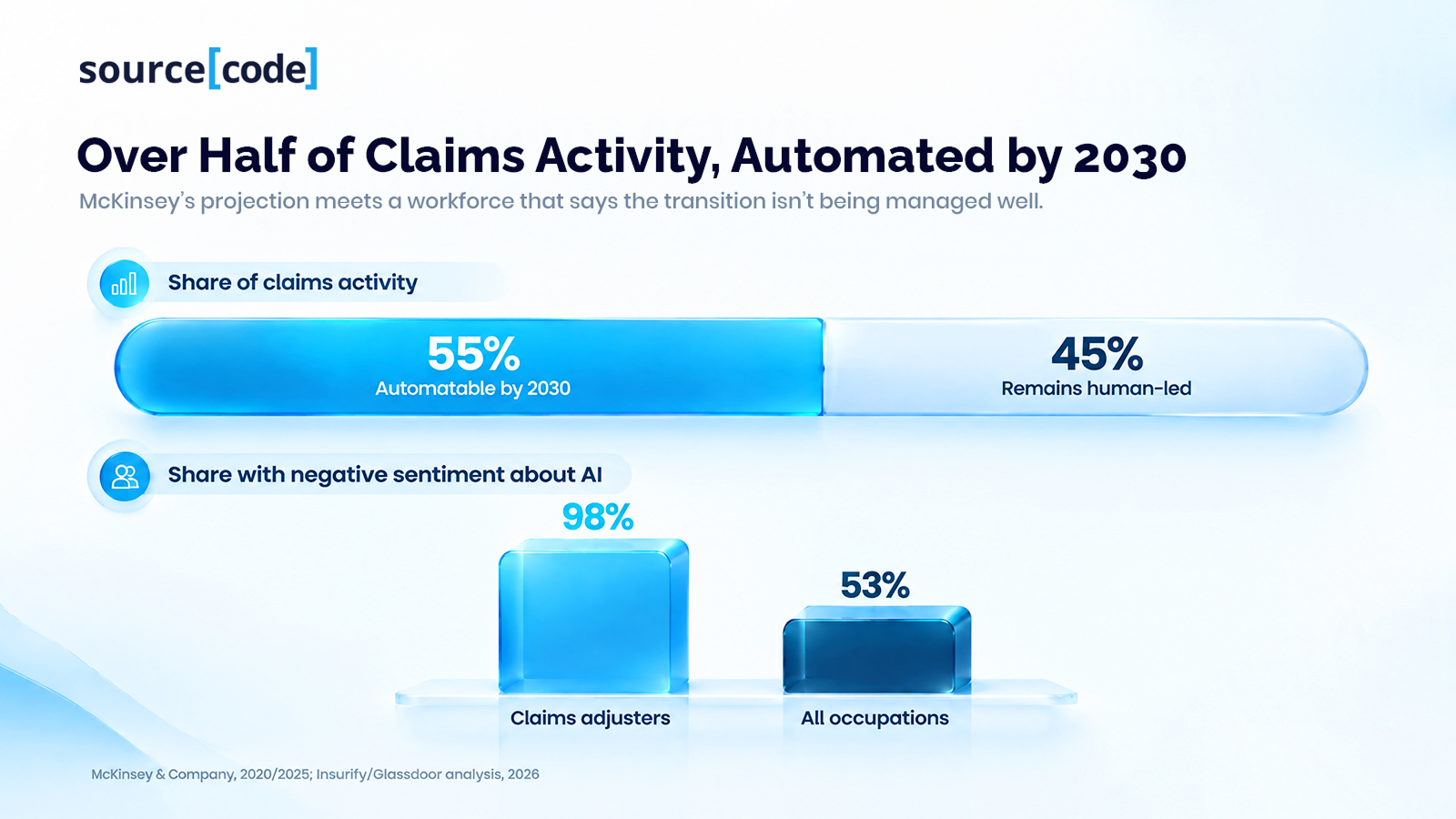
- McKinsey estimates more than half of today's claims activity could be automated by 2030, but the function that actually determines whether this works is the adjuster's redesigned role - not the model.
- Claims handlers overwhelmingly dislike the way AI has been introduced into their jobs: 98% of claims adjusters' AI-related Glassdoor comments were negative, against 53% across all occupations (Insurify/Glassdoor analysis, October 2026).
- A reviewer who checks AI-made first-pass decisions faces a well-documented risk - automation bias and complacency - that is not fixed by training alone (Parasuraman and Manzey, 2010).
- Regulators are starting to make "a human must review the AI's decision" a legal requirement, not an operational nice-to-have, in both P&C and health claims.
- A claims automation rollout plan needs an explicit role-redesign and incentive workstream - decision rights, escalation triggers, and performance metrics - run alongside the system-capability workstream, not after it.
Introduction
Most claims automation business cases are written as technology narratives: straight-through processing rates, cycle-time reduction, loss-adjustment-expense savings. The underlying assumption is that once the system can make a reliable first-pass decision, the adjuster's job simply gets easier - fewer files, less typing, more time for "complex" cases.
That assumption is where most rollout plans go quiet. Making a first-pass decision and reviewing someone else's (or something else's) first-pass decision are different jobs, with different skills, different failure modes, and different ways of being measured. An organisation that automates the decision but leaves the adjuster's KPIs, training, and escalation rules unchanged has not redesigned a role - it has relabelled one and hoped the person adjusts on their own.
This matters for Heads of Claims and Risk/Compliance leaders for a specific reason: the evidence on human oversight of automated systems says the "reviewer" role is harder to do well than the "decision-maker" role it replaces, not easier. Below, we work through what the research actually says about this transition, where sourceCode agrees and disagrees with the common framing, and what a credible rollout plan needs to include.
The Shift Is Already Underway - and the Workforce Is Not Being Told How It Changes
McKinsey's long-running claims research puts a number on the scale of change: more than half of today's claims activities could be automated by 2030, with some roles eliminated, new digital roles created, and the remaining roles given materially different responsibilities (Fong et al., 2020, updated 2025). The firm's framing is explicit that this is a role-design exercise - mapping which activities move, from physical investigation to virtual, for example - not just a capability rollout.
Deloitte's most recent survey of chief claims officers reinforces the direction of travel but adds a workforce stress signal most technology plans don't account for. Interviewing 17 US P&C chief claims officers, Deloitte found average adjuster attrition running around 20%, with each departure taking with it nearly six years of institutional experience (Kamalapurkar, Sharma and Satapathy, 2025). The same report frames the intended shift as moving adjusters "from task executors to strategic decision-makers and empathetic points of contact" on the claims that remain genuinely complex - while AI absorbs high-volume, lower-complexity assessment work.
The problem is what's happening in the labour market while that intended shift is supposed to be occurring. An October 2026 analysis of Glassdoor reviews and Indeed postings found that 98% of claims adjusters' AI-related comments were negative, compared with 53% across all occupations - the highest negativity rate of any profession measured (Insurify, 2026). The same analysis found entry-level adjuster job postings down nearly 50% since early 2024, against a 15% decline across the broader labour market, with researchers linking the drop to experienced adjusters using AI to absorb work that used to be a training ground for juniors. One reviewer cited in the piece described spending "15-20 minutes per claim correcting AI-generated mistakes" - the opposite of the capacity relief the business case promised.
Read together, these sources describe an industry that has correctly diagnosed where claims work is heading, but has largely left the adjuster workforce to experience the transition as something being done to them rather than with them.
Why This Is a Role-Design Problem, Not Only a Capability Problem
Deloitte's 2021 claims transformation research is useful here because it predates the current generation of AI tools and still reaches the same structural conclusion: technology is meant to supplement professionals by removing low-value work, and the resulting role - the "exponential claims professional" - needs four skill sets (technology, data analytics, business acumen, customer management), not one (Kamalapurkar and Cline, 2021). Crucially, that paper's analysis of more than 100,000 insurer job postings found emerging-technology skills such as AI and RPA appearing in only around 5% of postings by 2021 - down by half since 2016. Hiring and training had not caught up with the stated strategy even before generative AI entered claims workflows.
Four years later, Deloitte's 2025 soft-skills research shows the same gap persisting in a different shape: critical thinking, negotiation, and customer centricity are rising in demand, but onboarding still costs US8,000-10,000 per adjuster and is spent mostly on core technical content rather than the judgment and oversight skills the new role actually needs. Where experienced adjusters turn over frequently, the same research links underprepared staff to roughly 15% lower new-hire productivity and up to 20% higher indemnity payouts.
>> For readers who want the systems-and-goverance maturity framework that sits alongside this role-redesign argument: read more about the claims-AI maturity from pilot to production here!
The pattern across all four sources is consistent: every one of them treats the adjuster's changed day-to-day role as the central design question, and every one of them finds the organisation's actual hiring, training, and skills investment lagging the stated strategy. That lag is the gap a rollout plan needs to close - and it is an organisational design problem before it is a change-management communication problem.
The Reviewer Problem Nobody Budgets For: Automation Bias
Here is the part of the brief's thesis that benefits most from independent verification, because it is easy to assume reviewing is simply a lighter version of deciding. The human-factors research says otherwise.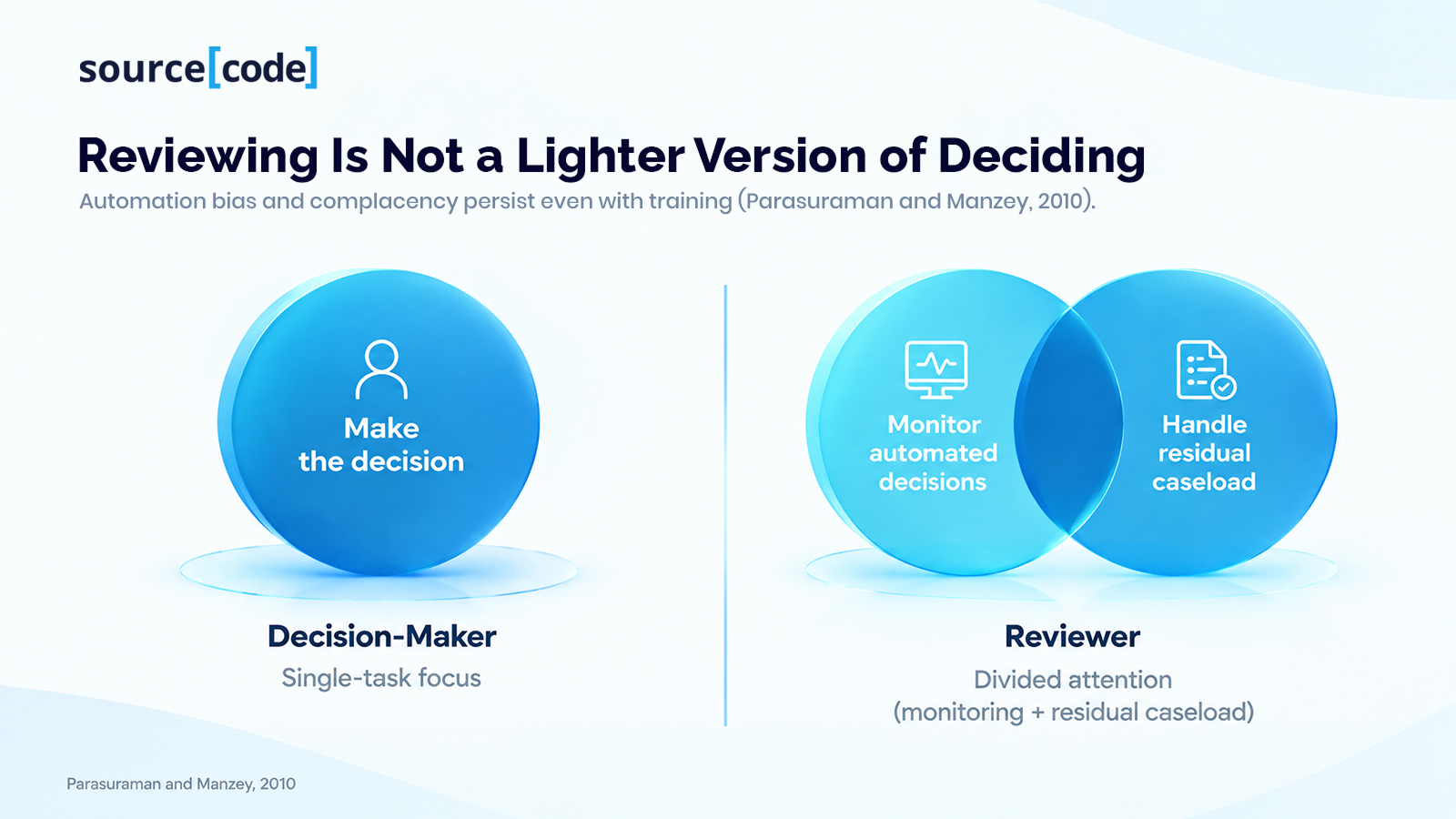
Parasuraman and Manzey's widely cited review of automation complacency and automation bias found that both effects persist even with practice and are not eliminated by training or instructions alone (Parasuraman and Manzey, 2010). Complacency tends to emerge when a person's manual duties compete with monitoring duties for attention - exactly the position a claims reviewer is in when they are also handling their own residual caseload. Automation bias produces both omission errors (failing to notice the system got it wrong) and commission errors (following an incorrect automated recommendation) and the effect does not go away simply because the operator has been warned the system is imperfect.
Applied to claims, this is a specific and uncomfortable finding: an adjuster who is told to "review the AI's recommendation" is being asked to perform a cognitively different and, in several well-documented ways, harder task than making the original call themselves - not a lighter one. A rollout plan that treats the reviewer role as requiring less skill, less time, or less seniority than the decision-maker role it replaces is designing against the evidence, not with it.
Separately, there is a trust-calibration problem in the other direction. Crawford & Company's 2026 claims trends analysis, reported by Carrier Management, notes that while AI is speeding up simpler-claims processing at some carriers, "few carriers use AI beyond a small scale, and most adjusters say AI needs human oversight" (Jergler, 2026, reporting on Crawford & Company). Adjuster skepticism toward the tools is, in that sense, a rational response to tools that are not yet reliable enough to warrant the trust the automation roadmap assumes - which makes the reviewer's judgment about when to override as important a design element as the system's accuracy itself.
Regulation Is Turning "Human Review" Into a Compliance Requirement, Not a Design Choice
Rollout plans that treat the reviewer role as optional or informal are increasingly running ahead of the law. In the United States, New Jersey Assembly Bill 5494 (introduced September 2026) would bar insurers from letting AI make the final denial decision on covered homeowner, auto, and flood claims, with penalties of up to US$5,000 per violation; automated tools would remain permitted for triage, assessment, fraud scoring, and approvals (Insurance Business Magazine, 2026). It sits alongside a broader 2026 wave of state legislation on AI-driven coverage decisions in health insurance - seven states, including Washington, Colorado, and Georgia, passed laws in 2026 requiring that a qualified human reviewer, not AI output alone, be the basis for an adverse determination (Becker's Payer Issues, 2026).
These are health- and property/casualty-specific statutes, and they do not yet form a uniform APAC or Gulf regulatory standard. But the direction is unmistakable, and it is consistent with how prudential and conduct regulators across Australia, Singapore, and the UAE have approached AI governance more broadly: the expectation that a named, accountable human stands behind an automated decision is becoming a compliance baseline, not a differentiator. A claims automation plan that has not defined what its reviewers are legally and contractually accountable for is building against a regulatory direction that is already visible.
The Reviewer Transition Map
Bringing the research together, sourceCode uses a simple five-dimension framework - the Reviewer Transition Map - to pressure-test whether a claims automation rollout plan has actually redesigned the adjuster's role, or has only redesigned the system around it.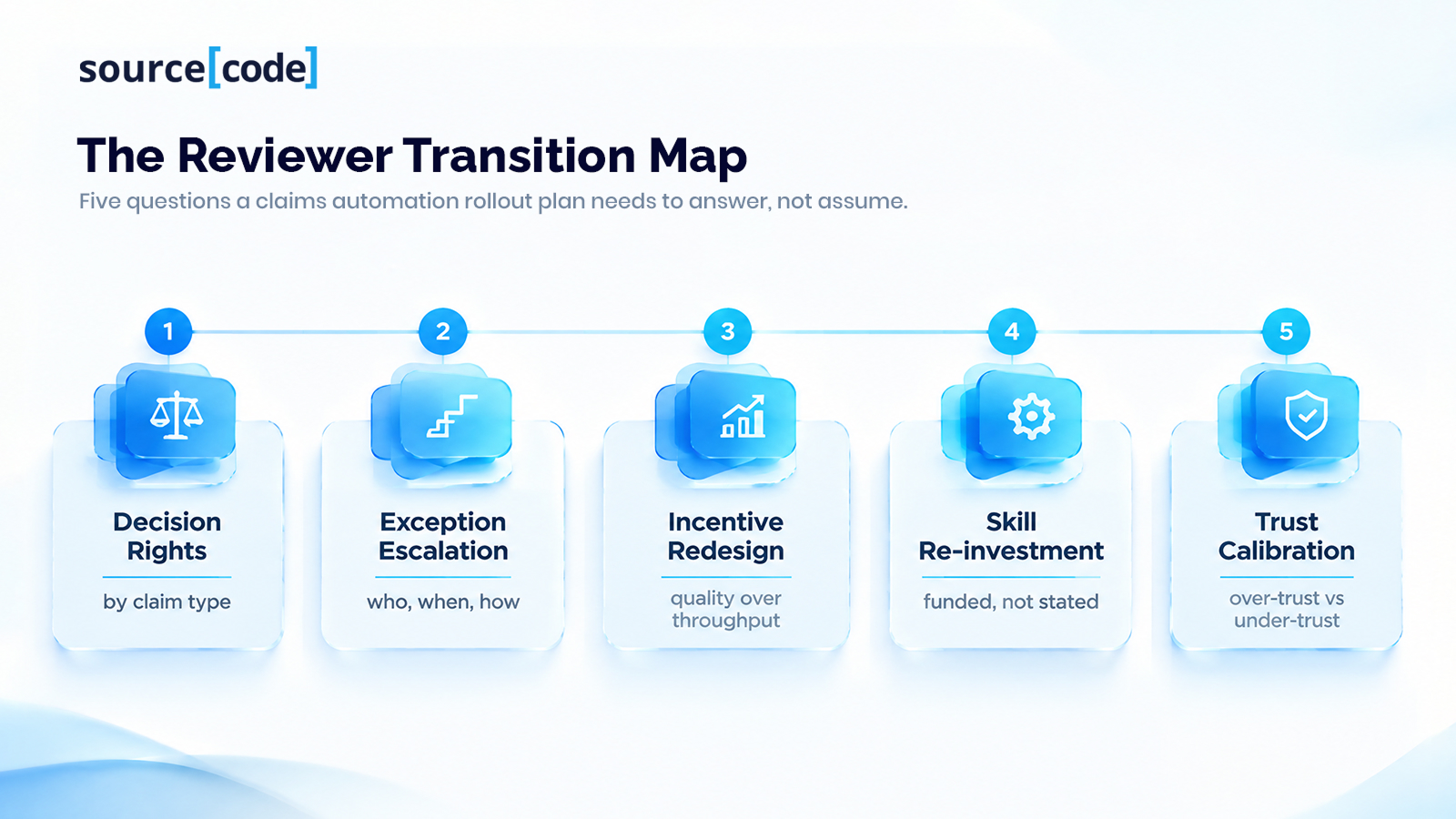
- Decision Rights - On which claim types does the adjuster retain final authority, on which do they retain override authority only, and on which has the organisation accepted full automated adjudication? This needs to be documented claim-type by claim-type, not asserted as a blanket "human-in-the-loop" policy.
- Exception Escalation - What specifically triggers a case leaving the automated path for human attention, and does the reviewer have the time, seniority, and information access to do that review properly, given the Parasuraman and Manzey findings on competing attentional demands?
- Incentive Redesign - Are adjusters still measured on throughput metrics designed for a decision-maker role (files closed per day), or have metrics been rebuilt around review quality, override accuracy, and catch rate on genuine exceptions?
- Skill Re-Investment - Has training spend moved from the technical-content-heavy onboarding Deloitte describes toward critical thinking, override judgment, and AI-literacy skills - and is that shift funded, not just stated?
- Trust Calibration - Does the organisation track whether adjusters are over-trusting the system (rising omission errors) or under-trusting it (overriding correct recommendations, eroding the efficiency case), and does it act on that signal?
A rollout plan that cannot answer all five with a specific, documented position has a system-capability workstream and no adjuster-role workstream - which, per the evidence above, is the half of the transformation most likely to determine whether the automation actually pays off.
Counterargument: Is This Overstating the Difficulty?
A fair challenge: many claims organisations would argue that "reviewer" roles already exist today as quality assurance and audit functions, and that extending this to AI-made first-pass decisions is incremental, not a new discipline requiring its own workstream. There is something to this - QA already samples completed files, escalates error patterns, and operates under documented authority limits, so much of the needed infrastructure is not being built from nothing.
The counter to the counter is a matter of scale and stakes, not kind. Traditional QA samples completed decisions after the fact, with no obligation to catch every error before it reaches a policyholder. A claims reviewer sitting between an AI-made first-pass decision and the customer is being asked to do real-time, on-every-file oversight at production volume - the exact combination of conditions (competing attentional demands, imperfect automation, no relief from time pressure) that the automation-bias literature identifies as hardest for human monitors. "Sample 2% of files after close" and "catch the exceptions in 100% of files before they go out" are not the same job at a different scale; they are different jobs. Organisations that assume the former infrastructure transfers cleanly to the latter are most likely to discover the gap in a regulatory review or a bad-faith claim, not in a pilot metric.
What This Means for the Buying Committee
For the Head of Claims, the practical test is whether the automation business case includes a costed, resourced workstream for role redesign with the same rigour as the systems-integration workstream - new role profiles, new KPIs, new training spend, and a defined escalation and override protocol - rather than a single slide on "change management."
For Risk and Compliance, the test is whether decision rights and reviewer accountability are documented at the claim-type level, in a form that would satisfy a regulator asking who was accountable for a specific denial, given the direction state legislation is already moving in the US and the broader global trend toward named human accountability for automated decisions.
For the CFO and the board, the test is whether the automation ROI case has priced in the Deloitte-documented costs of getting the workforce transition wrong - elevated onboarding spend, productivity loss during the transition, and the indemnity-payout risk of under-prepared reviewers - against the efficiency gains, rather than treating those as a rounding error against the headline cost-to-serve reduction.
The sourceCode’s Perspective
Having delivered insourced and ODC-model claims operations teams across Australia, Malaysia, and Vietnam for two decades, the pattern we see most often is not that carriers under-invest in claims AI capability - most organisations we work with are reasonably disciplined about model validation, bias testing, and system governance by the time a claims tool reaches production.
The gap is almost always on the human side of the handover: go-live is treated as the finish line for the technology workstream and the start of an unplanned, informal adjustment period for the people whose job just changed underneath them.
We have not seen, and will not claim, a single client case study proving the Reviewer Transition Map's five dimensions predict rollout success - that would require a controlled before-and-after study no carrier we know of has published, and we won't manufacture one to make this argument look more settled than it is. What we can say with confidence, from sitting inside delivery teams through multiple claims-automation go-lives, is narrower: organisations that treat the adjuster's new decision rights, escalation triggers, and incentive structure as a named workstream with its own budget and owner - reviewed at the same cadence as the model's accuracy metrics - are the ones where the reviewer role gets performed as designed, rather than as whatever each adjuster individually decides it means.
Where we'd push back on the brief as written: calling this an "HR afterthought" understates it. It is better understood as a second accountability system that Risk and Compliance need to co-own with Claims from day one, because - per the regulatory trend above - it is increasingly where accountability for an AI-assisted decision will actually be tested.
Conclusion
The research is consistent across McKinsey, Deloitte, workforce-sentiment data, and the human-factors literature: moving an adjuster from decision-maker to reviewer is a substantive role change with its own skill requirements, its own failure modes, and - increasingly - its own regulatory exposure. It is not a lighter version of the old job, and a rollout plan that doesn't treat it as a distinct workstream is building on an assumption the evidence does not support.
If your claims automation roadmap currently has a detailed systems and data workstream and a single slide on "adjuster change management," that asymmetry is worth examining before the next phase of rollout, not after the first bad-faith complaint or regulatory inquiry surfaces it.
Where does your claims automation rollout plan currently stand on adjuster role redesign and incentive design - as a resourced workstream, or as an assumption? We'd welcome a conversation about how that question is being answered inside your organisation. Contact us here for further discussion!
FAQ
Does AI replace claims adjusters? The evidence reviewed here does not support a wholesale replacement thesis. McKinsey's research frames the change as task reallocation - automating routine assessment while directing adjusters toward complex, judgment-heavy, and customer-sensitive work - alongside genuine headcount reduction in some entry-level categories, which Insurify's 2026 analysis of job postings documents directly.
What is automation bias, and why does it matter for claims reviewers? Automation bias is the tendency to over-rely on automated recommendations, producing errors of omission (missing a system's mistake) or commission (following an incorrect recommendation). Parasuraman and Manzey (2010) found it persists despite training, which means a claims reviewer role needs structural safeguards - workload limits, defined override triggers, monitored catch rates - rather than relying on adjuster diligence alone.
Should claims adjuster KPIs change when AI handles first-pass decisions? The research suggests yes. Metrics built for a decision-maker role (files closed per day) do not measure what a reviewer role needs to do well (catching genuine exceptions, calibrating trust in the system, exercising override judgment). Carrying old throughput metrics into a reviewer role risks measuring the wrong thing.
Is there a legal requirement for human review of AI claims decisions? A growing but uneven one. In the US, New Jersey's 2026 Assembly Bill 5494 would prohibit AI from making the final denial decision on certain P&C claims, and seven states passed laws in 2026 requiring human review of AI-driven health coverage denials. No equivalent uniform standard yet exists across APAC or the Gulf, but the regulatory direction is consistent with broader global AI-governance expectations around named human accountability.
What should a Head of Claims ask for in an automation business case? A costed, resourced role-redesign workstream - covering decision rights by claim type, escalation triggers, revised KPIs, and training investment - presented with the same rigour as the systems-integration and model-governance workstreams, not as a single change-management slide.
Reference List
Becker's Payer Issues (2026) 7 AI health insurance state laws passed in 2026. 28 July. Available at: https://www.beckerspayer.com/policy-updates/7-ai-health-insurance-state-laws-passed-in-2026/
Fong, A., Ganjani, K., Larrea, E. and Novo Sánchez, J.M. (2020, updated 2025) Claims 2030: A talent strategy for the future of insurance claims. McKinsey & Company, 10 December. Available at: https://www.mckinsey.com/industries/financial-services/our-insights/claims-2030-a-talent-strategy-for-the-future-of-insurance-claims
Insurance Business Magazine (2026) New Jersey bill targets AI-powered insurance claim denials. Available at: https://www.insurancebusinessmag.com/us/news/risk-compliance-legal/new-jersey-bill-targets-aipowered-insurance-claim-denials-590341.aspx
Insurify (2026) Claims Adjusters Really Dislike AI. Here's Why That Matters to You. 8 October. Available at: https://insurify.com/homeowners-insurance/news/ai-vs-insurance-claims-adjusters
Jergler, D. (2026) Nine Claims Trends to Watch Through the Rest of 2026. Carrier Management, 13 March (reporting on Crawford & Company research). Available at: https://www.carriermanagement.com/nine-claims-trends-to-watch-through-the-rest-of-2026/
Kamalapurkar, K. and Cline, M. (2021) Insurance claims transformation. Deloitte Insights, 11 October. Available at: https://www.deloitte.com/us/en/insights/industry/financial-services/insurance-claims-transformation.html
Kamalapurkar, K., Sharma, N. and Satapathy, S. (2025) Reimagining claims: Soft skills are the differentiator. Deloitte Center for Financial Services, 18 September. Available at: https://www.deloitte.com/us/en/insights/industry/financial-services/soft-skills-claims-management-shortage.html
Parasuraman, R. and Manzey, D.H. (2010) 'Complacency and Bias in Human Use of Automation: An Attentional Integration', Human Factors, 52(3), pp. 381-410. Available at: https://doi.org/10.1177/0018720810376055