The Real Cost of Running Three Core Insurance Platforms After a Decade of Point-Solution Buying
Key Takeaways
- A decade of point-solution buying - a new policy administration system (PAS) for each new product line, acquisition or digital initiative - has left many carriers running two or more overlapping core platforms rather than one. This is structurally the mirror image of vendor-concentration risk: too many systems doing the same job, instead of too few vendors doing all of them.
- Mergers and acquisitions are the best-documented driver. A 2007 Accenture survey of 112 insurance executives found M&A was a named major cause of policy administration redundancy, and that insurers who consolidated after merging cut operating costs by an average of 19% and IT costs by 25% (Accenture, 2007).
- The pattern hasn't gone away. A 2026 Wipro-commissioned survey of 100 US insurance executives found legacy platform cost is now the most-cited barrier (65%) to shifting IT budget from "run" to "change," and 93% of insurers report budgets still skewed toward run (Wipro, 2026).
- A vendor-sponsored 2026 study (RSM US LLP for INTX Insurance Software) reported most insurers now run two to three PAS platforms, with implementation cost scaling toward $3 million when a second or third system is layered in rather than retired. We flag this explicitly as single-sourced and vendor-commissioned.
- The business case that gets funded is not "modernize the core." It is a specific, named capability - a rating engine, a renewals workflow, a claims-data feed - proven duplicated, costed on both sides, and sequenced for retirement.
Introduction
Executive teams have spent two decades being warned about vendor concentration - depending on one core platform or one partner for too much of the business. (Read more about the vendor-concentration risk and the "Three Tests" framework). A less-discussed, equally expensive failure mode has been building in parallel: fragmentation. Years of point-solution buying - a new PAS for a new product line, a digital-only platform for a new channel, an inherited legacy system from an acquisition nobody fully decommissioned - have left many carriers running duplicate core capability across multiple platforms, each with its own data model, integration footprint and maintenance bill.[caption id="attachment_4836" align="alignnone" width="1600"]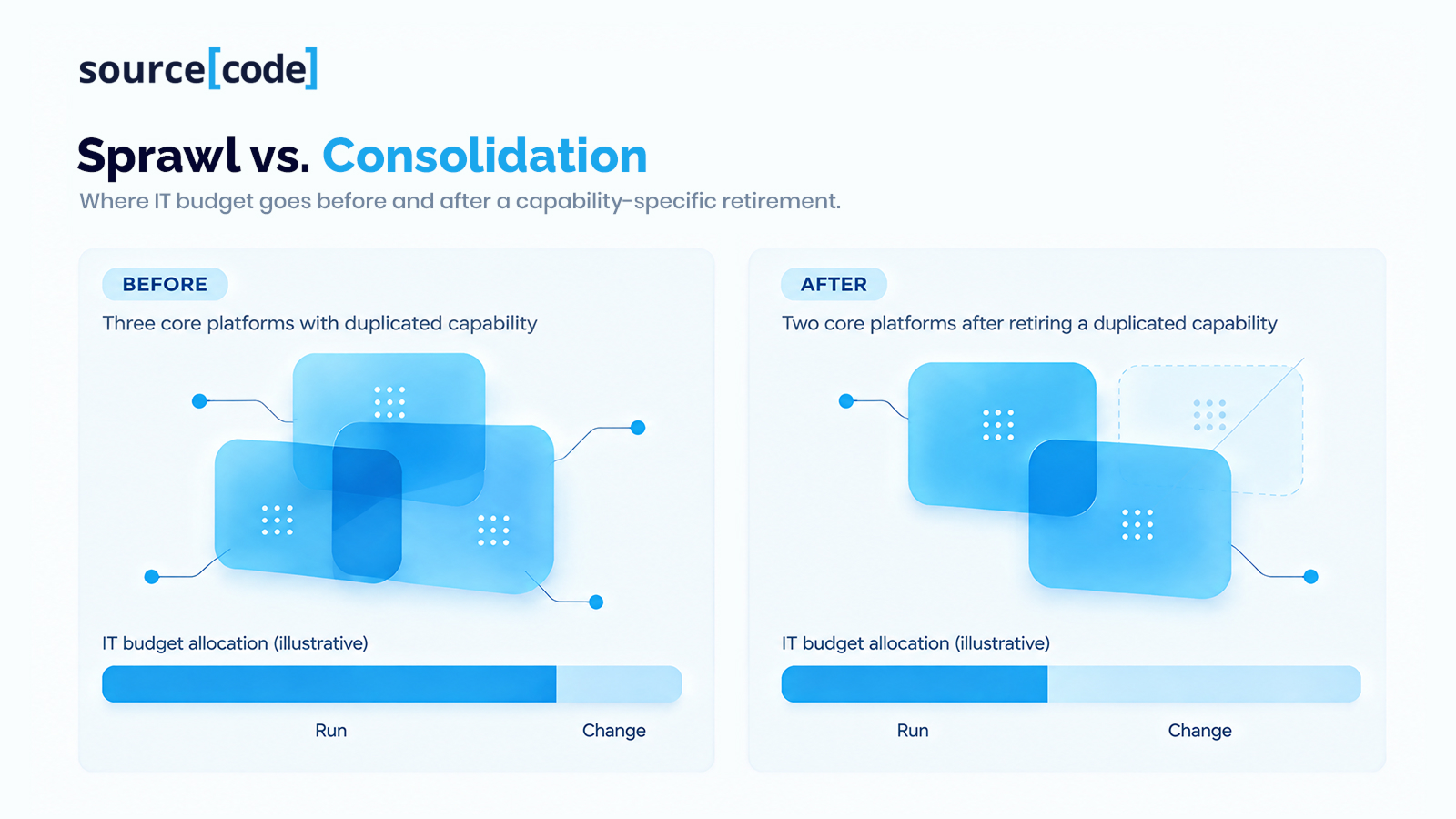 [/caption]
This shows up directly in how insurers describe their own budgets. In a Wipro-commissioned survey of 100 US insurance executives fielded in April 2026, 93% said IT budgets are skewed toward "run" costs rather than "change," and legacy platform costs were the most-cited barrier (65%) to shifting that balance (Wipro, 2026). That is not a story about one underfunded mainframe. It is a story about an estate of systems, several quietly doing the same job.
The thesis this piece tests, using independently verifiable evidence rather than assumption: for a meaningful share of carriers, the dominant legacy-cost driver today is not having too few core systems - it is having too many overlapping ones, each retained because retiring it is harder and less rewarding than buying the next point solution. The fix that survives a budget committee is not a sweeping "modernize the core" programme. It is a retirement case built around one specific, named, duplicated capability at a time.
How the Sprawl Actually Happens
Fragmentation rarely arrives as one bad decision; it accumulates through paths that are individually defensible.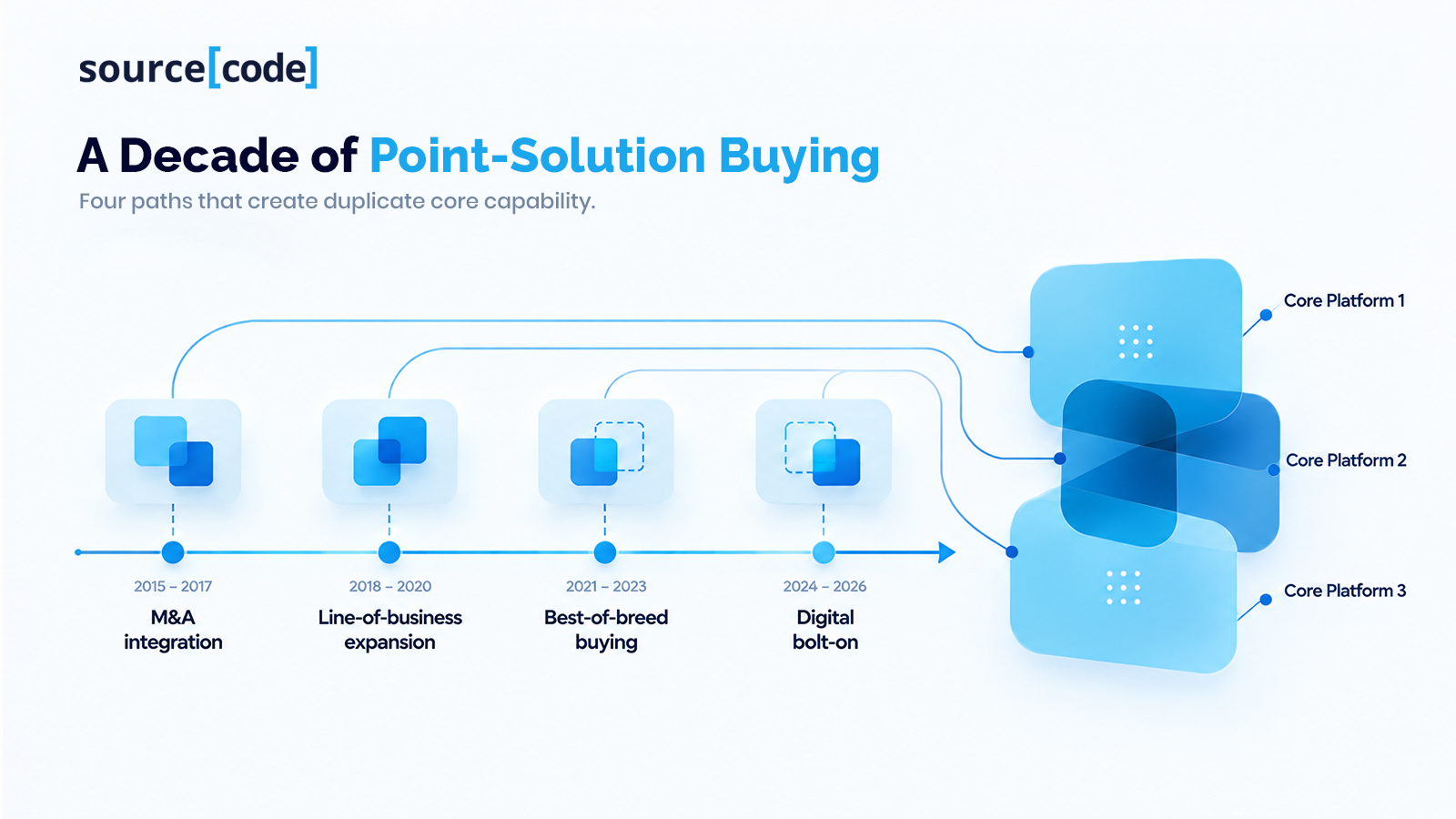
M&A that integrates the balance sheet before the technology. Accenture's 2007 survey - 112 executives across Europe, North America and Asia-Pacific, interviewed May-August 2006 - found mergers explicitly named as a major cause of redundancy, with 30% of European respondents expecting an M&A transaction within two years versus 9% in North America, and 34% of North American respondents already running eleven or more product platforms (Accenture, 2007). A specialty-insurer case from the same era shows the mechanism directly: when Pennsylvania Lumbermens Mutual and Indiana Lumbermens Mutual formed a shared-services alliance, Indiana Lumbermens was still running three separate legacy systems that had to be consolidated onto one platform as part of the integration (Digital Insurance, 2014).
Line-of-business and jurisdictional segmentation. A 2013 Strategy Meets Action survey of 121 US P&C insurers found PAS counts varied by line - personal lines averaged 1.7 systems, workers' compensation 1.9 - and that insurers over $1 billion in premium ran more systems on average, a pattern the researchers attributed "likely" to M&A rather than deliberate strategy (Digital Insurance, 2013). We flag this as a dated but credible data point, useful because it shows the pattern predates the current modernization cycle by well over a decade.
Deliberate best-of-breed buying. Carriers have long chosen to run a specialised system for one function - typically rating or underwriting - alongside a broader platform rather than forcing everything onto one core. Vendor executives interviewed in 2004 described this as the pragmatic alternative to a single-step migration (Digital Insurance, 2004). It is a legitimate pattern - and also exactly the pattern that, unmanaged over a decade, produces duplicated capability.
Digital initiatives bolted on rather than built in. The most familiar driver to current CDOs: a digital-first initiative gets its own lightweight platform to move fast, and that "temporary" workaround becomes the permanent system of record for a product line.
What the Evidence Actually Shows About the Cost
Three findings can be stated with reasonable confidence; a fourth should be treated with real caution.Carriers are overwhelmingly spending to maintain, not transform. In the Wipro/Coleman Parkes survey, 58% of respondents allocate 65-79% of IT budget to "run," and a further 6% allocate 80% or more; only 7% spend more on change than run. Application rationalisation and legacy decommissioning was the joint top-ranked cost-reduction priority (52%), tied with cloud cost optimisation - evidence that carriers themselves increasingly see decommissioning duplicate systems, not just modernising single ones, as the lever worth pulling (Wipro, 2026).
Consolidation has a demonstrated payoff where it has actually been measured. Accenture's 2007 survey found insurers that had completed consolidation reported, on average, a 19% drop in operating costs, a 25% drop in IT costs, and a 35% increase in new-product launch speed (Accenture, 2007). These figures are nearly two decades old and cannot be assumed to hold at the same magnitude today, but no more recent independently verifiable study we found contradicts the direction of the finding.
Running duplicate platforms resembles a permanent version of a cost McKinsey describes as temporary. McKinsey's 2026 analysis of agentic AI in core modernization identifies a "double-bubble" period - funding the legacy estate and a replacement programme simultaneously - as a defining cost driver of any transformation, with most effort going into reconciling underdocumented rules and data rather than writing code (Gundurao et al., 2026). A carrier running three overlapping platforms indefinitely is, in effect, living permanently inside that double-bubble. A companion 2025 McKinsey analysis adds a caution: carriers that have invested heavily in core transformation have had mixed results and often haven't fully realised expected returns, and a from-scratch build typically takes five to ten years against three to five for a configured commercial platform (Krishnakanthan et al., 2025). Consolidation is not a quick or guaranteed win.
Treat the fourth claim with caution. A March 2026 study commissioned by INTX Insurance Software and conducted by RSM US LLP reported most surveyed insurers run two to three PAS platforms, that a third of insurers spent over $500,000 implementing a single core system, and that implementation cost can reach $3 million across two to three systems, with hidden operational costs "up to $5 million annually" for some firms (RSM US LLP / INTX, 2026). This is vendor-commissioned by a company that sells a competing platform; the release doesn't disclose the base for several percentages, and "$5 million" is an explicit upper bound, not a typical figure. We include the directional finding - more systems compound cost - because it's corroborated elsewhere, but the dollar figures should be treated as single-sourced, not an industry benchmark.
A Counterargument Worth Taking Seriously
Platform consolidation is not a universal good, and three points deserve real weight.First, not all duplication is wasteful. The best-of-breed pattern - a core policy platform plus a specialised rating engine - is a legitimate architectural choice where the specialised system materially outperforms the core platform's native equivalent (Digital Insurance, 2004). Forcing everything onto one platform for tidiness can destroy value it set out to capture.
Second, replacement carries its own execution risk, not symmetric with the cost of the status quo. One executive quoted in 2004 compared replacing a live PAS to "swapping an engine while the aircraft is still flying" (Digital Insurance, 2004) - and McKinsey's 2025 finding that heavily invested US transformation programmes have produced mixed results is almost exactly that warning restated two decades later (Krishnakanthan et al., 2025). A carrier running three stable, well-understood platforms may, in a given year, be taking less risk than one attempting to collapse them into one.
Third, line-of-business and jurisdictional differences are often real. The 2013 SMA finding that workers' compensation and personal lines carriers run different average platform counts reflects genuinely different regulatory and distribution requirements, not simply poor governance (Digital Insurance, 2013). For a carrier operating across APAC and Gulf jurisdictions, some platform segmentation by jurisdiction may be the right long-term answer, not a problem to solve away.
The honest conclusion: fragmentation is a cost driver worth investigating rigorously, not a problem to assume and solve with one transformation programme.
The Duplication Register: Five Checks Before You Build the Business Case
Because that counterargument is genuine, the right response to suspected sprawl is a disciplined audit of exactly which capability is duplicated, where, and at what cost - not an immediate consolidation mandate. We call this process the Duplication Register.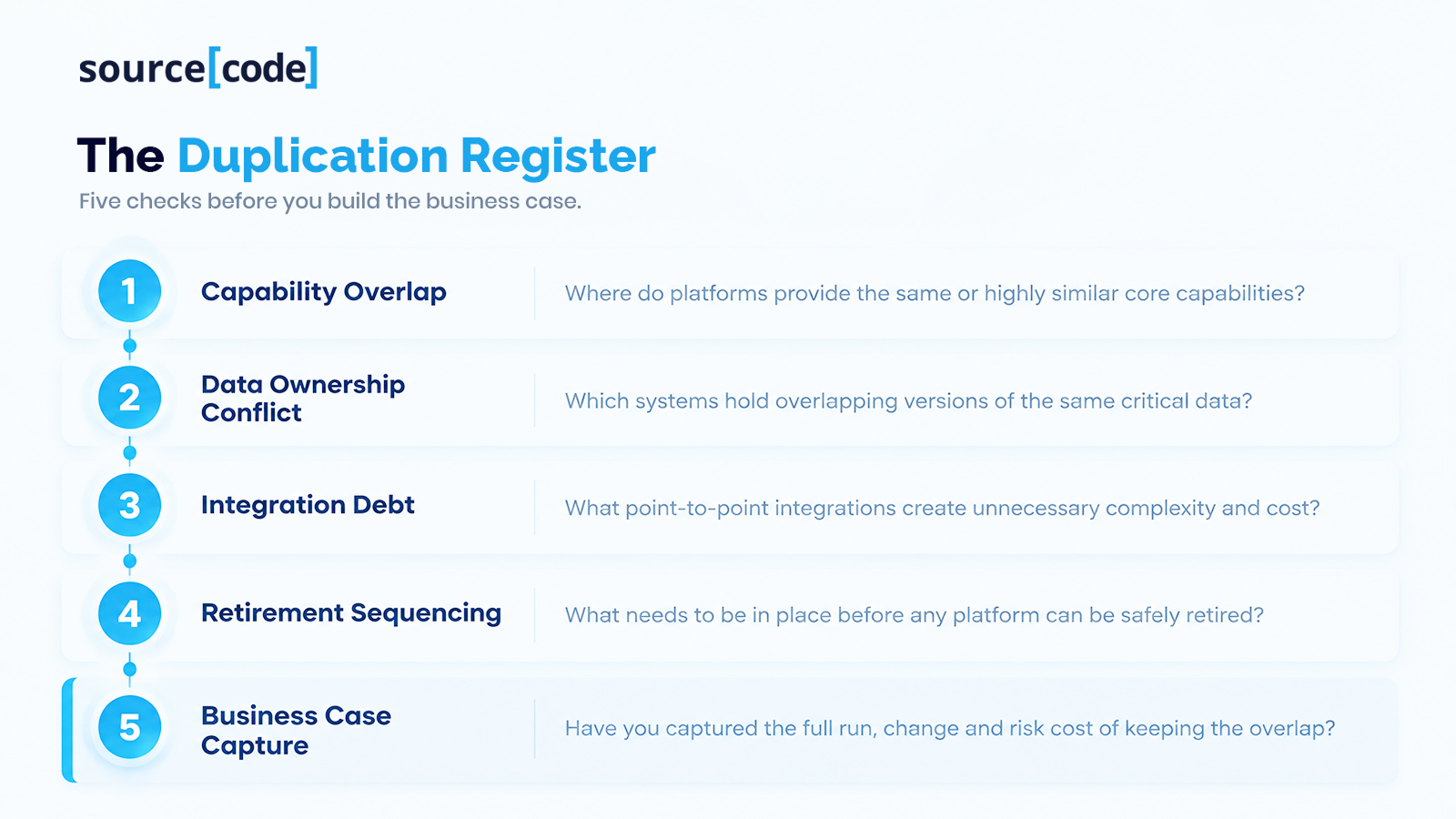
- Capability Overlap - For each platform, list the specific functions it performs (new business issuance, endorsement, renewals, claims-data feed, rating), not "policy administration" in the abstract. Map which named capabilities exist, unmodified, on more than one platform today.
- Data Ownership Conflict - Where two platforms perform the same capability, identify which is the actual system of record for the underlying data, and where that ownership is ambiguous. This is usually where the real operational cost hides, in reconciliation work nobody has costed.
- Integration Debt - Count the point-to-point integrations that depend on each overlapping platform specifically. A platform with forty downstream dependencies is a materially different retirement decision from one with four.
- Retirement Sequencing - Sequence migration by cohort - product line, book of business, jurisdiction - rather than one cutover, consistent with McKinsey's finding that full replacements commonly take five to ten years (Krishnakanthan et al., 2025).
- Business Case Capture - Quantify, for the specific capability retired, the run-cost removed, the licence cost removed, and the skills freed - not a generic modernization ROI model. This is the step most consolidation pitches skip, and the one that determines whether the case survives a CFO.
What This Means for the Buying Committee
For the CDO, the Duplication Register is a data-governance exercise before it is a technology one. Ownership of the capability-overlap map and the data-ownership-conflict findings should sit with the CDO's office, because the hardest disputes in any consolidation case are about which system is the true source of truth - not which vendor's platform is technically superior.For the CTO, the integration-debt count is the most useful early artefact. It reframes the conversation from "which platform is newer" to "which platform, if retired, breaks the fewest things" - a far more defensible basis for sequencing than age or vendor relationship.
For the Head of Claims, fragmentation is rarely abstract. It shows up as manual reconciliation at first notice of loss, inconsistent claims-data feeds into reserving, and workaround spreadsheets bridging gaps between platforms - consistent with, though not proof of, the RSM US LLP / INTX finding (flagged above as vendor-sponsored and single-sourced) that a notable share of surveyed insurers still rely on Excel or internally built tools for critical insurance workflows (RSM US LLP / INTX, 2026).
The sourceCode’s Perspective
Everything above is drawn from independently verifiable industry research, not our own client work, and it supports a clear conclusion: platform fragmentation is a real, long-standing and currently under-addressed cost driver, distinct from - and in some ways the opposite failure mode to - vendor concentration risk.Where we can add something from direct delivery experience is narrower, and we want to be precise about its limits. Over two decades working inside BFSI delivery teams across Australia, Malaysia and Vietnam - operating an insourcing model where our engineers, business analysts, QA and project managers sit directly inside a client's own workflows rather than delivering from arm's length - the pattern we observe most consistently is organisational, not technical. The hardest part of resolving platform duplication is rarely migrating data or rewriting an integration. It is getting agreement, inside the client organisation, on which system is actually the system of record when two platforms have both been treated as authoritative for years. Embedded teams tend to surface that ambiguity faster than external audit teams do, simply because they are inside the day-to-day workflow long enough to see where staff are quietly reconciling two systems by hand.
We do not have a published case study to cite here, and we are not going to invent one. What we can say, consistent with the independently sourced evidence above, is that a consolidation business case built around a specific named capability - not a generic "modernize the core" mandate - is the version of this work that tends to get funded and finished. Talk to us here!!!
Conclusion
The last decade's industry narrative has correctly worried about vendor concentration: depending on too few partners for too much critical infrastructure. The evidence here - a 2007 Accenture survey of 112 executives, a 2013 survey of 121 US P&C carriers, and 2026 surveys from Wipro/Coleman Parkes and (with caveats) RSM US LLP/INTX - points to a less-discussed but equally expensive mirror image: carriers that, through a decade of point-solution buying, now run duplicate core capability across multiple platforms, each defensible alone and collectively expensive. McKinsey's "double-bubble" concept, framed around the cost of a single migration, describes with unsettling accuracy what it feels like to run three overlapping platforms indefinitely rather than for a defined transition period.The genuine counterargument matters: not every instance of multiple platforms is a problem, and a forced single-platform mandate can destroy as much value as it claims to create. What separates a funded, finished consolidation programme from an abandoned transformation initiative is specificity - naming the duplicated capability, proving the data-ownership conflict, counting the integration debt, sequencing the retirement, and capturing the business case in those terms rather than the language of generic modernization.
If your organisation has never formally mapped where core capability is duplicated across your current platform estate, that mapping - not a replatforming decision - is the right next step.
We work with CDOs and CTOs to map which core and policy administration capabilities are duplicated across your current estate, what each actually costs to keep running, and which specific retirement case would be worth taking to your budget committee first. If that mapping hasn't been done at your organisation, we're glad to talk through what it would involve.
Frequently Asked Questions
How many policy administration systems does a typical insurer run? There is no single current, independently verified industry-wide figure. The most credible named data points are a 2007 Accenture survey finding 34% of North American respondents ran eleven or more product platforms (Accenture, 2007), and a 2013 SMA survey finding average counts of 1.7-1.9 per line of business (Digital Insurance, 2013). A 2026 vendor-sponsored study put the figure at two to three systems for most insurers, but we flag its dollar figures as single-sourced (RSM US LLP / INTX, 2026). It varies substantially by carrier and M&A history.Is running multiple core platforms always a problem? No. Deliberate best-of-breed segmentation - a specialised rating engine alongside a broader PAS - is a legitimate, long-documented pattern (Digital Insurance, 2004), and jurisdictional or line-of-business segmentation can reflect genuine regulatory differences (Digital Insurance, 2013). The problem is unmanaged, undocumented duplication of the same capability, not the existence of more than one system.
What's the real cost of legacy policy administration fragmentation? The most defensible figures come from carriers that measured consolidation after the fact. Accenture's 2007 survey found consolidated insurers reported average reductions of 19% in operating costs and 25% in IT costs, with a 35% increase in product launch speed (Accenture, 2007). More recent data shows the budget consequence indirectly: 93% of insurers report budgets skewed toward "run," with legacy platform costs the most-cited barrier to reallocating spend (Wipro, 2026).
How should an insurer decide which duplicated platform to retire first? Start with a capability-level map, not a platform-level one: identify the specific function duplicated, establish the true system of record, count the dependent integrations, and sequence migration by cohort rather than one cutover - consistent with McKinsey's finding that full replacements commonly take five to ten years (Krishnakanthan et al., 2025).
How is platform fragmentation different from vendor-concentration risk? They are near mirror images. Vendor concentration is the risk of depending on too few vendors for too much of the business, discussed in the 2026 “Three Tests" piece. Platform fragmentation is the risk of running too many overlapping platforms for the same capability, usually a legacy of M&A and point-solution buying. Both drive up cost; the remedies point in opposite directions, which is why neither should be pursued as blanket policy without first mapping the specific capability involved.
Reference List
Accenture (2007) European Life Insurers Outpace North American Counterparts at Systems Consolidation, According to Accenture Survey. Accenture Newsroom, 23 January. Available at: https://newsroom.accenture.com/news/2007/european-life-insurers-outpace-north-american-counterparts-at-systems-consolidation-according-to-accenture-surveyDigital Insurance (2004) Vendors: Getting to One System Often a Myth. Digital Insurance, 1 July.
Digital Insurance (2007) For Carriers, Platform Consolidation Necessary. Digital Insurance, 1 October.
Digital Insurance (2013) Policy Administration: P&C Plans and Priorities [survey conducted by Strategy Meets Action (SMA)]. Digital Insurance, 29 July.
Digital Insurance (2014) Newly-Affiliated Specialty Insurers Consolidate Four Core Systems into One. Digital Insurance, 1 December.
Gundurao, A., Krishnakanthan, K., Walsh, R., Kaniyar, S. and Catlin, T. (2026) Can agentic AI (finally) modernize core technologies in insurance? McKinsey & Company, 29 April. Available at: https://www.mckinsey.com/middle-east/our-insights/can-agentic-ai-finally-modernize-core-technologies-in-insurance
Krishnakanthan, K., Kaniyar, S., Catlin, T. and Ru, S. (2025) How P&C insurers can successfully modernize core systems. McKinsey & Company, 12 May. Available at: https://www.mckinsey.com/industries/financial-services/our-insights/how-p-and-c-insurers-can-successfully-modernize-core-systems
GlobeNewswire (2025) BriteCore Releases 2025 P&C Core Systems Report Highlighting Industry Shifts Toward Integration, Analytics, and AI. GlobeNewswire, 29 October. Available at: https://www.globenewswire.com/news-release/2025/10/29/3176360/0/en/BriteCore-Releases-2025-P-C-Core-Systems-Report-Highlighting-Industry-Shifts-Toward-Integration-Analytics-and-AI.html
RSM US LLP / INTX Insurance Software (2026) The Cost of Legacy Insurance Software Systems: Wasted Time & Money, reported via Business Wire, 11 March. Available at: https://www.businesswire.com/news/home/20260311938897/en/INTX-Sponsored-Research-Reveals-Legacy-Insurance-Systems-Create-Up-to-%245-Million-Annually-in-Hidden-Operational-Costs [Vendor-commissioned study; dollar figures are single-sourced and flagged as such in this article.]
Wipro / Coleman Parkes (2026) From Run to Reinvention: How Insurers Are Reshaping IT Spend to Fund the Future. Wipro, fieldwork April 2026. Available at: https://www.wipro.com/content/dam/nexus/en/industries/insurance/PDFs/from-run-to-reinvention-how-insurers-are-reshaping-it-spend-to-fund-the-future.pdf