Executive Summary
- Data residency language in Gulf AI vendor contracts has historically been treated as boilerplate - a standard clause procurement teams expect legal to insert and move past. That treatment is increasingly out of step with how Gulf regulators and vendors actually behave.
- Saudi Arabia's offshore-hosting rules already require financial institutions' data to clear Saudi Central Bank approval before leaving the Kingdom, and many cloud and AI providers default to in-Kingdom hosting specifically to avoid that approval process - a commercial choice with a cost, not a neutral default (Shelkey and Neskoromyuk, 2026).
- Saudi Arabia's proposed "data embassy" model under its draft Global AI Hub Law would let foreign entities process data under their home jurisdiction's legal framework rather than Saudi law - a structural option that, if enacted, gives vendors and buyers a genuinely new variable to negotiate and price (Andreeva et al., 2026).
- Separately, the UAE Central Bank's Guidance Note on responsible AI use raises the general compliance bar for regulated financial AI - governance, human oversight, third-party risk management - without itself addressing residency pricing, a related but distinct pressure pushing institutions toward more rigorous contract scrutiny overall (Singh, Shankar and Jabsheh, 2026).
- sourceCode's Residency Cost Map is our own disclosed framework - not drawn from any source above - for pricing out where a proposed AI contract's data physically sits, clause by clause, and what repatriation or in-region hosting would actually cost if required, before signature rather than after.

Introduction
Ask a procurement or vendor management lead at a Gulf bank or insurer where their AI contracts stand on data residency, and the answer is usually confident: "it's covered, legal reviewed the clause." Ask what it would cost to repatriate that data, or move it to in-region hosting, if a regulator required it next year, and the confidence disappears. Not because the information is hidden - because nobody priced it. The clause describes a location. It does not describe a cost.
That gap used to be tolerable, because data residency was a compliance formality rather than a live commercial question. The vendor hosted where the vendor hosted, the clause said so, and the conversation moved on to price, SLAs and liability caps - the terms that actually got negotiated.
That is changing, from two directions at once. Gulf regulators are formalising expectations around responsible AI use in financial services, raising the governance bar enough that institutions are reading every AI vendor contract more carefully overall. And separately, the regulatory and infrastructure landscape around where data can actually sit - Saudi Central Bank approval requirements for offshore hosting, proposed data embassy structures, UAE free-zone adequacy arrangements - is getting more specific and more expensive to get wrong. Put those two pressures together and the residency clause stops being boilerplate. It starts being a line item somebody has to be able to defend the price of.
This article is about what changes for Gulf procurement and vendor management teams when that shift happens, why the objection that this just adds friction to deals is not quite right, and the framework we use with clients to price residency before it becomes a signed, immovable term.
Why the Residency Clause Used to Be Boilerplate
The reason data residency clauses have historically gone unscrutinised is not negligence. For most of the last decade there was genuinely little to negotiate. A vendor hosted in one or two regions, the buyer's regulatory obligations were general rather than AI-specific, and the clause's job was simply to confirm a location that was not going to change during the contract term. Procurement teams were right to spend their negotiating effort elsewhere - on price, SLA remedies, liability caps - because residency was, in practice, fixed and low-stakes.

Two things have moved since then, and both are visible in how Gulf regulators and vendors are now behaving, not in speculation about what might happen.
First, the compliance bar around AI specifically has risen. The UAE Central Bank's Guidance Note on Consumer Protection and the Responsible Adoption and Use of AI and ML sets expectations for licensed financial institutions covering human oversight of high-impact decisions, transparency to customers, bias testing, and - directly relevant here - third-party risk management, including vendor due diligence, contractual audit rights and data safeguards (Singh, Shankar and Jabsheh, 2026). The Guidance Note itself does not set residency pricing expectations; it is a general responsible-AI framework. But it puts every AI vendor contract, including its data handling terms, under more active institutional review than it would have received two years ago. A clause that used to get a glance now gets read.
Second, and more directly, the regulatory and infrastructure landscape around data location in the Gulf has become genuinely more consequential to get wrong. In Saudi Arabia, offshore hosting of financial institution data requires prior Saudi Central Bank approval, and the practical effect is that many cloud and AI providers simply default to hosting fully in-Kingdom to avoid that approval process entirely (Shelkey and Neskoromyuk, 2026). That default is a vendor's commercial decision, made to manage its own regulatory exposure - and it is not free. In-Kingdom hosting capacity and a narrower set of willing providers carry a cost that gets built into pricing somewhere, whether or not the contract itemises it. Meanwhile, Saudi Arabia's draft Global AI Hub Law proposes a "data embassy" model under which foreign entities could process data under their home jurisdiction's legal framework rather than Saudi law - a mechanism that, if enacted, would be the first of its kind among G20 nations and would change what a residency clause is even describing (Andreeva et al., 2026). A clause written against today's rules may not describe tomorrow's hosting economics.
Neither development is, by itself, a statement that "data residency now has a published price list" - neither source makes that claim, and this article does not either. Together, they show that the conditions that made residency a stable, low-stakes boilerplate clause - predictable hosting, low regulatory attention, few jurisdictional options - no longer hold uniformly across the region. When the underlying conditions shift, a clause that assumed they wouldn't becomes a liability the buyer hasn't priced.
The Cost Was Always Real - It Just Wasn't on the Page
The cost of data residency in a Gulf AI contract is not a new invention. In-region hosting has always cost more than hosting in a vendor's lowest-cost global region, where that option exists. Repatriating data - moving it out of a vendor's infrastructure, because a regulator's expectations changed or a vendor relationship ended - has always been operationally expensive and slow. Cross-border transfer limits have always constrained which disaster-recovery options are actually available, whether or not the contract spelled that out.
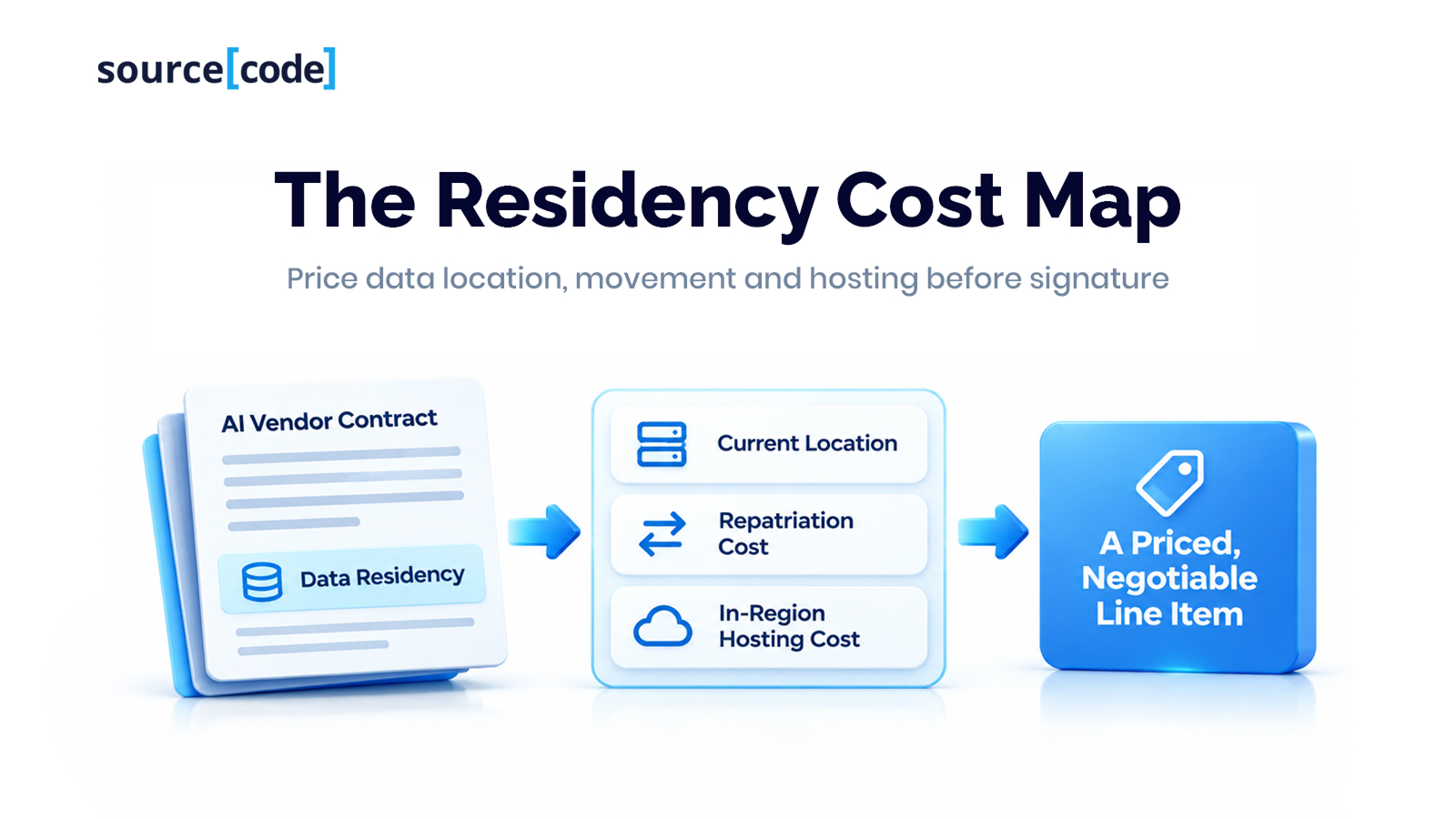
What's changing is not the existence of these costs. It's whether anyone can name them before signature. A contract that says data will be hosted in a named region, with a right to request relocation on notice, describes a location and a theoretical right - not what exercising that right would cost, or what would happen to service continuity during the transition. Two AI vendor proposals that both check the "data stays in-region" box can hide a meaningfully different real cost, depending on which vendor's infrastructure and transfer mechanisms sit behind the claim.
This is the mechanism by which residency has quietly stopped being a yes/no compliance question and started behaving like any other negotiated commercial term: it has a price, that price differs by vendor and jurisdiction, and a buyer who doesn't ask gets whatever price was built into the vendor's default. Institutions still treating the clause as a formality are not avoiding this cost - they are agreeing to pay it without having seen the number.
It's Reasonable to Ask Whether This Just Slows Procurement Down
The strongest objection here is practical: Gulf procurement cycles for AI vendors are already loaded with compliance review, security assessment and legal negotiation. Adding a formal residency-cost exercise to every deal risks turning a clause that used to take an afternoon into a multi-week negotiation, slowing down exactly the AI adoption Gulf institutions are otherwise trying to accelerate. There is also a real risk that vendors, asked to itemise costs they've never had to disclose before, walk away from smaller deals or pad the number defensively - making the contract more expensive precisely because someone asked.
That risk is real, and a residency-pricing exercise applied indiscriminately to every vendor and deal size would deserve the criticism. But the objection assumes the cost only exists once someone asks about it. It doesn't. The in-region hosting premium, the repatriation friction, the cross-border transfer constraint are already priced into the vendor's economics and the buyer's risk exposure, whether or not either side has written the number down. Asking for it before signature doesn't create a new cost; it moves an existing one from unknown and unbudgeted to known and negotiable.
Procurement teams that skip this step are not avoiding friction - they are deferring it to the point, a regulatory change or an incident, where it is most expensive and least negotiable to deal with. The right response to the pace concern is to scope the exercise to the deals where exposure justifies it - larger AI contracts, core financial-data workloads, multi-year terms - not to apply it uniformly or to skip it altogether.
Who Actually Has to Sign Off on a Priced Residency Position
The decision to price residency before signature, rather than discover its cost after, does not sit with one function - part of why it tends not to happen unless someone owns it deliberately.
Procurement and Vendor Management usually negotiates the AI contract's commercial terms, and is best placed to insist that residency and repatriation costs be itemised in the vendor's proposal rather than buried inside a bundled fee - but only if that insistence is built into the RFP from the start, not raised during final redlines.
The CTO or Head of Technology owns the technical reality of what a hosting-region change would actually require - data volume, retraining, integration dependencies - turning a vendor's stated cost from a plausible number into a verified one.
The CFO owns the budget line that absorbs an in-region hosting premium or an unplanned repatriation cost, and has to explain, after the fact, why a cost that could have been scoped during procurement showed up as an unbudgeted variance instead.
The CRO, Head of Compliance or Data Protection Officer owns the regulatory exposure if residency terms don't match Saudi Central Bank approval requirements or UAE data protection rules, and is usually first asked, after an incident, whether the position was ever actually verified rather than assumed.
A Decision Framework: Four Questions Before You Sign
Where does the data in this specific contract actually sit, clause by clause? A vendor's general hosting-region marketing claim and the contract's actual sub-processor list, backup locations and disaster-recovery arrangements are not always the same thing. The question before signature is what this contract commits to, not what the vendor's website says about its infrastructure generally.
What would repatriation or a move to in-region hosting cost if we needed it after signature? This is the number the Residency Cost Map is built to produce. If the vendor cannot or will not give a reasoned estimate, that itself is information: the cost is unknown to both sides, and the buyer carries that uncertainty by default.
Is the residency position priced anywhere in this contract, or only described? A clause that states a hosting region without attaching any cost consequence to changing it is a description, not a commercial term. The question is whether a residency change is treated as a negotiated, costed event or something sorted out informally if it ever comes up.
What triggers a renegotiation of this position - and is it written down? Institutions managing this deliberately can name the trigger before being asked. Institutions managing it by default only discover the trigger was "whenever the regulator forces it" - the most expensive and least controllable version of this conversation to have.
sourceCode’s Perspective
We built the Residency Cost Map because we kept seeing the same pattern in Gulf AI procurement conversations: a residency clause that reads as settled, a vendor never asked to itemise what a hosting change would cost, and a procurement team that only discovers the real number during a crisis. This is our own disclosed point of view, built from our delivery and vendor-negotiation work with Gulf financial institutions, not an independently published industry benchmark - and we are naming that distinction directly rather than presenting it as something it isn't.
The Residency Cost Map is not a legal clause template or a compliance checklist. It is a pricing exercise, applied to a specific proposed AI contract before signature: for every place the vendor's infrastructure, sub-processors or backup arrangements put the buyer's data, what would it cost - in money, time and operational disruption - to move that data to in-region hosting or repatriate it entirely, and what would trigger that move. The output is not a single number but a map of each data location against its specific, costed exposure, so that a "data stays in-region" clause from one vendor and the same-sounding clause from another can be compared on what they would cost to change, not just on what they currently say.
Institutions that run this exercise are not guaranteed a cheaper contract. Some find a vendor's in-region hosting premium is modest and well justified by the regulatory certainty it buys. Others find that a clause they assumed was settled carries a six-figure repatriation cost with no defined trigger for revisiting it - information that changes which vendor gets the deal, or at minimum what gets renegotiated before signature rather than after.
Conclusion
The residency clause in a Gulf AI contract still reads like a formality in most procurement processes - a location named, a box checked, a move to the next point. The regulatory and infrastructure conditions that made that treatment safe are shifting, visibly, in Saudi Arabia's offshore-hosting approval regime and its proposed data embassy model, and in the broader rise in scrutiny that comes with formal responsible-AI expectations across the region's financial regulators.
None of this means residency has a published price list institutions can simply look up. It means the cost was always there, and the only real choice left is whether a procurement team prices it before signing or discovers it afterward, at the worst possible moment to negotiate.
The question worth asking before the next AI vendor contract reaches signature is not whether the residency clause is present. It is whether anyone has priced what it would cost to be wrong about it.
FAQ
Q1. What does it mean for data residency to become a "line item" rather than a "clause" in an AI contract?
It means the location where a vendor hosts a buyer's data is treated as a commercial term with an attached, negotiated cost - what it would cost to change that location, and under what conditions - rather than as a descriptive statement of fact that gets agreed once and never revisited.
Q2. Does Gulf regulation currently require vendors to disclose data residency costs?
Not directly. Saudi Arabia requires Saudi Central Bank approval for offshore hosting of financial institution data, and the UAE Central Bank's AI guidance raises the general compliance bar for third-party risk management - but neither mandates that a vendor itemise repatriation or in-region hosting costs in a contract. That disclosure has to be negotiated by the buyer, not assumed from regulation.
Q3. Is the Residency Cost Map a legal or compliance framework?
No. It is a commercial pricing exercise sourceCode uses with clients, applied to a specific proposed AI contract, to quantify what a hosting-location change would cost and what would trigger it - meant to sit alongside, not replace, legal review of the underlying data protection and residency clauses.
Q4. Why would a vendor's in-region hosting premium vary so much between deals?
Because it depends on factors specific to each vendor's infrastructure and each buyer's data volume and complexity - which jurisdictions the vendor already operates in, whether in-region hosting requires a new facility, and how much of the buyer's data pipeline would need to move. A generic industry-wide premium figure would not reflect any specific deal's actual exposure, which is why this needs to be priced per contract.
Q5. Should every AI vendor contract go through a residency-cost review before signature?
Not necessarily every one. The exposure that justifies the exercise scales with the size and duration of the contract, the sensitivity of the data involved, and whether the workload touches regulated financial data specifically. A short-term, low-sensitivity pilot carries less of this risk than a multi-year contract covering core underwriting, claims or transaction data.
Reference List
Andreeva, K., Dergacheva, A., Davy, M. and Murphy Melby, B. (2026) 'Technology transactions across Europe, the Middle East, and the United States', Tech & Sourcing @ Morgan Lewis, 26 May. Available at: https://www.morganlewis.com/blogs/sourcingatmorganlewis/2026/05/technology-transactions-across-europe-the-middle-east-and-the-united-states (Accessed: 17 November 2026).
Shelkey, D.G. and Neskoromyuk, A. (2026) 'Saudi Arabia cloud compliance part 1: data residency and contractual expectations', Tech & Sourcing @ Morgan Lewis, 27 March. Available at: https://www.morganlewis.com/blogs/sourcingatmorganlewis/2026/03/saudi-arabia-cloud-compliance-part-1-data-residency-and-contractual-expectations (Accessed: 17 November 2026).
Singh, A., Shankar, V. and Jabsheh, N. (2026) 'AI in insurance: CBUAE sets expectations for responsible use', Al Tamimi & Company Law Update, 18 May. Available at: https://www.tamimi.com/law_update_articles/ai-in-insurance-cbuae-sets-expectations-for-responsible-use/ (Accessed: 17 November 2026).