Executive Summary
• The decision that gets scrutinised in an insourcing, ODC or GCC build-out is build-vs-buy: own the capability or rent it. The decision that actually determines whether that capability is reliable at scale happens afterwards, inside the org chart, and it gets almost no scrutiny at all.
• Most ODC build-outs staff in the order demand presents itself: feature engineers first, because the backlog is visible and the roadmap is loud, then platform and site reliability engineering (SRE) roles later, if headcount allows, because reliability work has no backlog item until something breaks.
• That hiring order is not a staffing detail. It is a reliability decision, made by whoever happened to be hiring fastest, rather than by anyone who owns the question of what the team's role mix should be.
• Industry benchmarking on adjacent functions shows organisations that treat platform and productivity-engineering investment as a deliberate percentage of headcount, rather than a residual, consistently land in a measurable, maintained band - while BFSI-grade ODC teams we see are frequently staffed with no equivalent target at all.
• sourceCode's Role Mix Ratio gives engineering leaders a starting benchmark across four roles - feature, platform, QA and SRE - so the structure of a BFSI-grade ODC team is set deliberately before scale makes it expensive to fix.
Introduction
Every insourcing or ODC build-out starts with the same conversation: should this capability live inside the bank or insurer, or should it be bought from a vendor. That conversation is well served. Procurement has scorecards for it. Finance has a total-cost-of-ownership model for it. The board has an opinion about sovereignty and control, and the CIO has a point of view about which systems are differentiating enough to justify owning the team that builds them.
What happens next is far less examined. Once the decision lands on "build it ourselves" - an ODC, a captive centre, an insourced delivery team - somebody has to decide what that team actually looks like. Not its size, which gets a budget line and a hiring plan, but its composition: how many of those engineers are writing features, how many are maintaining the platform those features run on, how many are testing before release, and how many are on call for what happens after release.
In our delivery work with Australian banks and insurers scaling ODC and insourced teams, that composition decision is rarely made on purpose. It is made by momentum. The business case for the ODC was built on feature velocity - faster delivery of the products and integrations the roadmap demands - so the first ten, twenty, fifty hires are feature engineers, because that is what the business case promised and what the backlog visibly needs. Platform and SRE roles get added later, usually after an incident makes the absence obvious, and usually at a worse ratio than if they had been planned in from the start.
This matters more in BFSI than in most other industries building ODCs, because the cost of reliability debt in banking and insurance technology is not a slow page load. It is a core banking integration that silently drops transactions, a claims platform that cannot scale during a catastrophe event, or a policy administration system that degrades during a renewal cycle it was never load-tested for. The feature engineer who shipped the integration is not the person who finds out it is failing at 2 a.m. By then, the team that was supposed to catch it was never hired.
Why the Build-vs-Buy Decision Isn't the One That Determines Reliability
The build-vs-buy framing treats the sourcing decision as the moment of maximum consequence. It is an important decision, but it is not the one that governs whether the resulting capability holds up under load, under incident, or under scale. Two ODCs can make the identical build-vs-buy decision - both choose to insource - and arrive at completely different reliability outcomes, because one of them staffed platform and SRE roles deliberately and the other staffed them as a residual.
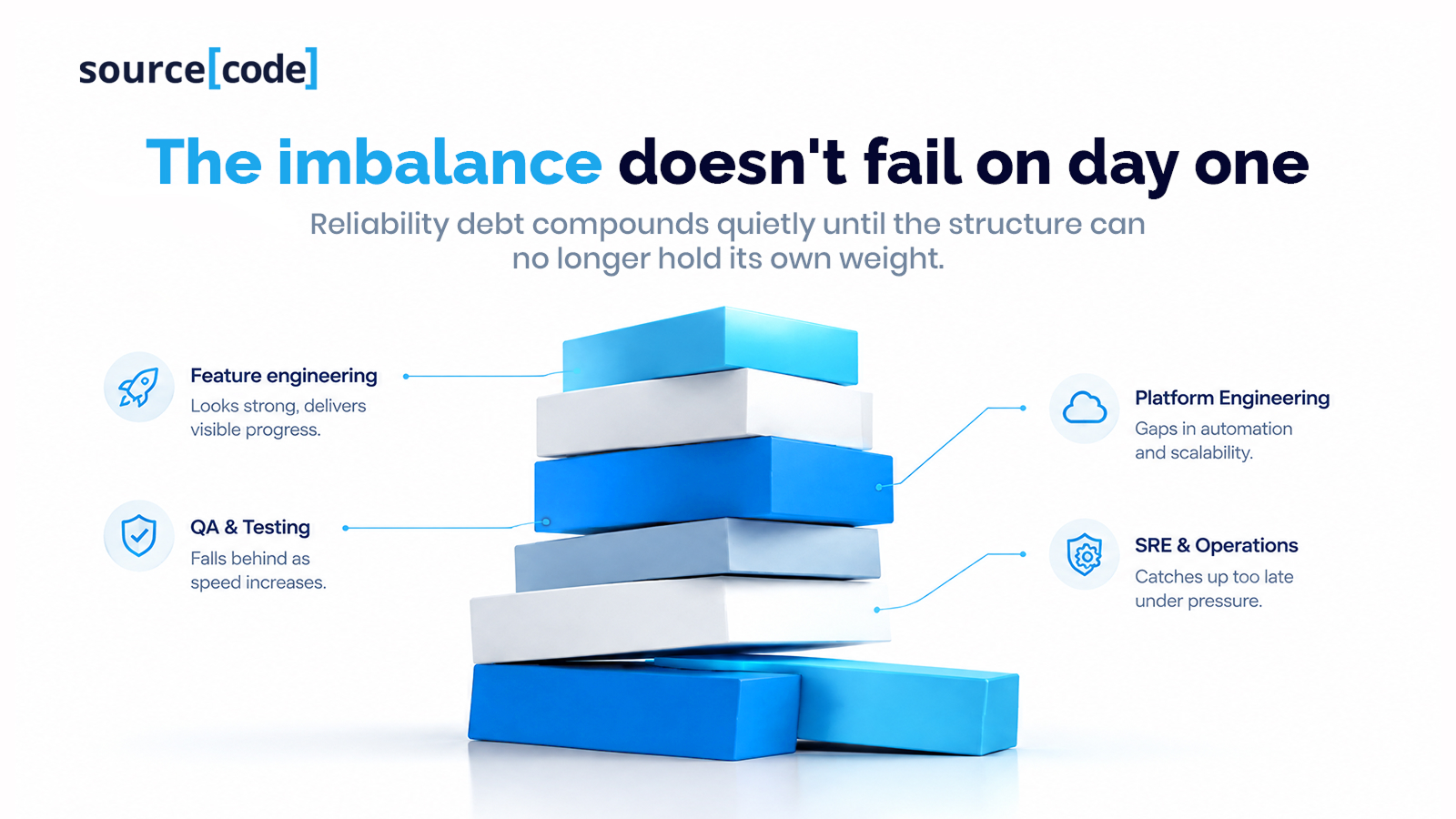
The mechanism is straightforward. A feature engineering team ships functionality. A platform team builds and maintains the shared infrastructure, tooling, CI/CD pipelines and internal services that feature teams depend on, so that feature engineers are not each independently solving deployment, observability and environment problems. An SRE function owns production reliability specifically: error budgets, incident response, capacity planning and the operational discipline that keeps a system inside its reliability target rather than discovering its limits in production. QA sits across both, verifying that what ships actually works before a customer or a regulator finds out otherwise.
When an ODC build-out under-invests in platform and SRE relative to feature engineering, the shortfall does not show up immediately. Feature velocity looks strong for the first year, because the team is shipping the roadmap exactly as promised. What accumulates instead is reliability debt: manual deployment processes that do not scale past a certain team size, monitoring that exists in pockets rather than consistently, incident response that depends on whichever feature engineer happens to understand that part of the system, and an operational burden that increasingly falls on engineers who were never meant to carry it. The bill for that debt arrives later, and it arrives as an incident, not as a line item anyone budgeted for.
What the Adjacent Benchmarking Data Actually Shows - and Where It Runs Out
There is no widely published, India/ANZ-specific benchmark for exactly this ratio - feature versus platform versus QA versus SRE inside a BFSI-grade ODC - and we are not aware of one that exists publicly with a credible, disclosed methodology. That gap is itself part of the point: engineering leaders making this decision are mostly doing it without a reference point.
The closest adjacent data comes from developer-productivity benchmarking rather than reliability engineering specifically. DX's DevProd Headcount Benchmarks study, drawn from a sample of 39 companies, found engineering organisations typically dedicate roughly 2 to 6 percent of total engineering headcount to centralised developer-productivity functions, averaging 4.7 percent among companies under 1,000 engineers, with the figure varying meaningfully by sector - closer to 4.9 percent in technology companies and 4.4 percent in fintech and financial services, against roughly 3.3 percent in large, more traditional enterprises (Reock, 2026). That data is useful as an illustration of how a mature engineering organisation treats a support function as a deliberate percentage of headcount rather than a residual - but it is scoped specifically to developer-productivity tooling, and its own methodology explicitly excludes site reliability engineering, which it treats as a distinct function focused on production reliability rather than developer tooling (Reock, 2026). It tells us that deliberate, tracked allocation is standard practice for one adjacent function. It does not tell us the right ratio for feature-to-platform-to-QA-to-SRE inside an ODC, and we are not going to borrow a number from an adjacent function and present it as if it answers a different question.
That is the honest position, and it is also the reason this benchmark needs to be built rather than looked up - which is the case for sourceCode's own Role Mix Ratio, below.
It Is Reasonable to Ask Whether This Is Over-Engineering the Problem
The strongest counterargument to all of this is straightforward: a growing ODC should scale its platform and SRE investment as the team scales, not front-load it before there is anything to maintain. A ten-person ODC standing up its first integration does not need a dedicated SRE function; it needs features shipped. Over-investing in platform and reliability roles before there is production scale to justify them is its own kind of waste - headcount sitting on infrastructure nobody is stressing yet, while the roadmap that justified the ODC's existence in the first place slips.
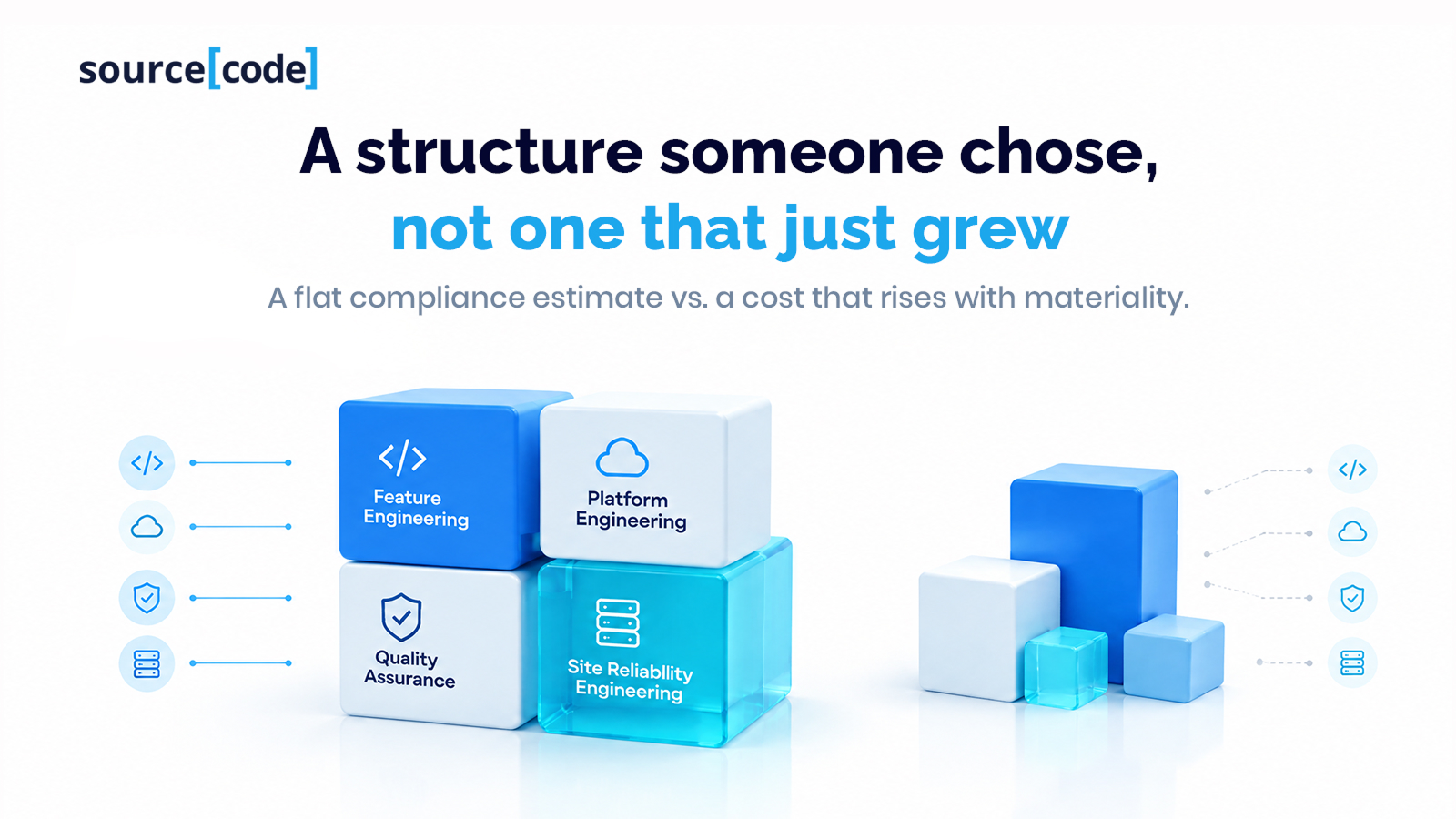
That argument is correct as far as it goes, and a Role Mix Ratio that ignored team size and maturity stage would deserve the criticism. The failure mode we are describing is not "platform and SRE investment should start at the same scale as feature engineering from day one." It is that most ODC build-outs never set an explicit ratio or a trigger for when it should shift, at any size - so platform and SRE investment does not scale deliberately with team size and production maturity; it scales with whichever incident most recently got attention. A ten-person ODC genuinely may not need a dedicated SRE. A hundred-person ODC running production BFSI workloads that still has no dedicated SRE function, and no plan for when one gets added, is not managing sequencing. It is managing by accident, and has usually been doing so for long enough that the gap is now expensive to close.
Who Is Actually Deciding This, Whether They Know It or Not
The role-mix decision does not sit with one buyer, which is part of why it gets made by default rather than by design.
- Engineering and delivery leadership inside the bank or insurer own the ODC's day-to-day structure and are usually the first to feel the consequence of an unbalanced ratio, through escalating on-call burden and slipping delivery dates once reliability work starts competing with feature work for the same people.
- The CIO or Head of Technology owns the broader capacity plan the ODC sits inside, and is the person who has to explain, after an incident, why the team that should have caught it was never resourced.
- Procurement and vendor management, where the ODC is run through a managed-services or staff-augmentation partner rather than a wholly owned captive, are the ones who actually write the role-mix ratio into a contract or statement of work - or fail to, leaving it to the partner's own hiring judgment.
- Risk and compliance functions, particularly under operational resilience regimes like CPS 230 in Australia, increasingly need to be able to demonstrate that a critical technology function has adequate reliability and incident-response capability - which makes role-mix evidence a resilience artefact, not just a staffing preference, whether or not the function has asked for it yet.
A Decision Framework: Four Questions Before the Next Hiring Round
- What is the current ratio, and did anyone choose it? Most engineering leaders can state headcount by team but not by function. The first step is simply counting: of the people currently delivering against this ODC or insourced capability, how many are feature engineers, how many are platform, how many are QA, and how many are SRE or production-reliability specific. If the honest answer is "we don't track it that way," the ratio was set by hiring order, not by decision.
- Does the ratio match the workload's actual production maturity, not its headcount? A small team running a low-criticality internal tool can run leaner on platform and SRE than a large team running core transaction or claims processing. The right comparison is not team size against some universal benchmark; it is role mix against what the systems this team owns actually need to stay reliable in production, given their criticality and scale.
- What is the trigger for adding the next platform or SRE hire - and is it written down anywhere, or does it only happen after an incident? Teams that manage this deliberately have an answer before they are asked: a headcount threshold, a production-incident-rate threshold, or a criticality tier that triggers the next reliability hire. Teams that manage it by accident only discover the trigger after it has already cost them an outage.
- If this ODC or insourced team is run through a delivery partner, is the role-mix ratio specified anywhere in the commercial arrangement? A statement of work that specifies headcount and seniority mix but says nothing about the feature-to-platform-to-SRE ratio has left the single most consequential structural decision to whichever roles are easiest for the partner to staff and bill - which, left unmanaged, is almost always feature engineers.
The sourceCode’s Perspective
We built the Role Mix Ratio because we kept seeing the same pattern across BFSI engineering teams we work alongside: strong feature velocity in year one, a platform or production incident in year two, and a scramble to backfill reliability roles in year three at a worse ratio and a higher cost than if the structure had been set deliberately from the outset. This is our disclosed point of view, built from our own delivery benchmarking rather than from an independently published industry survey, and we are naming that distinction rather than presenting it as something it is not.
The Role Mix Ratio is a starting benchmark, not a rigid formula: it sets an initial feature-to-platform-to-QA-to-SRE allocation for a BFSI-grade ODC team based on the system's production criticality and the team's current scale, together with the triggers for when that ratio should shift as the team and its workload mature. It exists to replace "whoever we hired fastest" with a structure somebody actually chose and can defend to a risk committee, an auditor, or their own CIO. Teams that adopt it earliest tend to be the ones that are still debating team structure in year one, before an incident has already made the argument for them.
Conclusion
The build-vs-buy decision gets the governance attention because it is visible, structural and made once. The role-mix decision gets almost none, because it looks like an ordinary hiring sequence rather than a reliability commitment - until the system it was quietly under-resourcing fails in production.
For engineering leaders running or scaling an ODC in banking or insurance, the question worth asking before the next hiring round is not whether to insource. It is whether the team taking shape on the other side of that decision was built on purpose.
FAQ
What is a "role mix ratio" in an ODC or insourced engineering team?
It is the proportion of an engineering team's headcount allocated across feature engineering, platform engineering, quality assurance and site reliability engineering (SRE), set deliberately based on the systems the team owns and their production criticality, rather than emerging as a side effect of hiring order.
Why does platform and SRE investment usually lag feature engineering in ODC build-outs?
Because feature work has a visible backlog and a roadmap commitment behind it from day one, while platform and reliability work has no equivalent forcing function until an incident makes the gap obvious - by which point the shortfall is more expensive to correct than it would have been to plan for.
Does a small or early-stage ODC need a dedicated SRE function from day one?
Not necessarily. A small team running lower-criticality systems can reasonably run leaner on platform and SRE early on. What matters is having an explicit, pre-agreed trigger - a headcount, incident-rate or criticality threshold - for when that investment should increase, rather than discovering the need only after an outage.
How does this apply if the ODC is run through a managed-services or staff-augmentation partner rather than a wholly owned captive centre?
The role-mix ratio should be specified in the commercial arrangement itself - in the statement of work or service description - not left to the partner's own staffing judgment, which will typically default toward the easiest-to-bill feature roles unless the ratio is contractually set.
Is there an external, published benchmark for the right feature-to-platform-to-QA-to-SRE ratio in BFSI ODCs specifically?
Not one we are aware of with a credible, disclosed methodology specific to BFSI-grade ODC teams. The closest adjacent data - DX's developer-productivity headcount benchmarking - is useful context but explicitly excludes SRE and answers a different question, which is why this benchmark needs to be built deliberately rather than looked up.
Reference List
Reock, J. (2026) DevProd headcount benchmarks, Q1 2026. DX. Available at: https://getdx.com/blog/devprod-headcount-benchmarks-q1-2026/ (Accessed: 17 November 2026).