Key Takeaways:
- Project Nexus, the BIS-incubated multilateral instant cross-border payments platform, has moved from blueprint to build: a new entity, Nexus Global Payments (NGP), was incorporated in 2025, a Technical Operator (a PayNet-NETS joint venture) was appointed in February 2026, and the Philippines' central bank has already agreed a mid-2027 onboarding timeline.
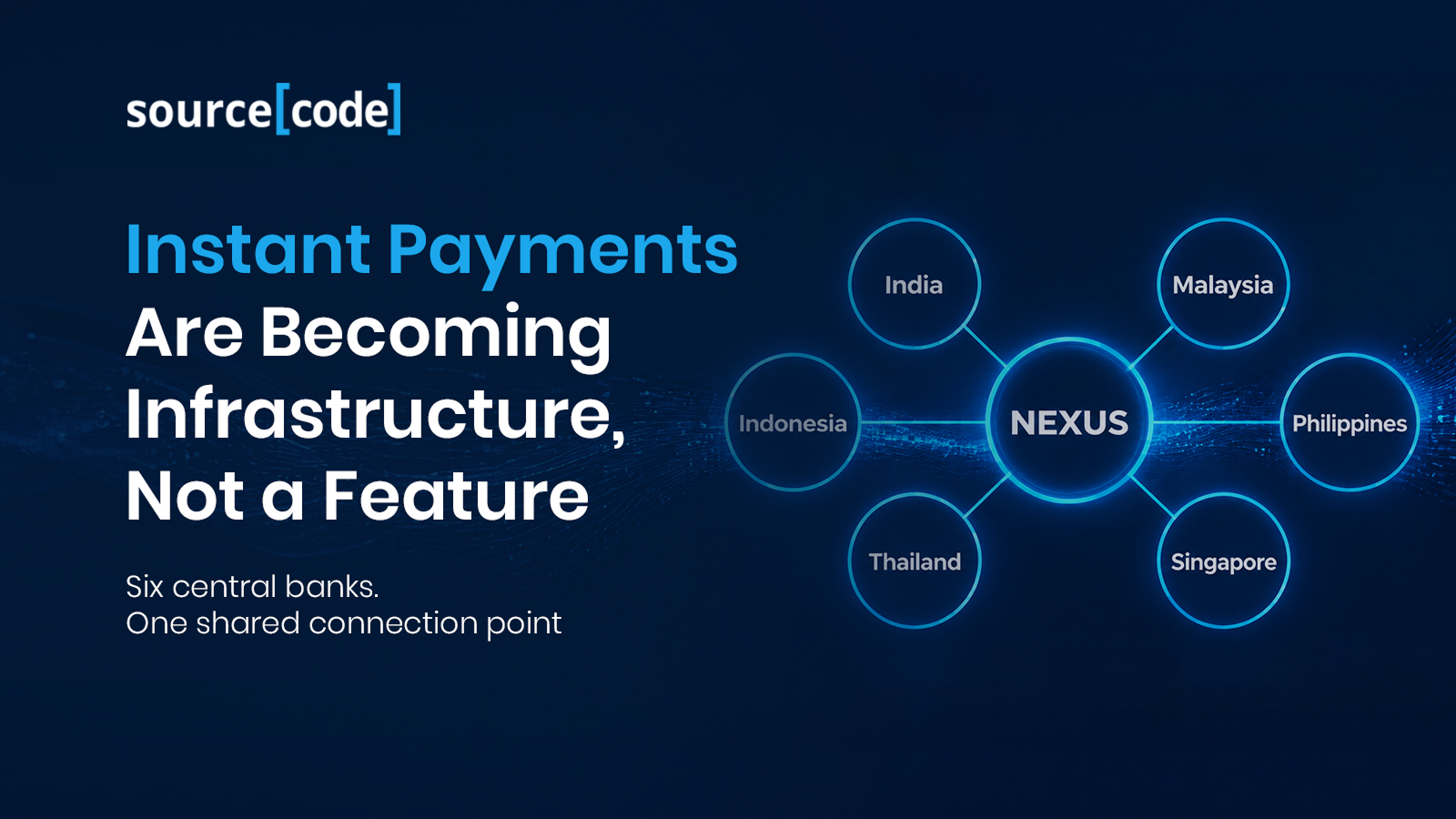
- Six central banks are now full members - India, Malaysia, the Philippines, Singapore, Thailand and, as of early 2026, Indonesia - with the European Central Bank and Latin America's FLAR separately exploring future connectivity, which signals the network is designed to extend well beyond its founding region.
- Nexus's core technical proposition is a single connection: an instant payment system operator connects once to Nexus rather than building a separate bilateral link to every country it wants to reach.
- A genuine academic debate exists about whether Nexus's new multilateral business model is commercially viable, or whether improving existing correspondent banking arrangements would achieve the same result more cheaply - a question banks should factor into their own architecture decisions rather than resolve for themselves.
- Banks still building cross-border payment capability as one-off, point-to-point integrations are optimising for a model regional infrastructure is actively moving away from; the practical question for a CTO is not whether to wait for Nexus specifically, but whether the current payments architecture could plug into a shared multilateral rail at all without a rebuild.
Introduction
For most of the last decade, a bank that wanted to send a retail payment into a neighbouring country built a bilateral connection to handle it - a correspondent banking relationship, a point-to-point API integration with a partner, or a proprietary link to a single payment corridor. Each new country meant another integration, another reconciliation process, another operational relationship to maintain. That approach made sense when cross-border retail payment volumes were a small, slow-growing adjunct to domestic business. It makes substantially less sense now that regional regulators are actively building the shared infrastructure that was supposed to replace it.
Project Nexus is the clearest evidence of that shift. Incubated by the Bank for International Settlements' Innovation Hub and now run by an independent entity its founding central banks own, Nexus is designed to let a country's instant payment system connect once and reach every other country in the network, rather than negotiating a separate bilateral link for each corridor. It is not a product a vendor is selling into the market; it is public infrastructure six central banks have committed capital, governance and a multi-year build programme to, with a technical operator now under contract and at least one member economy's regulator already working to a 2027 onboarding date. For an APAC bank CTO still treating cross-border payments architecture as a series of one-off integration projects, that is the detail worth sitting with.
From experiment to execution: where Nexus actually stands
Nexus has a longer history than its current momentum suggests, and the distinction between where it was and where it is now matters for how urgently a bank should treat it. The project traces to a 2021 BIS Innovation Hub proposal and a 2022 memorandum of understanding among Indonesia, Malaysia, the Philippines, Singapore and Thailand. A working prototype linking the Eurosystem's TIPS, Malaysia's RPP and Singapore's FAST systems followed, and by July 2024 the BIS, together with the central banks and instant payment system operators of India, Malaysia, the Philippines, Singapore and Thailand, had published a complete technical blueprint - the point at which BIS itself described Nexus as the first BIS Innovation Hub payments project to move toward live implementation.
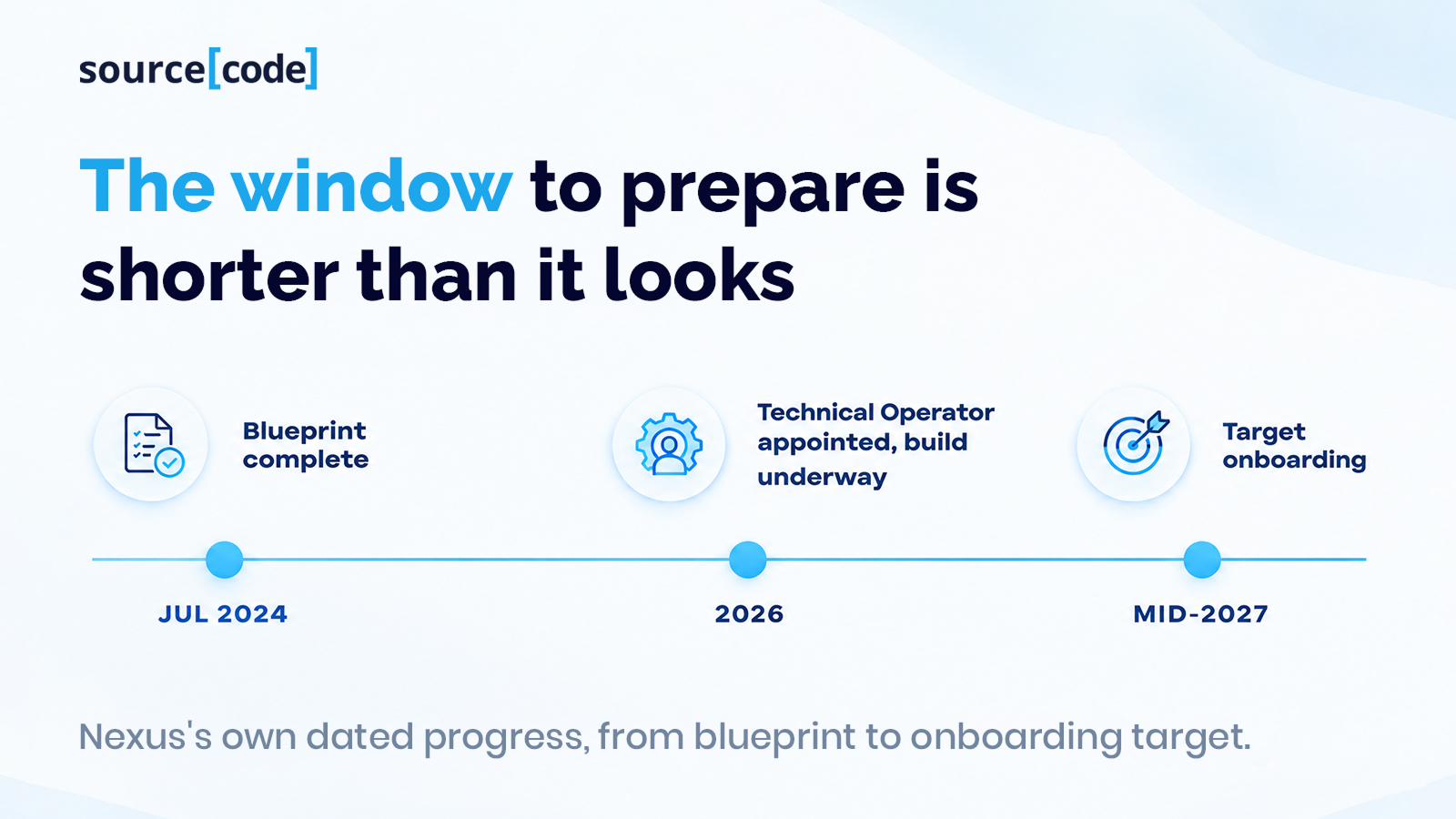 The governance structure changed materially in 2025. Rather than remaining a BIS-run pilot, the founding central banks incorporated Nexus Global Payments as an independent, not-for-profit entity in Singapore, owned and governed by its member central banks rather than by the BIS, which now plays only a technical advisory role during the handover. NGP hired its first chief executive in August 2025, appointed its first independent Board Chair in February 2026, and - in the same month - concluded the procurement process for a Nexus Technical Operator, the joint venture of Malaysia's PayNet and Singapore's NETS now contracted to build and run the platform day to day. Indonesia moved from "special observer" to full member alongside that February 2026 announcement, bringing the network to six full central bank participants, while the European Central Bank and Latin America's Reserve Fund (FLAR) have separately begun exploratory work on their own future connections - an indication that Nexus's architects intend it as a template other regions plug into, not an ASEAN-specific arrangement.
The most concrete signal of where this is heading, for an APAC technology leader, comes from the Philippines. In March 2026, Bangko Sentral ng Pilipinas' deputy governor told a local banking association that the platform is "currently being built" under the newly appointed technical operator, and that the BSP has agreed a target onboarding timeline for mid-2027 - with 2026 itself dedicated to building and testing the system before any bank is expected to connect. That is a specific, dated commitment from a regulator overseeing one of the region's largest instant payment systems, not a vendor's roadmap slide. Whether every member economy holds precisely to that timeline is a separate question; that one of them has already put a year on it is the signal a technology roadmap should respond to now.
Why a single connection changes the architecture decision
The technical proposition underneath Nexus is simple to state and easy to underestimate in its implications. Rather than an instant payment system operator - and, by extension, the banks that sit on it - building a custom connection for every new corridor it wants to reach, the operator makes one connection to Nexus and that single connection extends to every other country already in the network. The documentation BIS published alongside the 2024 blueprint frames this explicitly as a replacement for bilateral link-building: a common set of APIs and ISO 20022 message specifications standardised once, rather than renegotiated per corridor.
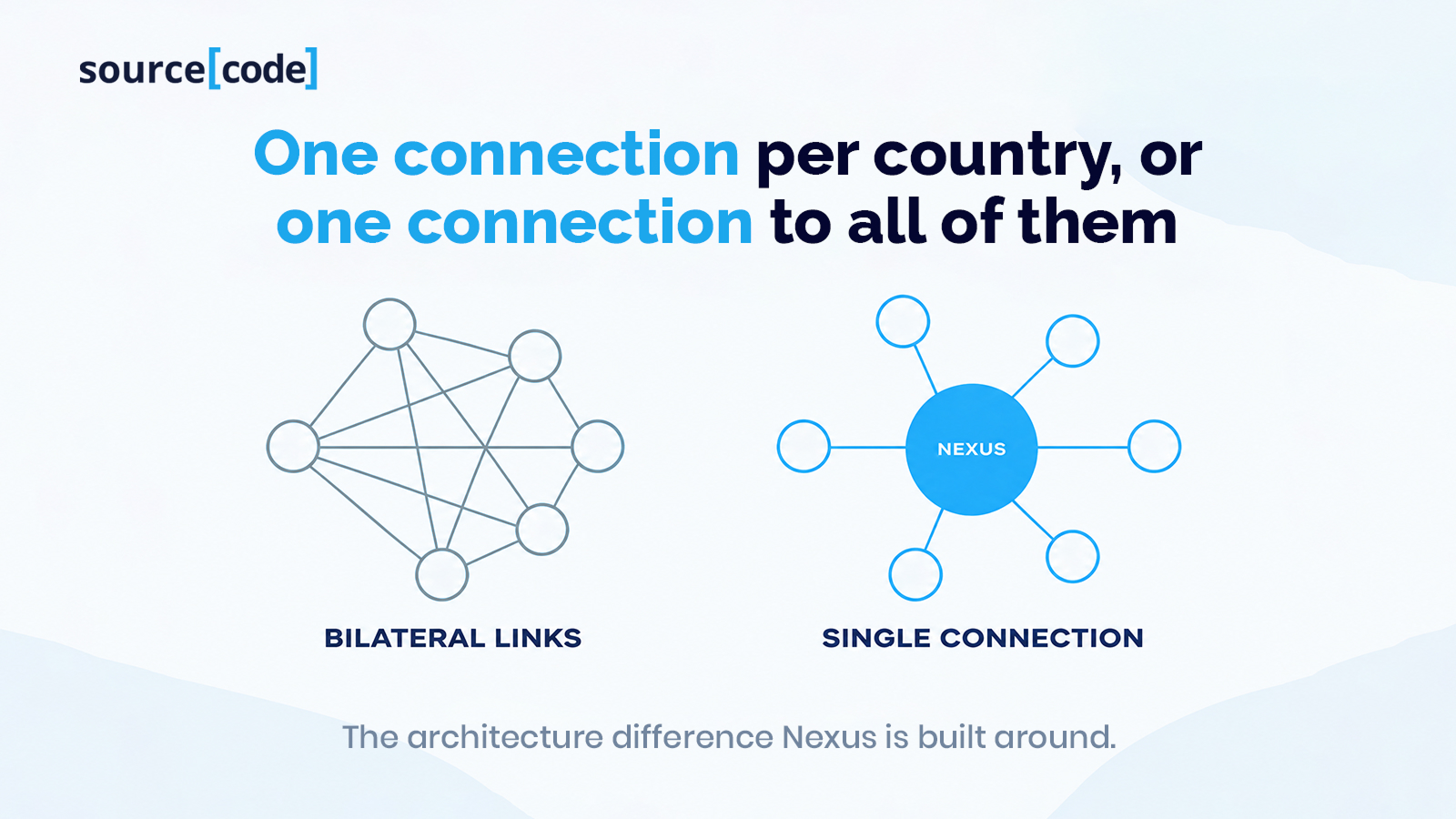 This is a genuinely different shape of integration problem than the one most bank payments architecture was built to solve. A system designed around bilateral correspondent relationships treats each new corridor as a discrete project with its own mapping, reconciliation and operational runbook - a model that scales roughly linearly with the number of corridors a bank supports. A system designed to plug into a shared multilateral rail treats the connection itself as a one-time architectural investment, after which new corridors on the same rail arrive at close to zero marginal integration cost. The economics only work in the bank's favour if the initial connection is built to the rail's actual standard rather than bolted onto an existing bilateral integration layer as one more special case. A core payments stack that currently represents every cross-border corridor as its own bespoke mapping will not become "Nexus-ready" by adding one more mapping; it will need the part of the architecture that talks to the outside world redesigned around a standardised, multilateral connection point.
The counterargument worth taking seriously
It would be a mistake to treat Nexus's institutional momentum as proof that the architecture question is settled, and a 2022 practice paper by He, Milne and Zachariadis in the Journal of Payments Strategy & Systems raises the right open question directly: it is genuinely unclear whether Nexus's proposed new business models for executing international payments will be commercially viable, and a separate, equally live question is whether international payments actually need a new operational architecture at all, versus whether incrementally improving existing correspondent banking arrangements would achieve much the same outcome at lower disruption. Three years on, with a technical operator under contract and a named onboarding year from one regulator, that scepticism has not been resolved so much as it has been overtaken by institutional commitment - six central banks do not incorporate an entity, hire a CEO and a board chair, and contract a technical build only to abandon it, but commitment at the central bank level is not the same thing as proof that commercial banks will find it economically compelling to route high volumes of retail cross-border payments through it rather than through cheaper incremental fixes to what they already run.
The practical implication is not to wait for that question to resolve before doing anything. It is to recognise that the two aspects of Nexus the 2022 paper separates - the technical messaging and standardisation layer, and the new commercial settlement architecture built on top of it - do not need to be adopted together. A bank can design its cross-border payments architecture around the standardised, multilateral connection model Nexus and comparable regional schemes are converging on, without betting the entire cross-border strategy on Nexus's specific commercial model succeeding. That is a materially different, and considerably less risky, decision than either ignoring the shift entirely or treating Nexus itself as the only possible destination.
What this means for a bank's technology roadmap
For a CTO or Head of Digital/Innovation at an APAC bank, the practical question raised by all of this is not "should we connect to Nexus specifically, and when." Most banks will reach Nexus, if at all, through their domestic instant payment system operator rather than through a direct connection of their own - the operator is the entity that connects to the network, not each individual bank. The question that does belong on a bank's own roadmap is narrower and more urgent: if the domestic instant payment system this bank already sits on connects to a shared multilateral rail on the kind of timeline the Philippines has already committed to, does the bank's own payments architecture support reaching a new corridor through that connection with no rebuild, or does every cross-border capability it currently has depend on bespoke, corridor-specific integration work that a shared-rail model was built specifically to eliminate?
Answering that question honestly, before a regulator's onboarding deadline forces the answer, is the practical value of treating this as an architecture decision rather than a vendor-selection one. It requires looking at the bank's actual cross-border payments stack - not the architecture diagram, the real integration layer - and asking whether a new corridor today is a configuration change or a development project. A bank where it is currently a development project, every time, has an architecture built for a world of bilateral links, in a region where the shared infrastructure underneath it is being built to make that model obsolete.
sourceCode's perspective
From our experience working with banks across the region on payments and core-platform architecture, this is one of the clearer cases where the technology decision and the regulatory timeline are moving in the same direction, which makes the planning window unusually well-defined rather than open-ended. We think of this as a readiness question rather than an adoption question: a bank does not need to decide today whether its own commercial strategy depends on Nexus succeeding, but it does need to know whether its current cross-border integration layer could plug into a standardised, multilateral connection point without being rebuilt from the point a domestic rail operator connects.
In practice, that is a short, structured technical review - of how cross-border corridors are currently represented in the core payments stack, what would have to change to treat a new corridor as a configuration rather than a project, and where the dependency on bespoke bilateral mapping actually lives - rather than a long transformation programme, and it is the kind of review worth doing on a regulator's building timeline, not after an onboarding date has already been set.
Conclusion
Project Nexus is not a feature a vendor will eventually bundle into a core banking platform. It is public, multilateral infrastructure that six central banks now own, govern and have put a technical operator and, in at least one member economy's case, an onboarding year against. Whether its specific commercial model ultimately proves itself against the genuine, still-open question of whether it beats incrementally improving correspondent banking is a question regulators and scheme operators will answer over the next few years, not one a bank's technology team needs to resolve today.
What a bank's technology team can and should resolve today is narrower: whether its own cross-border payments architecture is built to plug into a shared, standardised, multilateral connection, or whether it has quietly accumulated enough bespoke, bilateral integration debt that the question will answer itself, expensively, the moment a domestic rail operator's own connection comes online.
Frequently Asked Questions
What is Project Nexus? Project Nexus is a multilateral platform, incubated by the Bank for International Settlements' Innovation Hub, designed to let a country's domestic instant payment system connect once and reach every other participating country's instant payment system, rather than building a separate bilateral connection to each one.
Who currently participates in Project Nexus? Six central banks are full members as of early 2026: India (Reserve Bank of India), Malaysia (Bank Negara Malaysia), the Philippines (Bangko Sentral ng Pilipinas), Singapore (Monetary Authority of Singapore), Thailand (Bank of Thailand) and Indonesia (Bank Indonesia), which moved from special-observer status to full membership in February 2026. The European Central Bank and Latin America's FLAR are separately exploring future connectivity.
Is Project Nexus live yet? No. As of early-to-mid 2026, the platform is in its build-and-test phase under a newly appointed Technical Operator (a joint venture of Malaysia's PayNet and Singapore's NETS). Bangko Sentral ng Pilipinas has stated it has agreed a target onboarding timeline for mid-2027.
How is connecting to Nexus different from existing cross-border payment integrations? Instead of an instant payment system operator - and the banks on it - building a bespoke bilateral connection for each new country corridor, the operator makes a single standardised connection to Nexus, using common APIs and ISO 20022 message specifications, and that one connection extends to every other country already in the network.
Is Nexus guaranteed to succeed commercially? No. A 2022 academic analysis published in the Journal of Payments Strategy & Systems raised a genuine open question about whether Nexus's proposed new international-payments business models will be commercially viable compared with incrementally improving existing correspondent banking arrangements. That question remains unresolved even as the institutional build-out has continued, which is why banks are better served treating the underlying standardisation and connection model as the relevant architecture decision, rather than betting their entire cross-border strategy on Nexus's specific commercial outcome.
Reference List
Bangko Sentral ng Pilipinas, reported in Manila Bulletin (2026) Philippines Nears Seamless Cross-Border Payments With Project Nexus Link. 3 March 2026. Available at: https://mb.com.ph/2026/03/03/philippines-nears-seamless-cross-border-payments-with-project-nexus-link (Accessed: 16 November 2026).
Bank for International Settlements (2024) Project Nexus Completes Comprehensive Blueprint for Connecting Domestic IPSs Globally. Media release, 1 July 2024, reported via Monetary Authority of Singapore. Available at: https://www.mas.gov.sg/news/media-releases/2024/project-nexus-completes-comprehensive-blueprint-for-connecting-domestic-ipses-globally (Accessed: 16 November 2026).
Bank for International Settlements (2026) Project Nexus: Enabling Instant Cross-Border Payments. BIS Innovation Hub project page. Available at: https://www.bis.org/about/bisih/topics/fmis/nexus.htm (Accessed: 16 November 2026).
Bank Indonesia (2026) Strengthening Cross-Border Payment Linkages, BI Joins Project Nexus. Press release No. 28/24/DKom, 2 February 2026. Available at: https://www.bi.go.id/en/publikasi/ruang-media/news-release/Pages/sp_282426.aspx (Accessed: 16 November 2026).
Bank Negara Malaysia (2024) Project Nexus Completes Comprehensive Blueprint for Connecting Domestic Instant Payment Systems Globally. Press release, 1 July 2024. Available at: https://www.bnm.gov.my/-/nxs-pr (Accessed: 16 November 2026).
He, C., Milne, A. and Zachariadis, M. (2022) 'The Nexus international payments platform: Is it business-model viable?', Journal of Payments Strategy & Systems, 16(3), pp. 219-230. Available at: https://hstalks.com/article/7237/the-nexus-international-payments-platform-is-it-bu/ (Accessed: 16 November 2026).
Kapronasia (2025) From Experiment to Execution: Nexus Global Payments Enters the Operational Era. 7 April 2025. Available at: https://kapronasia.com/insight/blogs/payments-research/asia-payments-research/from-experiment-to-execution-nexus-global-payments-enters-the-operational-era (Accessed: 16 November 2026).
Nexus Global Payments (2026) Media and News, including 'Nexus Global Payments Appoints Technical Operator' (9 February 2026) and 'Nexus Global Payments Appoints First Board Chair and Expands Network With the Addition of Indonesia' (2 February 2026). Available at: https://nexusglobalpayments.org/media/ and https://nexusglobalpayments.org/about-nexus/ (Accessed: 16 November 2026).
PYMNTS (2026) Interoperability Now Drives Asia-Pacific's Real-Time Payments Agenda. 2 September 2026. Available at: https://www.pymnts.com/real-time-payments/2026/interoperability-now-drives-asia-pacifics-real-time-payments-agenda/ (Accessed: 16 November 2026).