Key Takeaways
- On 17 April 2026, the US Federal Reserve, OCC and FDIC jointly issued SR 26-2, a revised interagency Supervisory Guidance on Model Risk Management that updates the 2011-era framework (SR 11-7) for institutions with US$30 billion or more in total assets.
- The revised guidance is lighter, not heavier, on vendor models than the original - it drops the explicit expectation of contingency plans for third-party models and instead asks institutions to "develop an understanding" of the model plus ongoing monitoring and outcome analysis. It also formally excludes generative and agentic AI models from the guidance's scope, describing them as "novel and rapidly evolving," while flagging a forthcoming request for information (RFI) that will address AI-specific model risk directly.
- This is a US rule for US banks above a specific asset threshold. It is not binding in APAC or the Gulf. The relevant signal for Gulf and APAC risk leaders is directional, not legal: it shows how a mature prudential regulator is thinking about the boundary between "model" and "AI system," and where it has chosen, for now, not to draw a hard line.
- APAC and Gulf regulators are not simply trailing the US on a lag. Singapore's MAS (AI risk management guidelines, finalised October 2026, effective October 2027), Hong Kong's HKMA (ART Framework, October 2026) and the UAE's CBUAE (financial-sector AI guidance note) are each moving on AI-specific governance in parallel, and in some respects ahead of the narrower US model-risk update.
- The practical gap most Gulf and APAC lenders need to close is not regulatory - it is internal: vendor-sourced and agentic credit-scoring tools are routinely validated less rigorously than in-house models, on the assumption that a vendor's claims about its own methodology substitute for independent scrutiny. sourceCode's recommended starting point is a Vendor Model Equivalence Test, defined below.
Introduction: Why This Matters Now, Even Outside the US
Every major prudential regulator eventually has to answer the same question: when a lender buys a credit decision instead of building it, does that decision get the same scrutiny as one the bank built itself? For fifteen years, the US answer was set out in SR 11-7 (2011), and most APAC and Gulf supervisors absorbed its logic - conceptual soundness, independent validation, ongoing monitoring - into their own expectations, often with a multi-year lag.
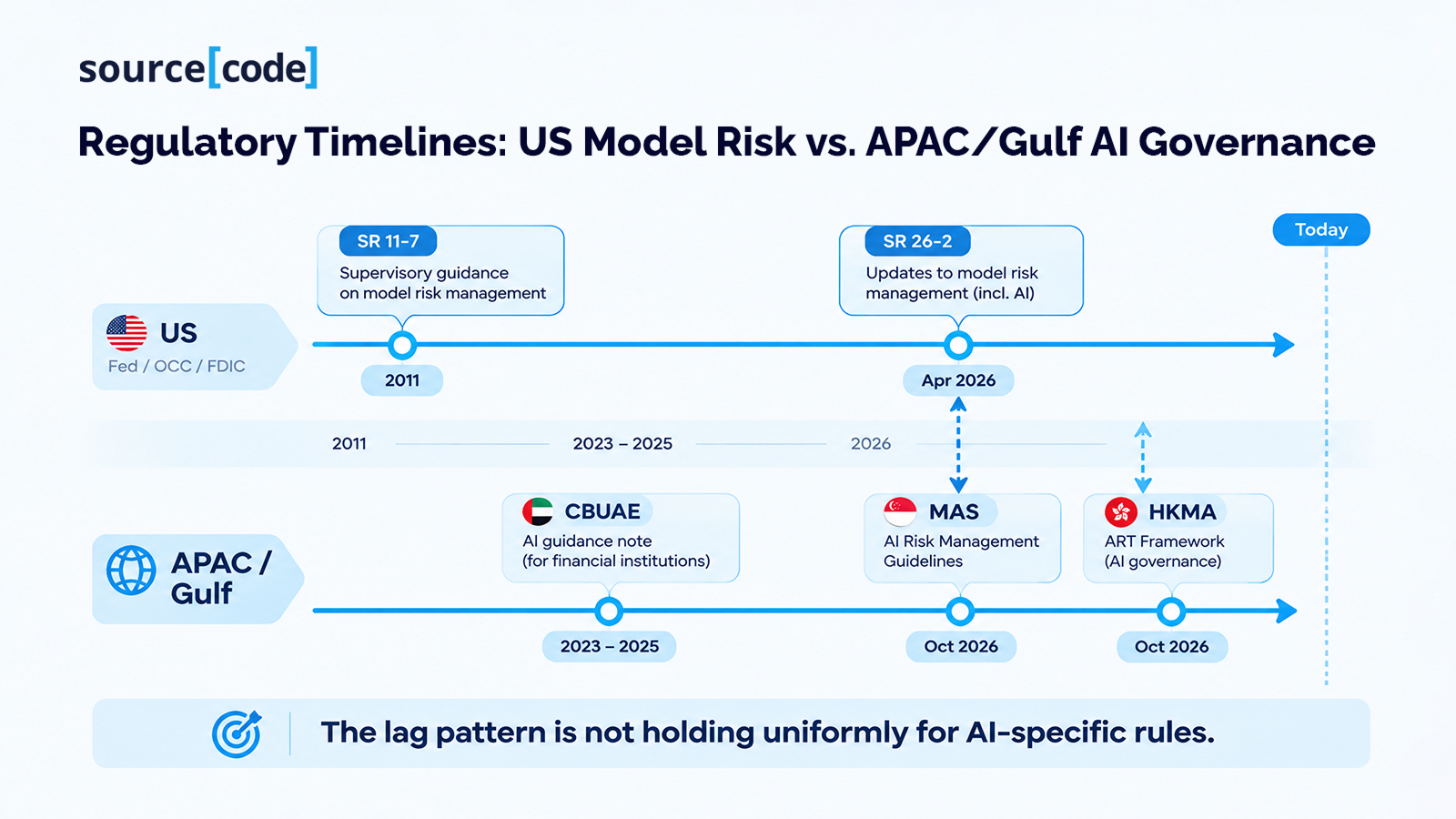
In April 2026, the three US banking agencies revisited that answer for the AI era. The result, SR 26-2, is genuinely newsworthy for risk and credit leaders outside the US - not because it creates any obligation for a bank in Riyadh, Singapore or Sydney, but because it shows how a sophisticated regulator, under real industry pressure, chose to handle vendor models and agentic AI when forced to decide. It chose a narrower model definition, a lighter vendor standard, and an explicit, temporary carve-out for generative and agentic AI, paired with a signal that more specific rules are coming.
For Gulf and APAC lenders already running AI-assisted or AI-sourced credit decisioning, that combination - lighter current obligations, explicit future scrutiny - is the more useful signal than the headline "the US has extended model risk rules to AI." It has not, yet, for agentic systems specifically. But it has told the market exactly where its attention is going next, and vendor-sourced credit models are named directly as a focus area within what SR 26-2 does cover.
This article sets out what SR 26-2 actually says, why vendor and agentic AI credit models have historically escaped validation rigour even where governance frameworks exist, where Gulf and APAC institutions are most exposed, and a practical framework - the Vendor Model Equivalence Test - for closing that gap before a local regulator forces the issue.
What Actually Changed in US Model Risk Guidance, and Why the Detail Matters
Based on a review of the Sullivan & Cromwell client memo analysing the joint agency action (Sullivan & Cromwell, 2026), SR 26-2 made four changes relevant to credit risk and AI:
- A narrower model definition. The revised guidance limits "model" to complex quantitative methods, explicitly excluding simple spreadsheet arithmetic and deterministic rule-based processes that lack an underlying theoretical basis. This matters because it removes ambiguity that previously let institutions classify borderline decision tools either way, often to their advantage.
- A lighter standard for vendor and third-party models. SR 11-7 had pushed institutions toward contingency planning and deep technical scrutiny of purchased models. SR 26-2's "sound practice," per the Sullivan & Cromwell analysis, is to develop an understanding of the model, combined with ongoing monitoring and outcomes analysis - a materially less prescriptive bar, and one that does not explicitly require contingency plans for vendor dependency. For institutions with heavy reliance on third-party credit-scoring vendors, this is the single most consequential line in the revision, and not in the direction most industry commentary has assumed.
- An explicit, temporary exclusion for generative and agentic AI. The agencies describe these systems as "novel and rapidly evolving" and keep them outside the formal scope of SR 26-2, while still applying the guidance to non-generative, non-agentic AI used in modelling. Crucially, the agencies also state that institutions should apply their broader risk management and governance practices to the excluded tools regardless - supervisory language for "you are not off the hook, we just haven't written the specific rule yet." A request for information covering AI, including generative and agentic AI, in model risk management has been flagged as the next step.
- A US$30 billion asset threshold, applied uniformly across the Fed, OCC and FDIC, and a statement that the guidance itself "does not set forth enforceable standards or prescriptive requirements" - consistent with its character as supervisory guidance rather than binding regulation.
A number of secondary commentaries, including a vendor blog from AI-evaluation company Openlayer (Openlayer, 2026), characterise SR 26-2 as extending validation rigour to vendor and agentic AI models outright. Based on the primary legal analysis available, that characterisation overstates the position on agentic AI specifically: the guidance carves those systems out for now, rather than bringing them in. Readers relying on vendor summaries of regulatory text should treat that distinction as material, and risk teams should verify the primary Federal Reserve, OCC and FDIC releases directly before building internal policy on any secondary account, including this one.
Why Vendor and Agentic AI Credit Models Have Escaped Validation Rigour
This gap is not new, and it is not unique to any one jurisdiction. Three structural reasons explain it:
Opacity gets mistaken for a waiver. When a vendor will not disclose full methodology - citing IP protection - risk teams often treat that as a reason to validate less, rather than a reason the model needs a different validation approach (behavioural testing, outcome analysis, challenger models). SR 26-2's own "develop an understanding of the model" standard, properly read, requires the former. In practice, most institutions default to the latter.
Procurement and model risk operate on different clocks. A vendor credit-scoring tool is bought through a commercial procurement process, often before the model risk function is in the room. By the time validation requirements are raised, the commercial relationship - and sometimes the production deployment - is already committed, and validation becomes a compliance formality layered onto a decision already made.
Agentic systems don't map to the old unit of analysis. Model risk frameworks were built to validate a model: an input-output function with a known shape. An agentic credit workflow - one that retrieves data, selects which sub-model or rule to apply, and sequences several decisions - doesn't present as a single model to validate. Several regulators are now responding to exactly this mismatch directly rather than through the existing model-risk lens: the HKMA's ART Framework (Hong Kong Monetary Authority, via Fintech Global, 2026) includes a planned discussion paper on agentic AI governance covering "intent-anchored accountability" and a registry of material AI agents - a different governance unit entirely from traditional model validation.
The Vendor Model Equivalence Test: A Decision Framework
Definition: The Vendor Model Equivalence Test is a structured self-assessment that asks whether a third-party or agentic AI credit model is subject to the same validation rigour - independent review, outcomes analysis, ongoing monitoring, and documented override rationale - that the institution would require of an equivalent model built in-house. If the answer is no for any dimension, the gap is a model risk exposure, not a vendor relationship issue, and it should be escalated and remediated on that basis.
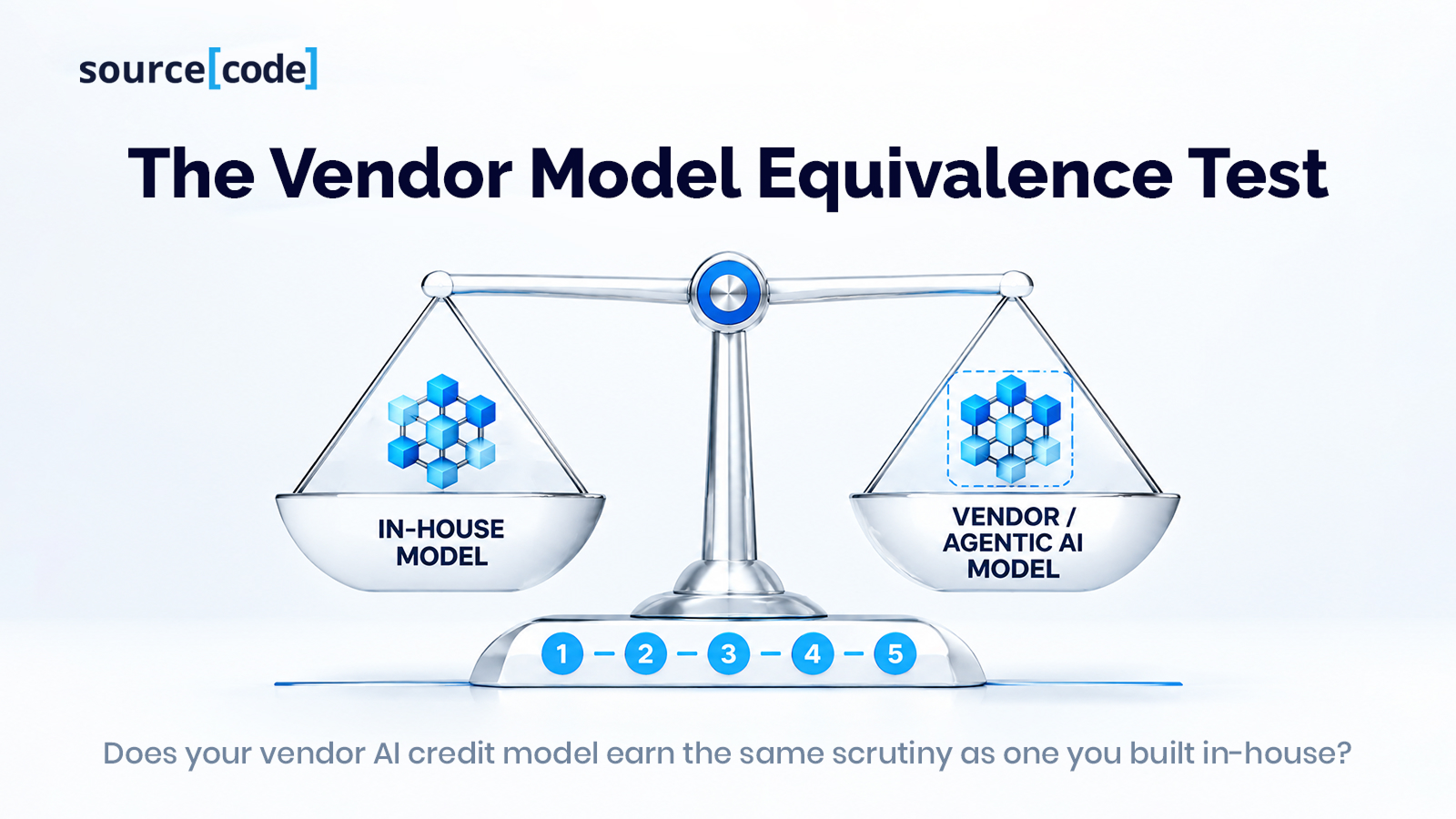
The test has five questions a risk or credit committee can answer in a single workshop:
- Independent validation - Has someone outside the model's development and sales chain (vendor or internal product team) reviewed its conceptual soundness, not just its output accuracy?
- Outcomes analysis - Is the model's real-world performance on your own portfolio tracked against defined thresholds, on a cadence equivalent to an in-house model, rather than relying on vendor-supplied performance claims?
- Explainability under stress - Can your credit team explain, to an auditor or ombudsman, why this specific applicant was declined or approved, without saying "the vendor's model said so"?
- Agentic traceability - If any part of the decision path involves an AI agent selecting data sources, sub-models or next actions, can you reconstruct that sequence after the fact, not just the final score?
- Change control - Do you know when the vendor last retrained or materially changed the model, and did that change trigger your own re-validation, or did you find out from a release note?
A credit model that fails two or more of these questions is, in substance, operating as an unvalidated exception - regardless of what any local regulation currently requires.
What Most Gulf and APAC Lenders Get Wrong
The most common error is treating "vendor-sourced" and "lower risk" as synonymous, on the theory that a specialist vendor's model has been battle-tested across many clients. That may be true of the vendor's engineering; it says nothing about how the model performs on your specific portfolio, your specific population, and your specific definition of default. SR 26-2's own retained standard - outcomes analysis - exists precisely because model performance is portfolio-specific, not a property of the vendor's brand.
The second error is sequencing: waiting for a local regulator (BNM, SAMA, CBUAE, MAS, HKMA, APRA or others) to publish explicit AI-model-risk rules before building internal capability. Regulatory lag between the US and APAC/Gulf jurisdictions has historically run two to five years for model-risk-adjacent guidance, but - as this analysis shows - that lag pattern is not holding uniformly for AI governance specifically. MAS, HKMA and CBUAE are each already active in this space, on their own timelines, independent of what the US does with agentic AI. An institution that waits for a formal local mandate on vendor AI credit model validation may find the mandate arrives with a shorter compliance runway than it assumes, precisely because the regulator has been building domain expertise in parallel rather than waiting its turn.
A Genuine Counterargument: The Risk of Over-Importing US Rigour
It would be a mistake to read this article as "adopt SR 11-7/SR 26-2 wholesale." Three caveats matter:
First, SR 26-2 itself is explicitly non-prescriptive guidance for large US institutions, built around a US$30 billion threshold and a US supervisory culture of consent orders and examination cycles. Transplanting its specific mechanics into a Gulf or APAC institution without adapting to local portfolio composition, data availability and regulatory relationship norms risks building expensive process theatre rather than genuine risk reduction.
Second, the guidance's own author agencies chose, deliberately, not to extend full model-risk rigour to generative and agentic AI yet, judging the technology too immature for prescriptive rules. An institution that over-applies validation bureaucracy to every agentic tool, ahead of its own regulator and ahead of the US agencies that wrote the playbook, may slow legitimate AI adoption without a commensurate risk reduction, especially for lower-materiality use cases.
Third, local nuance is not optional. A validation standard calibrated to US consumer credit data, US fair-lending case law and US model documentation conventions does not transfer cleanly to, for example, Shariah-compliant financing structures, thin-file populations common in several APAC and Gulf lending markets, or jurisdictions where credit bureau data coverage is materially different from the US. The right response to SR 26-2 is not imitation; it is using it as a forcing function to ask the five equivalence-test questions in your own context, with your own data.
Business and Governance Implications for Risk and Credit Leaders
For risk and credit committees, three implications follow directly:
Governance ownership has to move earlier. Model risk functions need a seat in vendor AI procurement before contracts are signed, not after deployment. SR 26-2's lighter vendor standard does not reduce this urgency - the "develop an understanding of the model" bar still requires technical access and documentation commitments that are far easier to negotiate before signature than after.
Agentic AI needs its own governance lane, not a forced fit into model validation. Following the direction several regulators (notably HKMA) are already taking, institutions should build a register of agentic AI tools used in credit decisioning, separate from the traditional model inventory, tracking decision-sequence traceability rather than only output accuracy.
Documentation discipline is now a competitive asset, not just a compliance cost. An institution that can walk an auditor, a board risk committee or an ombudsman through exactly how a vendor-sourced credit decision was reached - using the equivalence-test evidence base - will clear regulatory review faster than a peer relying on vendor assurances, regardless of which specific rule eventually applies locally.
From sourceCode's Perspective
In our experience working inside BFSI technology environments across APAC and the Gulf, the gap this article describes is rarely a capability gap - most institutions we work with have competent model risk teams. It is a sequencing and ownership gap: AI and vendor credit tools get adopted through product, data or digital transformation workstreams that run faster than the model risk function's engagement cycle, and validation gets retrofitted rather than designed in.
We see this most acutely in environments running hybrid delivery - part internal team, part vendor platform, increasingly part AI agent - where no single function owns end-to-end traceability of a credit decision. The institutions that handle this well are the ones that treat model risk governance as a delivery-engineering problem as much as a compliance one: traceability, change control and explainability built into the technical architecture of the AI system itself, not bolted on afterward as a validation report.
That is the lens we bring when we work alongside risk and technology teams on AI-enabled credit and lending platforms - building the governance into the delivery, not auditing it after the fact.
Conclusion
SR 26-2 is real, significant, and narrower than most secondary commentary suggests: it lightens, rather than tightens, the formal standard for vendor models, and it explicitly defers full treatment of generative and agentic AI to a future rulemaking process. For Gulf and APAC lenders, the direct regulatory relevance is limited - this is a US rule with a US asset threshold. The indirect relevance is substantial: it shows where a leading prudential regulator's attention is going next, at the same moment that MAS, HKMA and CBUAE are independently building AI-specific governance regimes of their own, on their own schedules.
The institutions best positioned, whichever regulator moves first and whatever it eventually requires, will be the ones that have already answered the Vendor Model Equivalence Test honestly for every AI-assisted credit decision in production today.
What Leaders Should Do Next
- Run the Vendor Model Equivalence Test against every vendor-sourced or agentic AI tool currently used in credit or lending decisions, and treat any two-or-more failure as an open risk item, not a vendor management note.
- Build a separate inventory for agentic AI tools used in credit workflows, tracking decision-sequence traceability alongside output accuracy.
- Bring model risk or validation capability into AI vendor procurement before contract signature, with explicit technical-access and documentation clauses.
- Track MAS, HKMA, CBUAE and your primary local regulator's AI-specific publications directly, rather than assuming US guidance timing predicts local timing.
Run a Vendor Model Equivalence self-assessment with sourceCode's risk and delivery team to find out where your vendor-sourced and agentic AI credit models stand before a regulator asks.
FAQ
What is SR 26-2? SR 26-2 is revised interagency Supervisory Guidance on Model Risk Management, jointly issued by the US Federal Reserve, OCC and FDIC on 17 April 2026, updating the 2011 model risk framework (SR 11-7) for US institutions with US$30 billion or more in total assets.
Does SR 26-2 apply to banks in APAC or the Gulf? No. SR 26-2 is US supervisory guidance that applies only to covered US institutions. It is not binding in APAC or the Gulf, and it is not enforceable regulation even in the US - the agencies describe it as guidance, not prescriptive rules. Its relevance to APAC and Gulf lenders is as a directional signal, not a compliance obligation.
Does SR 26-2 cover generative and agentic AI? Not directly. The guidance explicitly excludes generative and agentic AI models from its formal scope, describing them as novel and rapidly evolving, while encouraging institutions to apply broader risk governance to those tools anyway. The agencies have signalled a forthcoming request for information that will address AI-specific model risk, including generative and agentic AI, more directly.
Does SR 26-2 make vendor model validation stricter? Based on available legal analysis, SR 26-2 is lighter than the original 2011 guidance on vendor models. It replaces more prescriptive contingency-planning expectations with a standard of developing an understanding of the model, combined with ongoing monitoring and outcomes analysis.
What is the Vendor Model Equivalence Test? It is a five-question self-assessment - covering independent validation, outcomes analysis, explainability, agentic traceability and change control - that tests whether a vendor-sourced or agentic AI credit model receives the same validation rigour as an equivalent model built in-house.
Are APAC and Gulf regulators behind the US on AI model risk? Not uniformly. While historical model-risk guidance has often followed the US with a multi-year lag, Singapore's MAS, Hong Kong's HKMA and the UAE's CBUAE have each published AI-specific governance guidance in 2025-2026 on their own timelines, in some respects moving on agentic AI governance ahead of the narrower, more cautious US position under SR 26-2.
What should a Gulf or APAC bank's risk team do now? Run the Vendor Model Equivalence Test against current AI-assisted credit tools, bring model risk capability into AI vendor procurement earlier, build a separate governance inventory for agentic AI tools, and monitor local regulator publications directly rather than assuming US timing applies locally.
Reference List
Baker McKenzie (2026) Singapore MAS issues Guidelines on Artificial Intelligence Risk Management. Available at: https://www.bakermckenzie.com/en/insight/publications/2026/10/singapore-mas-issues-guidelines-on-artificial-intelligence-risk-management (Accessed: 2 November 2026).
Bank for International Settlements (2024) Artificial intelligence in central banking, BIS Bulletin No. 84. Available at: https://www.bis.org/publ/bisbull84.htm (Accessed: 2 November 2026).
Central Bank of the UAE (2026) CBUAE issues guidance note to protect consumers and ensure responsible use of artificial intelligence in the financial sector. Available at: https://www.centralbank.ae/en/news-and-publications/news-and-insights/press-release/cbuae-issues-guidance-note-to-protect-consumers-and-ensure-responsible-use-of-artificial-intelligence-in-the-financial-sector/ (Accessed: 2 November 2026).
Federal Deposit Insurance Corporation (2017) Financial Institution Letter FIL-17-022: Adoption of Supervisory Guidance on Model Risk Management. Available at: https://www.fdic.gov/news/financial-institution-letters/2017/fil17022.pdf (Accessed: 2 November 2026).
Fintech Global (2026) HKMA's ART framework sets rules for agentic AI in banking. Available at: https://fintech.global/2026/10/23/hkmas-art-framework-sets-rules-for-agentic-ai-in-banking/ (Accessed: 2 November 2026).
Monetary Authority of Singapore (2026) Guidelines on Artificial Intelligence Risk Management for Financial Institutions. Available at: https://www.mas.gov.sg/regulation/guidelines/guidelines-on-artificial-intelligence-risk-management-for-financial-institutions (Accessed: 2 November 2026).
Openlayer (2026) SR 26-2 Explained: 2026 Model Risk Management Updates for AI. Available at: https://www.openlayer.com/blog/post/sr-26-2-mrm-guide-ai-teams (Accessed: 2 November 2026). [Vendor commentary; characterisations of regulatory scope should be verified against primary agency text and the legal analysis cited above.]
Sullivan & Cromwell LLP (2026) OCC, Fed, FDIC Issue Revised Guidance on Model Risk Management. Available at: https://www.sullcrom.com/insights/memo/2026/April/OCC-Fed-FDIC-Issue-Revised-Guidance-Model-Risk-Management (Accessed: 2 November 2026).