Key Takeaways
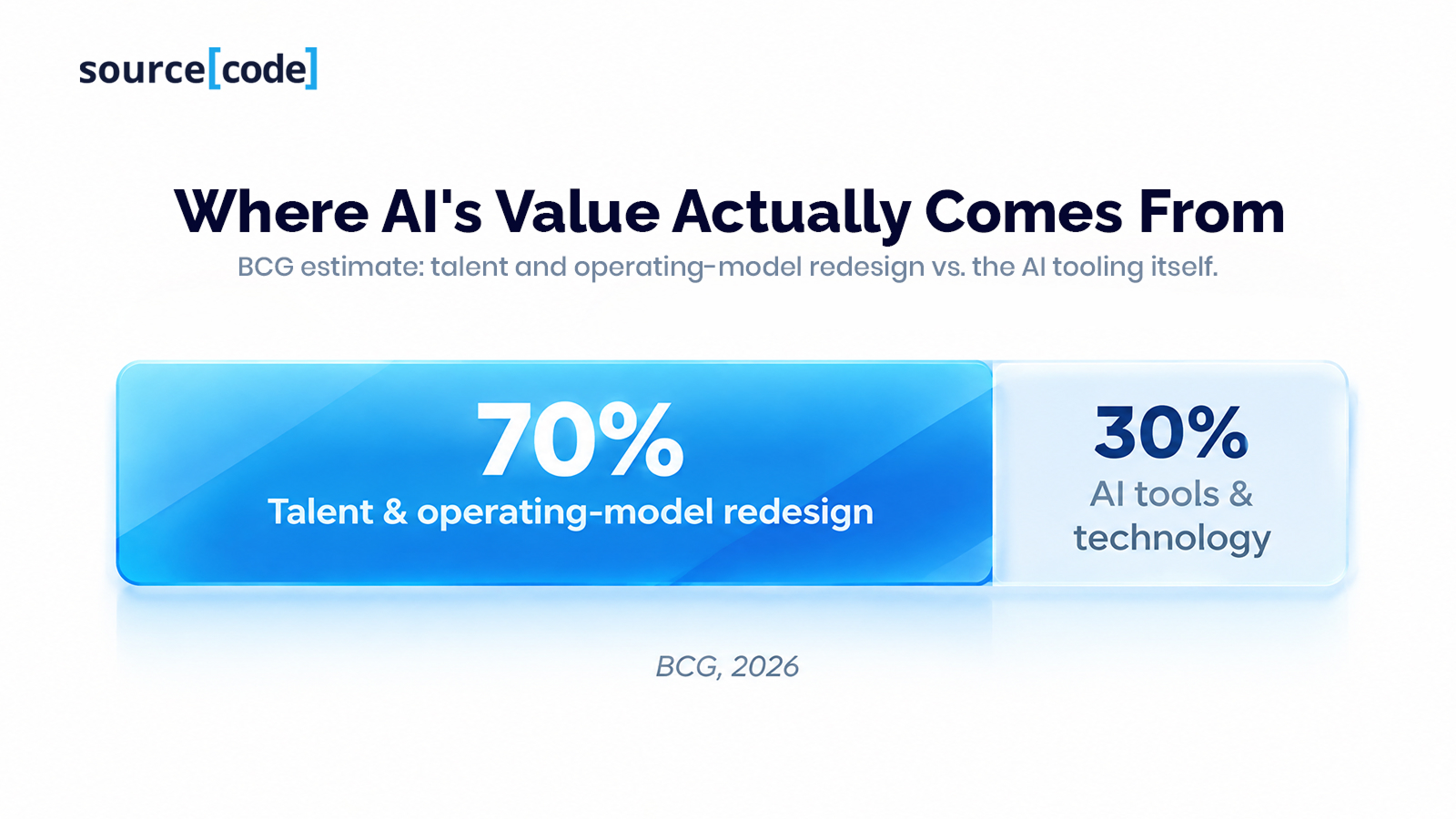
- BCG's 2026 analysis of insurance AI adoption estimates that roughly 70% of AI's potential value comes from redesigning talent and operating models around it, while only about 30% comes from the AI tooling itself - yet most insurance AI delivery roadmaps are still built almost entirely around the 30%.
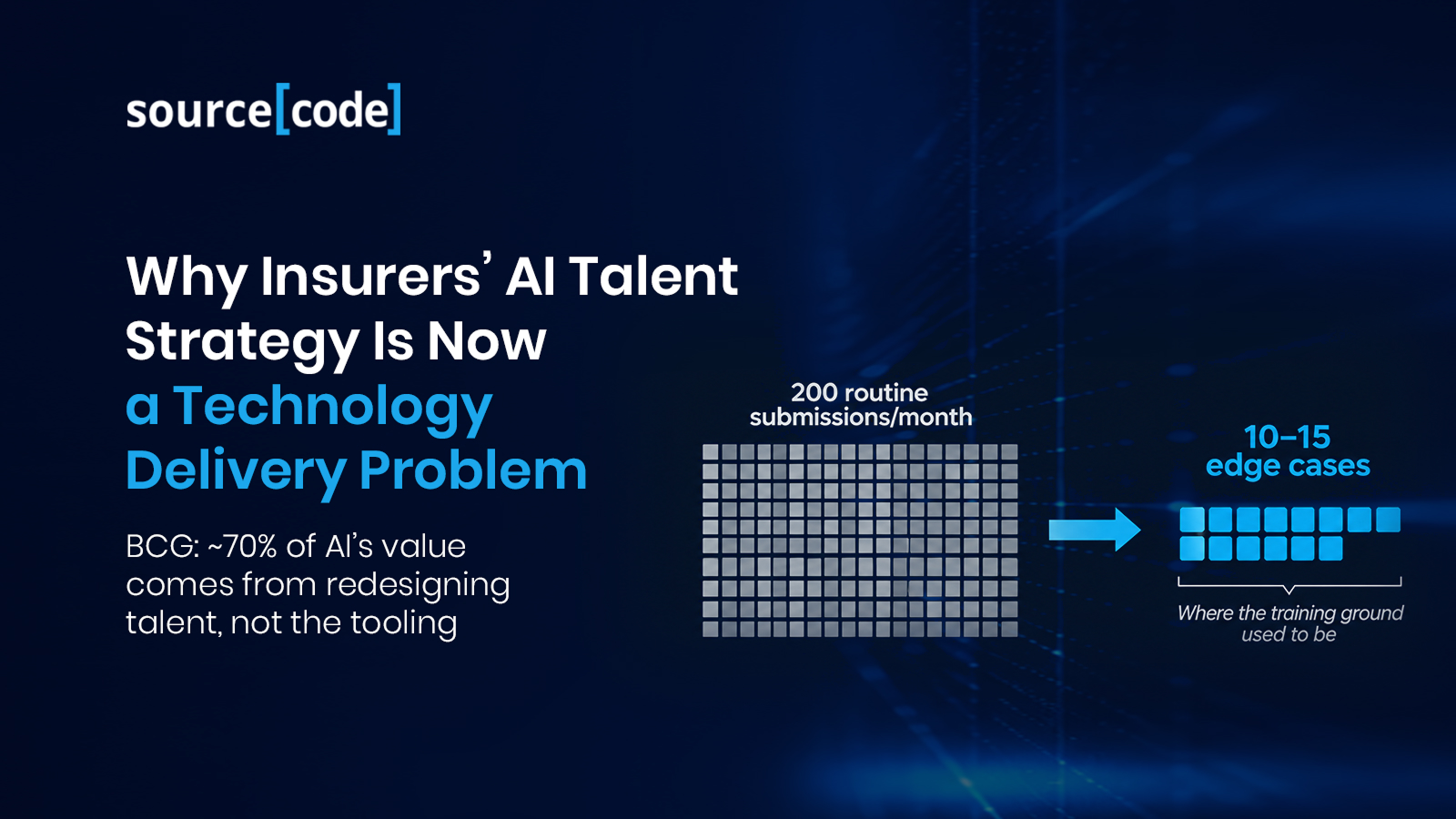
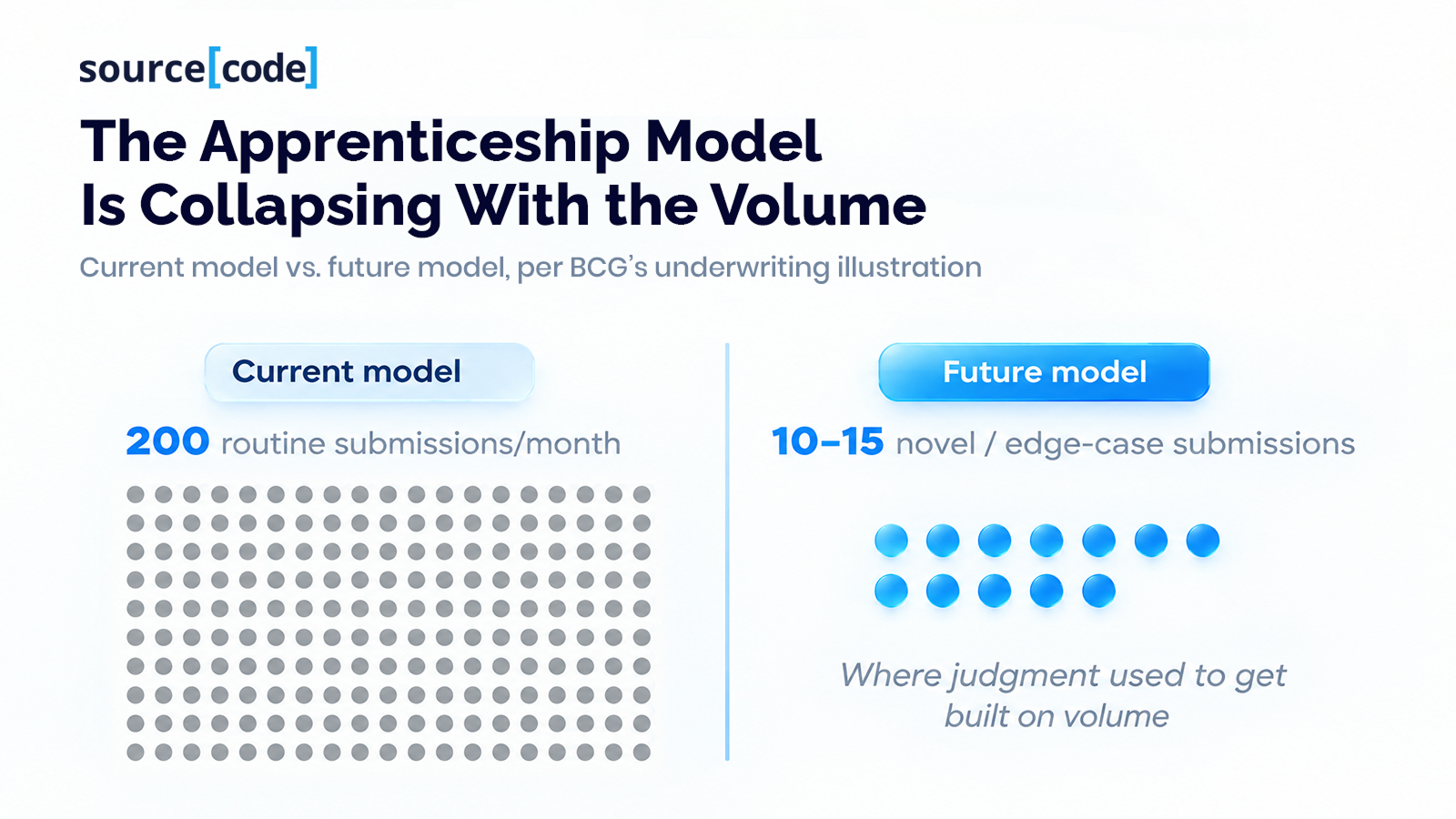
- The shift BCG describes is not incremental. An underwriter who once reviewed 200 routine submissions a month moves toward reviewing 10 to 15 genuinely novel or ambiguous ones - collapsing the apprenticeship model that trained the next generation of senior underwriters on volume.
- This creates a structural paradox: expertise becomes more valuable at exactly the moment it becomes harder to build, because the routine casework that once trained junior staff is the first thing AI automates.
- The pressure is already visible in hiring data. Australian insurers increased training investment sharply in 2026 (68%, up from 48% the year before), even as the traditional graduate intake model that assumed years of repetitive casework is visibly breaking down.
- Closing the gap is a delivery decision, not an HR initiative - it has to be designed into the AI implementation itself, through an explicit model for which decisions stay human, which become AI-assisted, and which can be safely automated. We call this the Judgment Allocation Model.
Introduction
Most insurance AI business cases are built the same way. A task is identified, the hours it currently takes are estimated, a loaded cost rate is applied, and the resulting saving is presented as the return on the AI investment. It is a clean calculation, and it is also, according to the Boston Consulting Group's most recent analysis of AI adoption in insurance, measuring roughly 30% of the actual opportunity.
BCG's July 2026 report on insurance talent models puts a specific number on the imbalance: by its estimate, roughly 70% of AI's potential value comes from change management, adoption, and the redesign of talent and operating models, while only 30% comes from the AI tools and technology themselves (Bellizia et al., 2026). The firm's conclusion is blunt - AI strategy cannot be separated from talent strategy. For an industry that has spent the past two years building AI business cases almost entirely around tooling, procurement, and technical integration, that is an uncomfortable reallocation of where the value, and the work, actually sits.
This matters specifically for technology delivery teams, not just HR. A delivery roadmap that successfully ships an AI underwriting assistant or claims triage engine but leaves the underlying role structure, review paths, and training pipeline untouched has, on BCG's own estimate, captured less than a third of the value it set out to create - and in the process, created a workforce problem the original business case never accounted for.
The 70/30 split insurance AI business cases keep getting backwards
The reason this split is easy to miss is that the 30% is the part everyone can see and price. Licensing costs, integration effort, model accuracy, implementation timelines - these show up in a vendor proposal and a project plan. The 70% is diffuse by comparison: it is the redesign of what underwriters, claims handlers, and actuaries actually spend their time on; the collapse of old review hierarchies; the new question of who is accountable when an AI-assisted decision is wrong; and the loss of a training ground that, until now, nobody had to design deliberately because volume did it automatically.
BCG frames this using a medical analogy that is worth sitting with: the shift resembles the difference between general practice and emergency medicine. A general practitioner sees a high volume of low-complexity cases and builds judgment gradually across thousands of routine encounters. An emergency physician sees a lower volume of higher-stakes, higher-ambiguity cases, where the cost of a wrong call is immediate and the training pathway to get there looks nothing like general practice. Insurance underwriting, in BCG's reading, is moving from the first model toward something closer to the second - and most insurers are still staffing, training, and promoting people as though the first model is permanent.
What actually changes: from 200 submissions to 10 or 15 edge cases
BCG's own illustration of the shift is specific. In the current model, an underwriter might review 200 straightforward submissions each month. In the future model BCG describes, that same underwriter instead focuses on 10 or 15 cases involving novel exposures and unusual characteristics - the ones AI cannot confidently price (Bellizia et al., 2026). The volume disappears into straight-through processing; what remains is concentrated, harder, and more consequential.
The same pattern shows up in claims. AI increasingly manages triage and fraud detection in clear-cut cases, which frees claims handlers to focus on negotiated settlements, policy ambiguities, and litigation scenarios - again, fewer cases, but each one carrying more weight (Bellizia et al., 2026). In both functions, BCG describes the net effect as a collapse of the apprenticeship model: the routine, lower-stakes work that used to be where junior staff built pattern recognition over several years is precisely the work being automated first.
BCG does not treat this as a simple efficiency win. It names a specific consequence worth taking seriously: human work becomes more intense, concentrated on exactly the cases with the least precedent to lean on, which "can breed decision fatigue, judgment inconsistency, and burnout" (Bellizia et al., 2026). Errors, meanwhile, will occur less frequently - but when they do occur, their impact will be broader and harder to contain, because fewer human touchpoints mean each one carries more downstream exposure. An after-action review culture built for a high-volume, low-stakes error pattern is not equipped for a low-volume, high-severity one.
The structural paradox no one is pricing into the business case
Put together, this produces what BCG calls a structural paradox: expertise becomes more valuable at the very time it becomes harder to build (Bellizia et al., 2026). The routine casework that used to teach junior underwriters how pricing, risk selection, and exceptions actually work in practice is the first thing automated - which means the pipeline that reliably produced senior underwriters five or ten years from now is quietly narrowing, even as the organisation needs those senior judgment calls more than ever on the cases AI can't resolve.
This is not a hypothetical concern for the industry. Insurance Business's August 2026 reporting on the Australian market found that the graduate hiring model built around years of repetitive, process-driven tasks is already breaking down, with insurers lifting training investment sharply in response - 68% of Australian insurers increased training investment in 2026, up from 48% the year before (Libatique, 2026). The same reporting cites PwC's 2026 Global AI Jobs Barometer finding that "professionalised" roles are growing twice as fast as "democratised" roles globally, with the most AI-exposed junior roles now roughly seven times more likely to require senior-level skills than before - a direct, measurable sign that the entry-level rungs of the career ladder are being redefined, not simply thinned out (Libatique, 2026). As one Australian insurer's graduate talent lead put it, the skills graduates now need are "about knowing how to work alongside AI and apply human skills of communication, adaptability, and critical thinking" rather than the volume-based pattern recognition the old model assumed (Libatique, 2026).
None of this is new in direction - McKinsey was already describing rising demand for digital and analytical skills in insurance underwriting and claims back in 2020, well before the current generative AI wave (Catlin et al., 2020). What has changed is the pace and the mechanism: AI is not simply shifting task mix at the margins, it is removing the specific volume of routine work that previously functioned, almost by accident, as the industry's training infrastructure.
Introducing the Judgment Allocation Model
BCG's analysis is unambiguous that talent redesign has to happen, and it offers useful analogies - general practice versus emergency medicine, an air traffic control tower as a model for oversight - but it stops short of a structured way to decide, role by role and decision by decision, where the line actually sits. That is the practical gap a delivery partner has to help close, because it determines how the AI system itself gets built, not just how the org chart gets redrawn afterward.
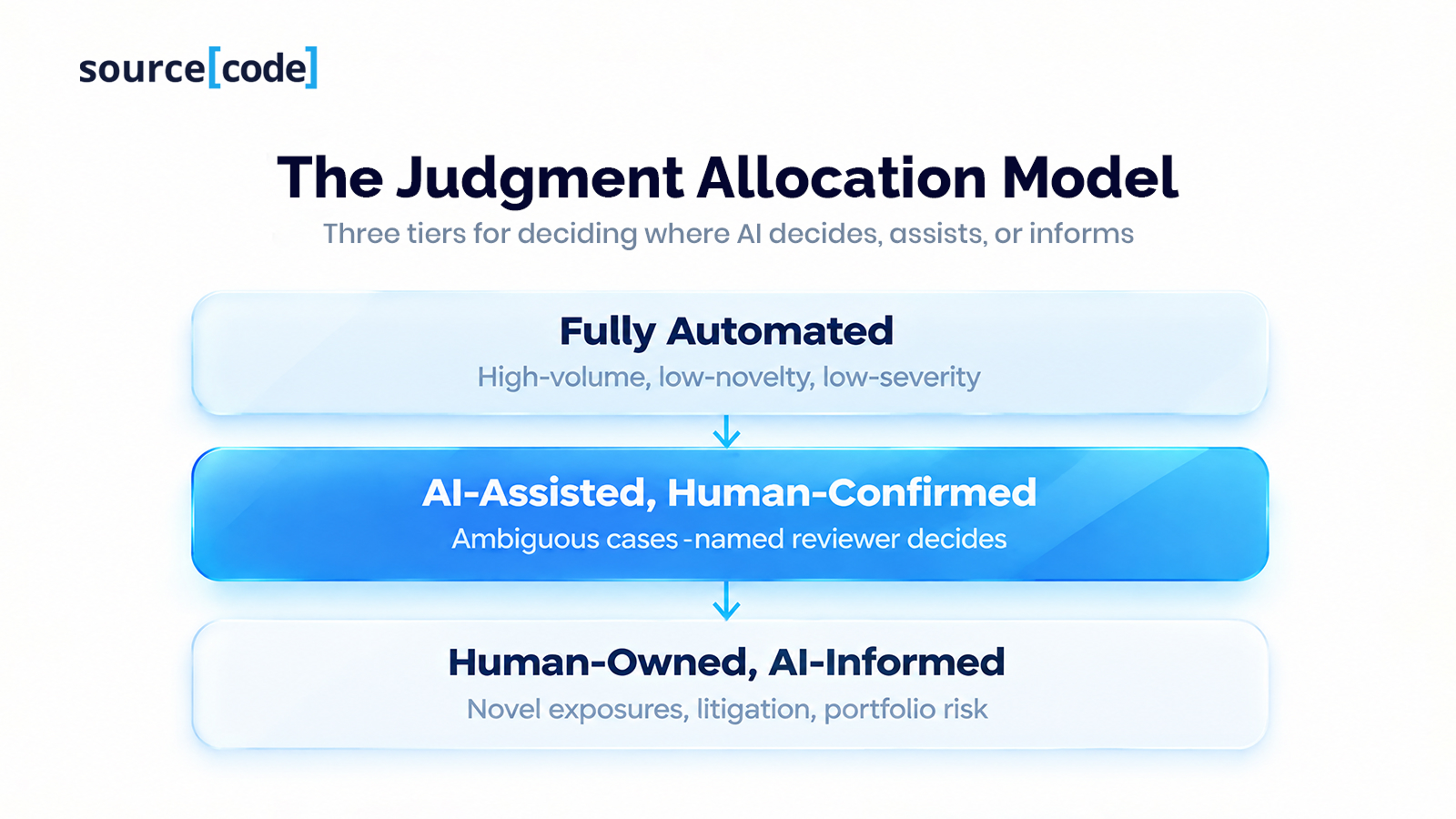
We use a simple three-tier model for this, built directly from the pattern BCG describes in underwriting and claims:
Tier one - fully automated. High-volume, low-novelty, low-severity decisions where historical data is dense and the cost of an occasional error is small and recoverable. This is the 185 of 200 standard submissions, the clear-cut claims triage and fraud flags. The AI decides; a human does not review every case, though sampling and monitoring still apply.
Tier two - AI-assisted, human-confirmed. Cases with some novelty or ambiguity, where AI can surface a recommendation, relevant precedent, and a confidence signal, but a named individual makes and owns the final call. This is where most of the 10 to 15 edge cases, and most contested claims, should sit - and it is also where junior staff can still build judgment, provided the review process is deliberately redesigned to teach, not just to approve.
Tier three - human-owned, AI-informed. Novel exposures, litigation-adjacent claims, and portfolio-level risk appetite decisions, where accountability has to sit with a senior, named owner regardless of what the AI recommends. BCG's own suggestion - small, senior, business-owned teams combining a business owner, a domain expert, and a data and technology lead - maps directly onto this tier (Bellizia et al., 2026).
The point of mapping decisions to a tier before the AI system is built, rather than after it ships, is that it changes two things the technology team controls directly: what the system is designed to automate outright versus merely assist, and where the interface is deliberately built to preserve a teaching moment for the staff who would otherwise have learned that judgment on volume alone. Tier two is where the apprenticeship model that BCG says is collapsing can be rebuilt in a different, more deliberate shape - but only if someone decided, in advance, that teaching was a design requirement and not an afterthought.
A fair counterargument
It would be an overcorrection to assume every insurer is already at the stage BCG describes, or that role redesign should outrun AI reliability. BCG's own underwriting illustration - 200 cases down to 10 or 15 - describes a mature future state, not where most carriers' AI deployments sit today. An insurer that strips its junior underwriting bench down to a handful of edge-case specialists before its AI system is demonstrably reliable at straight-through processing of the other 185 cases has created a capability gap in the wrong direction: not enough automated volume to justify the smaller human team, and not enough human reviewers left to catch what the AI gets wrong. The tiering exercise above has to be revisited as the AI system's actual, measured accuracy changes - it is not a one-off org design decision made at project kickoff and then left alone for several years.
Business and technology implications
For a Head of Digital or Innovation sponsoring the AI business case, the practical implication is that the value case itself should separate the tooling return from the operating-model return, and should treat the second as the larger, harder, and slower-moving of the two - not a soft benefit tacked on at the end of a deck built around licensing cost and hours saved.
For a CTO or CDO, the tiering decision is an architecture decision as much as an HR one: tier one needs confidence thresholds and sampling-based monitoring built into the system; tier two needs an interface that surfaces reasoning and precedent, not just a recommendation, so the human reviewer is actually building judgment rather than rubber-stamping output; tier three needs clear, auditable accountability logged against a named decision-owner.
For Risk and Compliance, the earlier point about error concentration is the one to carry into governance design: an after-action review cadence built for frequent, low-severity errors is the wrong tool for infrequent, high-severity ones, and the control framework needs to be rebuilt around that shift, not simply scaled down.
What leaders should do next
Before the next AI underwriting or claims system goes into detailed design, run the tiering exercise above against the specific decisions that system will touch - not as a one-time workshop, but as a structure the system's interface and controls are actually built around. Separately, ask where in the new model junior staff are still meant to build judgment, and whether that pathway was designed deliberately or is simply assumed to still exist. If the honest answer is the latter, that gap is the finding, and it belongs in the same roadmap review as the technical build, not in a separate talent strategy document nobody on the delivery team reads.
The sourceCode’s perspective
Working with insurers and Insurtechs across APAC and the Gulf on AI-enabled underwriting and claims builds, we see the 70/30 imbalance BCG describes show up concretely in how business cases get scoped: the request that lands with a delivery partner is almost always "build the model and the integration," with role redesign, review-path changes, and training-pathway design treated as a separate, later, often entirely unstaffed workstream. That sequencing is exactly backwards for the value BCG's estimate implies.
The insurers capturing more than the 30% are the ones that bring the tiering question into the same room as the technical design - deciding, before a single workflow is built, which decisions the system is meant to resolve outright, which it is meant to assist, and where a human reviewer's time is being deliberately spent building judgment rather than just clearing a queue.
That is a delivery design choice, available from day one of a build, not a retrofit to attempt once the system is already in production and the apprenticeship pipeline has already thinned. Talk to us here for further discussion!
Conclusion
BCG's estimate that 70% of AI's value in insurance comes from redesigning talent and operating models, not the tooling, should change where delivery teams spend their planning effort - not just where HR spends its budget. The shift from 200 routine submissions to 10 or 15 genuinely hard ones is not a staffing footnote to an AI rollout; it is the rollout's central design problem, because it determines whether the organisation still has a credible path to its next generation of senior underwriters and claims handlers once the routine volume that used to train them is gone.
A structured model for allocating judgment between full automation, AI-assisted human review, and senior human ownership - built into the system from the start, and revisited as the AI's real-world accuracy changes - is how that 70% actually gets captured, rather than left on the table alongside a technically successful AI deployment nobody designed the workforce around.
Frequently Asked Questions
What percentage of AI's value in insurance comes from talent and operating model redesign rather than the AI tools themselves? BCG's 2026 analysis estimates roughly 70% of AI's potential value in insurance comes from change management, adoption, and the redesign of talent and operating models, with about 30% coming from the AI tools and technology itself (Bellizia et al., 2026).
How does AI change the underwriter's job specifically? BCG illustrates the shift as underwriters moving from reviewing around 200 straightforward submissions a month to focusing on 10 to 15 cases involving novel exposures and unusual characteristics, with routine volume handled through straight-through processing (Bellizia et al., 2026).
Why does this create a problem for training junior underwriters and claims staff? The routine casework that used to teach junior staff pattern recognition through volume is the first work AI automates, which BCG describes as a structural paradox: expertise becomes more valuable exactly as it becomes harder to build (Bellizia et al., 2026).
What is the Judgment Allocation Model? It is a three-tier framework - fully automated, AI-assisted/human-confirmed, and human-owned/AI-informed - for deciding, before an AI underwriting or claims system is built, which decisions should be automated outright, which should route to a human reviewer for confirmation, and which must remain under senior, named human ownership regardless of the AI's recommendation.
Should insurers redesign roles ahead of their AI system's actual reliability? No. Role and staffing redesign should track the AI system's measured accuracy, not run ahead of it - stripping back junior review capacity before automation is reliably handling the routine volume it is meant to replace creates a capability gap rather than closing one.
Reference List
Bellizia, N., Cox, I., Mirabella, M. and Moore, N. (2026) Why AI Demands a New Insurance Talent Model. Boston Consulting Group, 22 July. Available at: https://www.bcg.com/publications/2026/why-ai-demands-a-new-insurance-talent-model (Accessed: 2 November 2026).
Libatique, R. (2026) The Graduate Hiring Model That Built Insurance Is Breaking Down. Insurance Business Australia, 10 August. Available at: https://www.insurancebusinessmag.com/au/news/breaking-news/the-graduate-hiring-model-that-built-insurance-is-breaking-down-585515.aspx (Accessed: 2 November 2026).
Catlin, T., Chester, A., Goran, J., McConnell, M. and Rutherford, S. (2020) Transforming the Talent Model in the Insurance Industry. McKinsey & Company, 6 July. Available at: https://www.mckinsey.com/industries/financial-services/our-insights/transforming-the-talent-model-in-the-insurance-industry (Accessed: 2 November 2026).