Key Takeaways
- Asia's embedded insurance market is forecast by McKinsey to grow substantially faster than the region's traditional insurance channels through the rest of this decade, reaching into the hundreds of billions of dollars in gross written premium by 2030 - a scale that changes embedded distribution from an experimental channel into a structural part of how APAC insurers will sell (McKinsey, via Reinasia, n.d.).
- Live partnerships are already operating at exactly the pace that forecast implies. In March 2025, Smartpay and Chubb launched what the companies describe as Japan's first embedded insurance service built into a buy-now-pay-later checkout flow - a real-time, point-of-sale integration between a fintech's payment rail and an insurer's underwriting and policy systems (Smartpay, 2025, widely syndicated via PR Newswire/Kyodo News).
- The commercial logic for both sides is straightforward: the fintech gets a new revenue line and a stickier checkout experience; the insurer gets distribution at a moment of genuine customer intent, without building or staffing its own point-of-sale channel.
- What that commercial logic does not automatically solve is the data and control question underneath it: what customer, transaction and eligibility data actually needs to flow from the distribution partner to the insurer's underwriting and compliance systems, in what format, on what latency, and who is accountable when it doesn't arrive, arrives wrong, or arrives too late to matter.
- Industry commentary on insurance APIs and embedded models in 2026 increasingly treats this as the live operational question in the category - not whether embedded insurance will scale, which the market has already answered, but whether the underwriting and compliance data architecture underneath each partnership scales with it, or quietly becomes the constraint nobody budgeted for.
 A Distribution Channel That Outgrew Its Own Plumbing
Embedded insurance's pitch to an insurer is seductive in its simplicity: let someone else's checkout flow be your distribution channel. The fintech or BNPL platform already has the customer's attention at the exact moment a protection product is most relevant - a purchase, a trip booking, a loan drawdown - and the insurer supplies the underwriting and the balance sheet behind it. Everyone involved gets to describe the arrangement as a partnership rather than a sale, which is mostly true, and mostly beside the point for a CTO trying to work out what actually has to be built to make it real.
McKinsey's own research on the category frames Asia's opportunity in genuinely large terms: embedded distribution is positioned to grow meaningfully faster than the region's conventional insurance channels through 2030, carried by the sheer scale of digital commerce, BNPL adoption and platform ecosystems across the region (McKinsey, via Reinasia, n.d.). That is not a speculative thesis any more. It is already visible in individual, named partnerships launching across the region's major markets.
Smartpay and Chubb's March 2025 launch in Japan is a clean example of what "live" actually looks like. The two companies describe the product as Japan's first embedded insurance service built directly into a BNPL checkout flow - meaning the insurance decision, the pricing and the policy issuance all happen inside the few seconds a customer spends completing a purchase, not as a follow-up email or a separate app download days later (Smartpay, 2025). That is the commercial promise of embedded insurance working exactly as designed: insurance sold at the point where the customer's need for it is most obvious and their attention is most available.
It is also, from an insurer's technology and risk perspective, a materially different integration than a traditional broker or agency relationship. A broker sells a policy an insurer has already fully specified, priced and controlled end to end. An embedded partner's checkout flow is, in a real sense, now part of the insurer's own underwriting and distribution system - a system the insurer does not operate, cannot fully see inside, and is nonetheless accountable for the output of.
What "Live" Actually Requires, and What the Market Is Not Yet Agreeing On
The uncomfortable part of embedded insurance's growth curve is that the commercial and technical questions have different maturity levels. The commercial question - will customers buy insurance this way, at this moment, in this volume - has a confident, evidence-backed answer across the region's major embedded launches. The technical and risk question - what specifically needs to pass between the two systems, continuously, for the insurer to remain in control of what it is underwriting - does not yet have a standard answer, and 2026's trade and technical commentary on insurance APIs reflects exactly that gap: a category focused on what embedded insurance can now do commercially, with far less settled consensus on how the underlying data exchange should be specified, audited and governed once a partnership is live rather than just launched.
That gap matters because the failure mode in embedded insurance is rarely dramatic. It is not usually a single catastrophic breach. It is a slow accumulation of small mismatches - eligibility data that is slightly stale by the time it reaches the insurer's underwriting engine, a change the fintech partner makes to its own checkout flow that silently alters what data the insurer receives, a product change on either side that the other side only discovers when a claim exposes it. Each of those is survivable in isolation. None of them shows up in the pilot launch's press release. All of them accumulate as the partnership scales from a single market to several, and from a single product to several.
Three Places the Gap Actually Shows Up
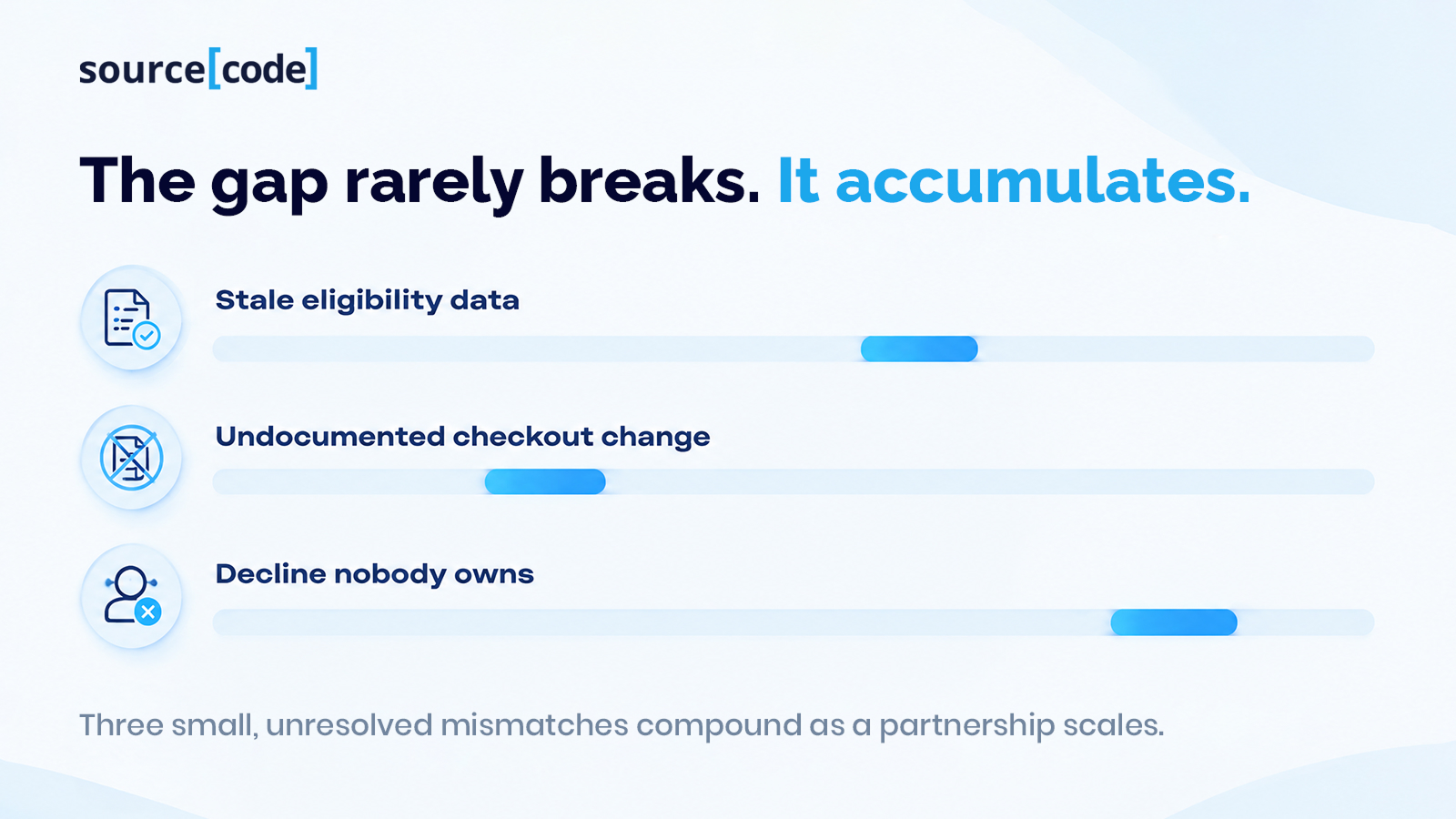
Eligibility and underwriting data that is current, not just available. A fintech's checkout flow typically holds transaction data - purchase amount, item category, customer identity verification already completed for the payment itself. What it usually does not hold, by default, is the specific eligibility and risk data an insurer's underwriting engine actually needs, formatted and timed the way that engine expects it. Building that translation layer once, specified clearly, is a materially different and more durable piece of engineering than building it ad hoc for the first partner and hoping the next one looks similar enough to reuse it.
A clear answer to who owns a decision made at the boundary. When an embedded product declines a customer, offers a different price than expected, or fails to issue a policy at all, the customer experienced that failure inside the fintech's interface, not the insurer's. Whether the fintech's support team, the insurer's underwriting team, or some jointly staffed function is accountable for resolving it - and whether the data needed to resolve it quickly actually reaches whoever is accountable - is a design decision that is easy to defer during a pilot and expensive to improvise once volume is real.
Compliance and disclosure obligations that travel with the data, not just the product. An insurer remains the regulated entity underwriting the risk, regardless of whose checkout flow sold it. Current industry commentary on insurance APIs and embedded distribution increasingly treats this as a first-order design question rather than a legal afterthought: a partnership's technical architecture needs to carry the insurer's compliance and disclosure obligations through the integration, not assume the distribution partner will replicate them independently.
The Honest Counter-Argument
The natural objection is that this is over-engineering a problem the market is already solving itself: embedded insurance is scaling successfully, named partnerships like Smartpay and Chubb's are live and functioning, and demanding a fully specified data and control architecture before every partnership launches would slow a genuinely valuable distribution channel down for a risk that has not, in the public record, produced a well-documented embedded-insurance-specific failure at scale.
That objection has real force at the level of an individual, well-run pilot. It has far less force at the level of a portfolio. An insurer running one embedded partnership can absorb a reasonable amount of ad hoc integration work and informal escalation process. An insurer running five, in three markets, with three different fintech partners each making their own independent product and checkout changes on their own release cycles, is running a materially different risk surface - and the McKinsey-scale growth forecast for the category means portfolio, not pilot, is where most serious APAC insurers are actually heading over the next few years. The sensible response is not to slow the first partnership down. It is to specify, once, what a partnership needs to provide before it scales past the first one - so the fifth integration is a known pattern applied again, not a fresh negotiation with its own undiscovered gaps.
A Practical Framework: The Embedded Risk Handshake
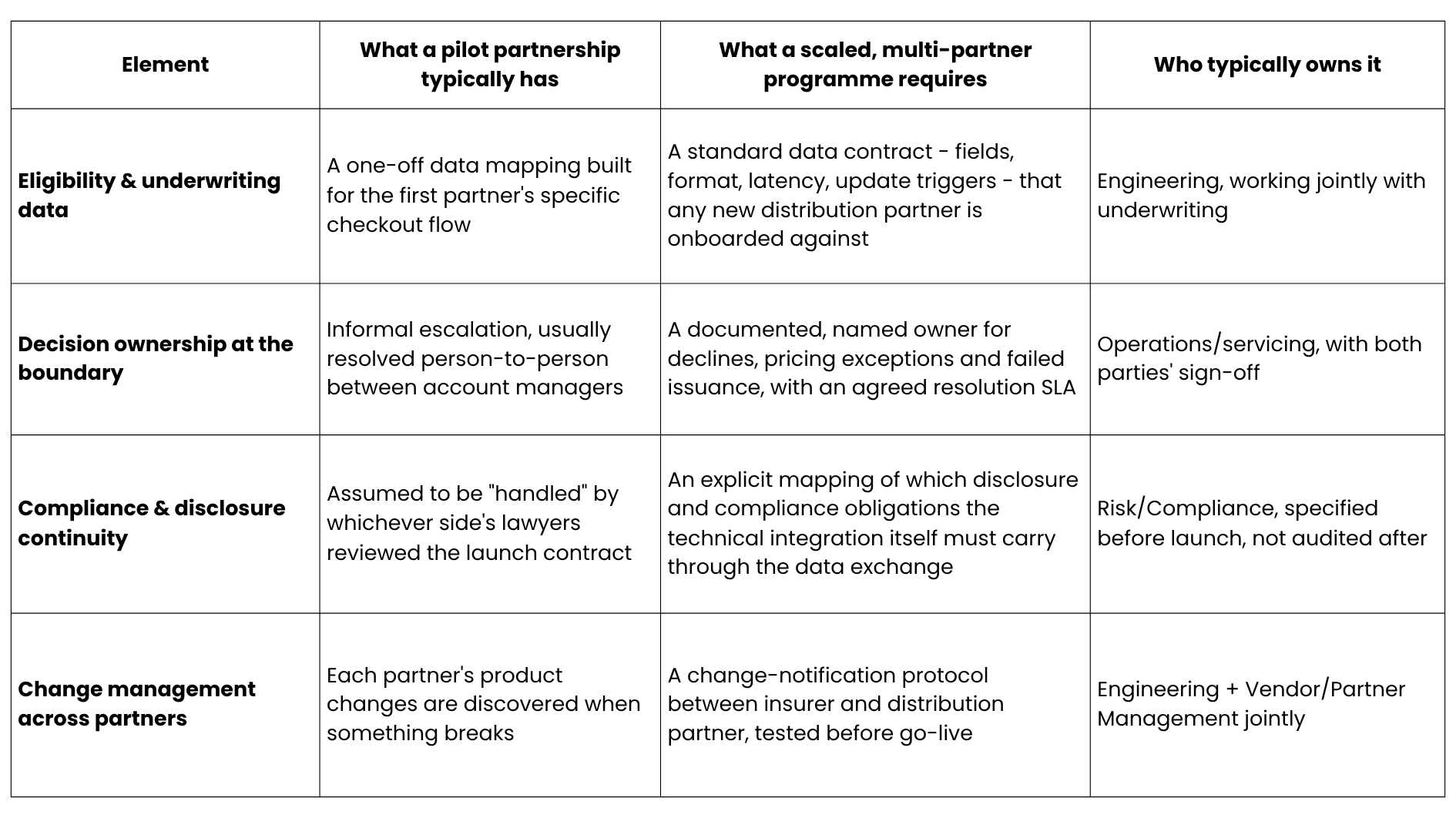
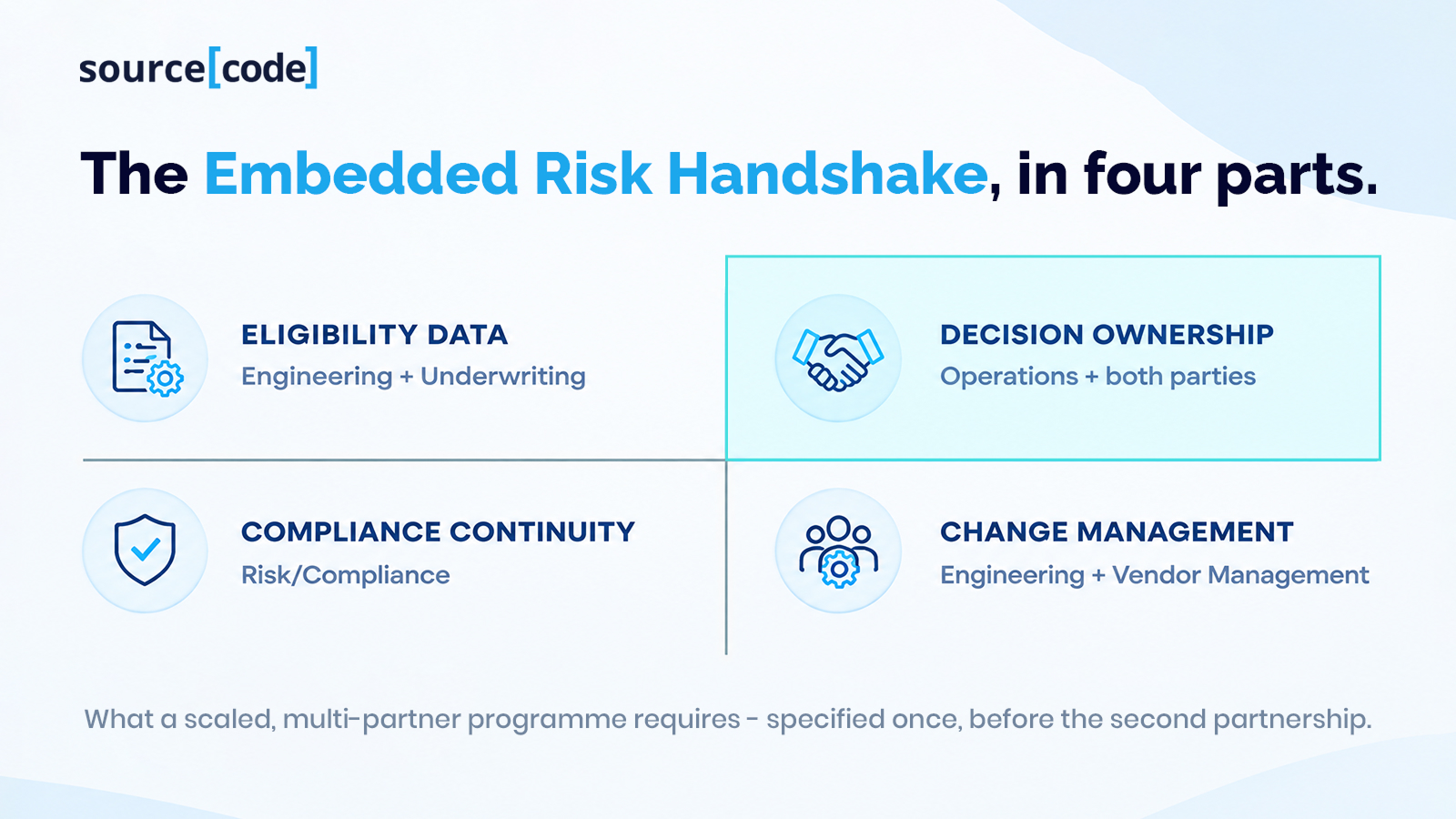
This is, in substance, what "The Embedded Risk Handshake" describes: the minimum data and control exchange an insurer should require from a distribution partner before that partnership goes live - specified once, as a standard, rather than renegotiated informally with every new BNPL or fintech relationship the business development team brings in.
What This Means by Buying-Committee Role
For the CTO or CDO, the practical implication is architectural: the data contract and change-management protocol in the table above are worth building as a reusable integration pattern, not as bespoke work for each partner. The McKinsey-scale growth forecast for the category means the cost of building that pattern once is recovered quickly against the cost of rebuilding ad hoc integration work for every new partnership.
For Risk and Compliance, the useful reframing is that a distribution partnership is not merely a commercial agreement with a technical appendix. The technical integration is where the insurer's actual compliance and disclosure obligations either do or do not travel with the data, and that should be specified and tested before launch, not discovered during an audit or a complaint.
For Head of Digital/Innovation, the uncomfortable trade-off is speed versus durability: a partnership can launch faster by skipping the data contract and handling exceptions informally, but every partnership launched that way adds to a portfolio of bespoke integrations that gets harder, not easier, to operate as the channel scales - which works against the exact growth the category's own forecasts are pointing toward.
For Procurement and Vendor Management, evaluating a prospective distribution partner should include the partner's own capability to meet a standard data contract and change-notification protocol, not only their customer reach and commercial terms. A partner who cannot commit to a stable, documented data exchange is a harder partner to scale with, regardless of how attractive their checkout volume looks in the pitch.
The sourceCode’s Perspective
We build integration and data architecture for insurers and their distribution partners across the region, so we have a direct commercial interest in embedded insurance programmes being built to scale rather than rebuilt with every new partner - which is also the basis for being specific about where we see this actually go wrong in delivery.
In our experience, the gap between a successful embedded insurance pilot and a scalable embedded insurance programme is rarely a model or pricing problem. It is almost always the data contract: what exactly is agreed, specified and tested about the information flowing between the two systems, before the first customer transaction rather than discovered after the hundredth. A single well-run partnership can survive that gap being informal. A programme spanning several partners and markets generally cannot, because each new partner adds its own version of the same undocumented assumptions, and those assumptions compound rather than cancel out.
Specifying the Embedded Risk Handshake once, as a standard an insurer applies to every new distribution relationship, is an engineering and governance discipline - not a product any single vendor sells on its own.
Conclusion
Asia's embedded insurance market is not a channel insurers need to be convinced to enter. The growth forecasts, and the live partnerships already operating at Smartpay-and-Chubb scale, have settled that question. What remains genuinely open, and is where most of 2026's trade commentary on insurance APIs is now focused, is whether the data and control architecture underneath each partnership is built to scale with the channel or merely to survive the first launch. An insurer that treats the Embedded Risk Handshake as a standard to specify once, before its second and third partnership rather than after a problem in its first, is positioned to capture the growth the category's forecasts describe without discovering its own integration debt at the exact moment volume makes that debt expensive.
If your organisation is running, or about to launch, more than one embedded distribution partnership, the useful next step is not another partner negotiation. It is a short review of what your current partnerships actually require from each other today - informally or formally - scored against the four elements in the framework above. We run this as a working session with technology, risk and partnership leads together, not a product demo.
>> Read more: Why CPS 230 Changes How Australian Insurers Should Be Writing Technology Contracts
FAQ
What is embedded insurance? Embedded insurance is insurance sold at the point of another transaction - a purchase, a BNPL checkout, a travel booking - through a technology integration between the distribution partner's platform and the insurer's underwriting and policy systems, rather than through a traditional broker, agent or standalone insurer channel.
How big is Asia's embedded insurance opportunity? McKinsey's research on the category positions Asia's embedded insurance market to grow substantially faster than the region's traditional insurance channels through 2030, reaching into the hundreds of billions of dollars in gross written premium at scale, as reported by Reinasia summarising McKinsey's analysis.
What is the main risk in embedded insurance partnerships? The most consequential and least discussed risk is not fraud or mispricing, but a gradual data and accountability gap between the insurer's underwriting and compliance systems and the distribution partner's checkout flow - eligibility data that is stale or incomplete, unclear ownership of decisions made at the point of sale, and compliance obligations that are not explicitly carried through the technical integration.
What is the "Embedded Risk Handshake"? A practical framework for specifying, before a distribution partnership goes live, the minimum data exchange and control relationship an insurer should require: a standard eligibility and underwriting data contract, a named owner for decisions made at the partnership boundary, an explicit mapping of compliance obligations onto the technical integration, and a tested change-notification protocol between both parties.
Should an insurer slow down embedded insurance launches to fix this? Not necessarily for a single, well-run pilot. The risk compounds specifically as an insurer moves from one partnership to a portfolio of several, across markets, each adding its own undocumented assumptions. Specifying a standard data and control pattern once, before scaling past the first partnership, is materially cheaper than discovering the gap informally across five simultaneous partner relationships.
Reference List
McKinsey & Company (n.d.) Why Asian insurers are ideally positioned for embedded market gains, as reported in: Reinasia (n.d.) McKinsey: Asia's embedded insurance market could reach US$270bn in GWP by 2030. Available at: https://reinasia.com/mckinsey-asias-embedded-insurance-market-could-reach-us270bn-in-gwp-by-2030 (Accessed: 10 November 2026)
Reinasia (2025) Chubb Japan Partners with Smartpay to Offer Embedded Insurance for BNPL Transactions. Available at: https://reinasia.com/chubb-japan-partners-with-smartpay-to-offer-embedded-insurance-for-bnpl-transactions/ (Accessed: 10 November 2026).
Smartpay (2025) Smartpay Announces Japan's First "Embedded Insurance Service" in BNPL in Partnership with Chubb, 5 March. Company press release, syndicated via PR Newswire and Kyodo News. Available at: https://kyodonewsprwire.jp/release/202503065263 (Accessed: 10 November 2026).