Key Takeaways
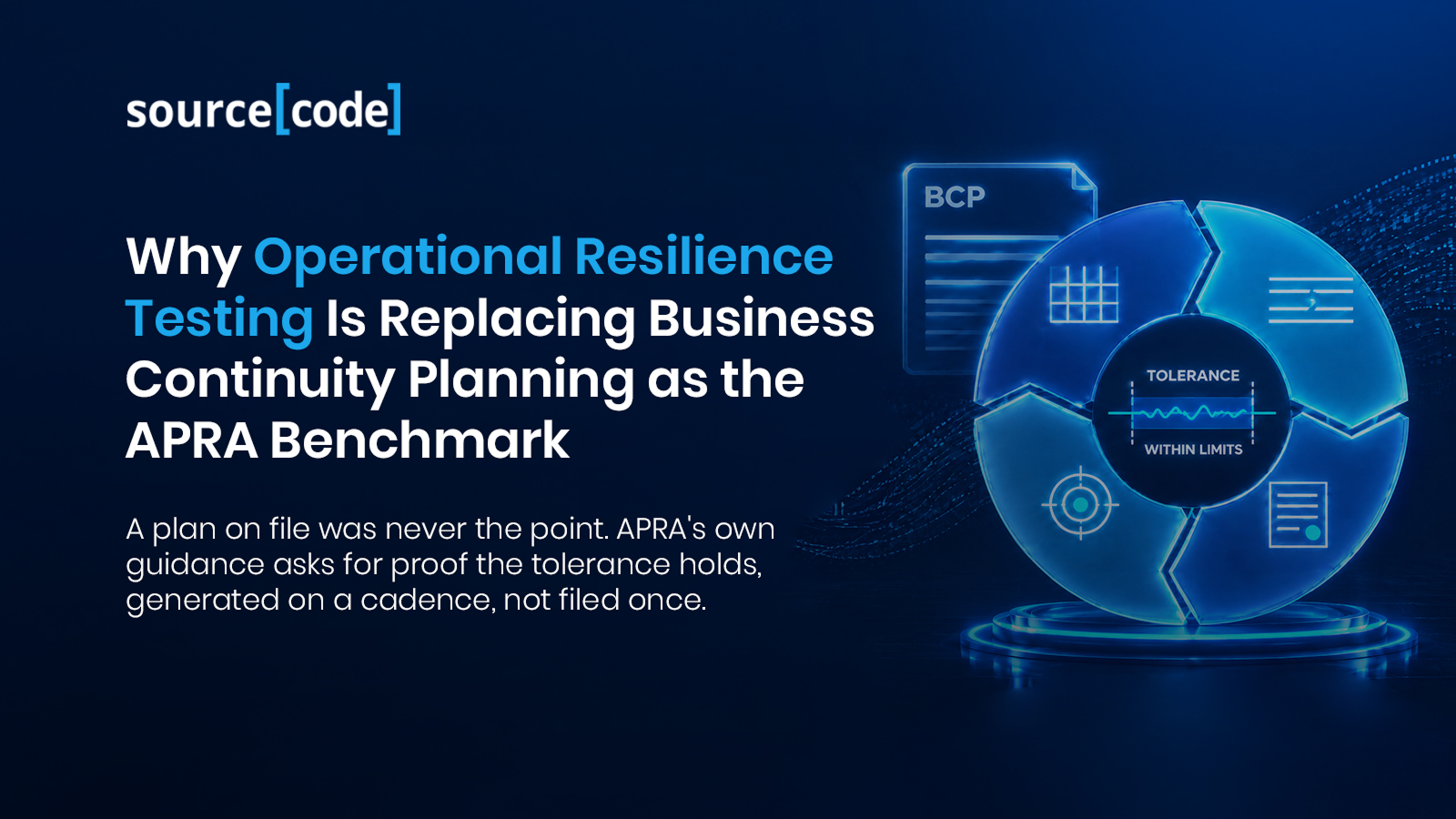
- For years, the artefact that satisfied a board, an auditor or a regulator asking about operational resilience was a business continuity plan (BCP) document: approved, filed, reviewed on a schedule. Under CPS 230, that document is now the starting point, not the answer.
- APRA's own CPG 230 practice guide is explicit that a BCP must be backed by a systematic testing program covering all critical operations, including at least one annual exercise against severe-but-plausible scenarios - and that tolerance breaches must be reported to APRA within 24 hours. The bar was always testing, not filing; most firms have only recently had to prove it.
- Most firms and their delivery and risk-advisory partners built a BCP for CPS 230's 1 July 2025 commencement. Far fewer built a recurring cadence that actually tests whether each critical operation holds within its tolerance - maximum disruption period, maximum data loss, minimum service level under contingency - under a realistic scenario, on a schedule anyone could defend to a supervisor.
- An annual test satisfies the letter of CPG 230's minimum requirement but often becomes a single aggregated exercise rather than operation-by-operation proof, which leaves a gap between "we tested something this year" and "we can show this specific critical operation holds within its stated tolerance today."
- sourceCode's Tolerance Proof Cycle turns a one-off BCP document into a recurring testing cadence - classify, rehearse, evidence, recalibrate - so what a risk or operations lead can produce on request is proof the system holds, not a plan that says it should.
Introduction
CPS 230 has applied to APRA-regulated banks, insurers and superannuation trustees since 1 July 2025, with the compliance clock for existing third-party and service-provider arrangements running out a year later. In the lead-up to both dates, most institutions did the predictable thing: they updated their business continuity plan, had the board approve it, and filed it alongside a register of critical operations and material service providers. That work was necessary. It was also, on its own, never going to be sufficient, because CPS 230 was never written as a documentation standard.
APRA's own CPG 230 practice guide says so directly. A business continuity plan has to be "backed by a systematic testing program" that covers every critical operation, includes an annual exercise, and tests against "severe but plausible" scenarios - including disruption at a material service provider, not only disruption inside the institution's own walls. Tolerances that aren't held - a disruption that runs longer than the stated maximum, data loss beyond the stated threshold, a contingency arrangement that can't deliver the promised minimum service level - must go to the board with a remediation plan, and a breach outside tolerance must be reported to APRA within 24 hours. None of that is achievable from a document sitting in a policy register. It requires evidence generated by actually running the test.
This is the shift most risk and operations leads are only now reckoning with. The conversation around CPS 230 has largely been about classification and documentation: which operations are critical, which providers are material, what the register looks like. The harder, ongoing obligation - proving, on a recurring basis, that each critical operation holds within tolerance under a real test - has had far less attention, partly because it is genuinely more work and partly because there has been no forcing function for it, unlike the initial filing deadline. Industry guidance, including the FSC's work on criticality and materiality for its member firms, points the same direction: toward a rigorous, evidence-based standard, not merely a documented one. The sections below are explicit about which claims come from APRA's own published guidance and which are sourceCode's own practitioner response.
The Document Everyone Has, the Evidence Almost Nobody Does
Ask a risk or operations lead at an APRA-regulated institution whether they have a business continuity plan, and the answer is almost always yes. Ask whether they can produce, for any named critical operation, dated evidence that it was tested against a severe-but-plausible scenario in the last twelve months and held within its stated tolerance - and the answer gets noticeably less confident.
The gap between those two answers is the actual compliance exposure. A BCP document describes what should happen if a critical operation is disrupted: who is notified, what the fallback arrangement is, what the recovery time objective is. It does not, on its own, demonstrate that the fallback arrangement works, that the recovery time objective is realistic, or that the institution's dependency on a given material service provider behaves the way the document assumes it does. That demonstration only exists once someone actually runs the test, records what happened, and compares the result against the tolerance the board approved.
This matters because APRA's supervisory posture under CPS 230 has consistently treated testing evidence as the dividing line between genuine operational resilience and a compliance exercise built to pass a review. A written plan never exercised against a realistic scenario is materially weaker evidence of resilience than one that has - even a partial test. For an institution relying on a single annual exercise to cover every critical operation it has classified, the honest question is whether that exercise produced operation-specific, tolerance-specific evidence, or a general assurance that the plan "worked" at a level of abstraction too high to defend to a supervisor asking about one named operation.
What APRA's Own Guidance Actually Requires - and Where the Evidence Gap Sits
CPG 230, APRA's practice guide to the standard, sets out the testing obligation in more operational detail than most institutions' internal programs currently reflect. For each critical operation, the entity sets three tolerances: the maximum period of disruption, the maximum acceptable data loss, and the minimum service level to be maintained under alternative arrangements. The board approves the plan and those tolerances, and reviews whether the two are actually consistent with each other - not simply whether both exist. The testing program must cover all critical operations, run at least one annual exercise, and test scenarios that are severe but plausible, specifically including disruption at a material service provider and situations requiring contingency arrangements to be invoked; APRA can require a specific scenario. Separately, the controls supporting critical operations must be tested for design and operating effectiveness on a frequency tied to risk materiality, by staff independent of the control owner - and internal audit must periodically review the testing program itself.
Put together, that is a considerably more demanding and more continuous obligation than "have a BCP and update it once a year." It is a standing requirement to generate dated, operation-specific, tolerance-specific test evidence, on a cadence scaled to how critical and material the underlying risk is - and to be able to show a regulator that evidence, not just the plan it is meant to validate.
The Financial Services Council has published guidance aimed at its member firms on assessing and substantiating the criticality and materiality judgements that sit underneath this testing obligation - the methodology question of which operations and providers warrant this level of rigor in the first place. We attempted to read that guidance note in full for this article and could not retrieve its primary text through the channels available to us: what came back was an index page to the FSC's resource library rather than the document itself, and a direct download attempt was blocked. We disclose that limitation plainly rather than paraphrase a document we could not read. Nothing here attributes a specific statistic, methodology detail or quoted requirement to the FSC note; every testing requirement described above comes from APRA's own CPG 230 practice guide, fetched and read in full. Law-firm commentary used elsewhere in this piece is used only for general context on the standard's direction and deadlines, not as a substitute source for FSC's specific guidance.
Isn't an Annual Test Already a Testing Cadence?
The strongest objection to everything above is that APRA has already specified the cadence, and most institutions are already meeting it: an annual business continuity exercise is the stated minimum, firms run one, and asking for more sounds like scope creep dressed up as a new framework.
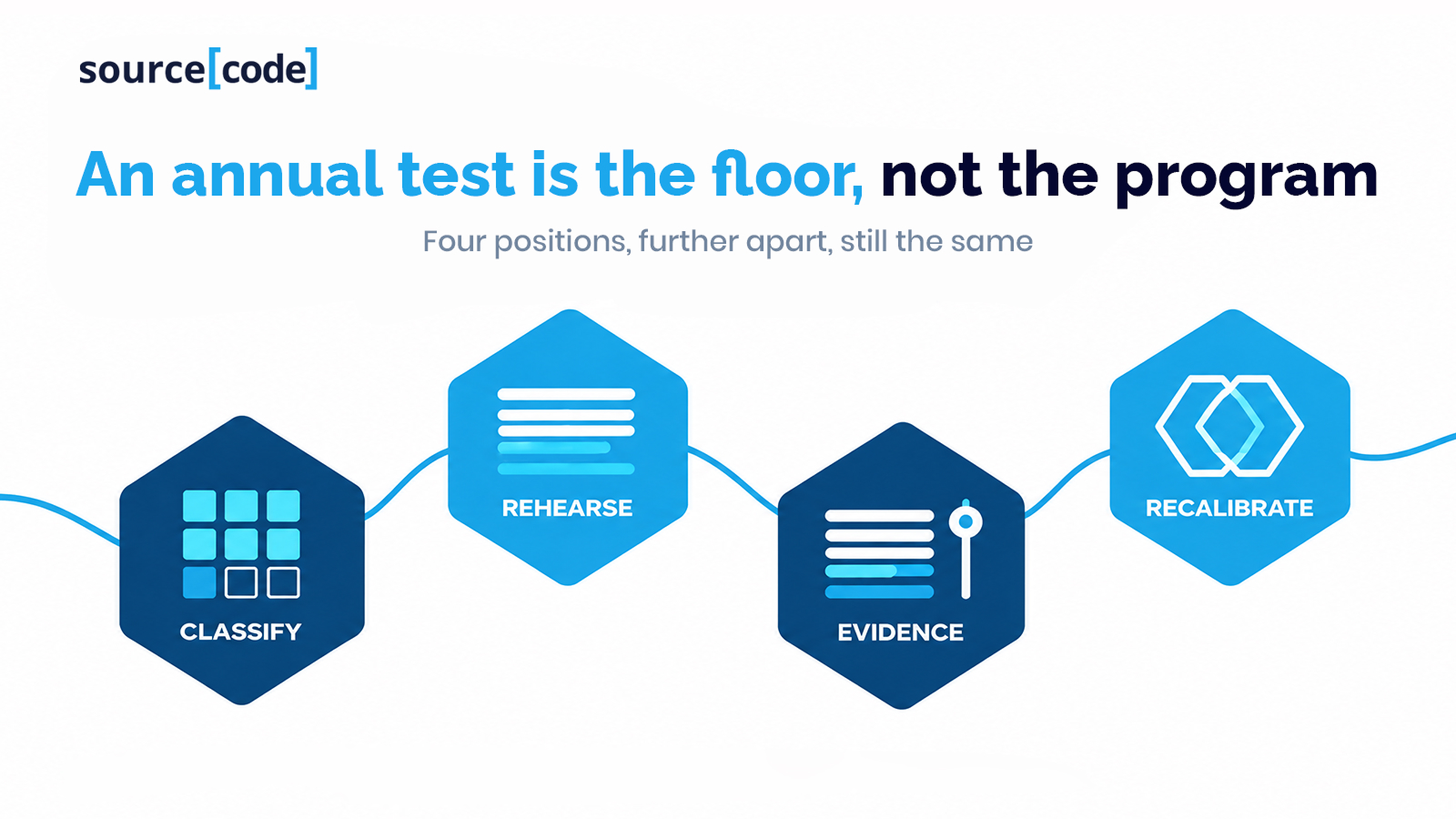
That objection is fair as a description of the letter of the requirement, and deserves a real answer rather than a dismissal. The minimum is indeed annual, and the failure mode is not that firms test less often than CPG 230 requires. It is that a single annual exercise, built to demonstrate overall program compliance, is frequently designed to cover critical operations in aggregate - a broad scenario, a representative sample of systems, a result reported at the program level - rather than to produce named, dated, tolerance-specific evidence for each operation on a schedule reflecting how material and fast-changing it actually is. A core payments function whose underlying platform or provider has changed meaningfully since the last annual test is not meaningfully "tested" by a result that predates the change. A claims platform facing a catastrophe season is not well served by evidence generated in a quiet month twelve months earlier.
The honest version of the counterargument is not "testing shouldn't happen more often than annually" - for many lower-criticality operations, it genuinely shouldn't, and a Tolerance Proof Cycle that ignored materiality and insisted on identical frequency for every operation would deserve the same criticism this section raises. It is that the annual minimum is a floor, not a program, and treating it as the whole program is how firms end up with a compliant-looking testing calendar and a supervisor's question they still can't answer about one specific operation, on one date, against one tolerance.
Who Actually Owns This, Across the Institution
The testing-cadence gap does not sit with a single role, which is part of why it persists even at institutions that take CPS 230 seriously.
The Chief Risk Officer owns the operational risk framework CPS 230 sits inside and is accountable for the tolerance-setting methodology, but typically does not run the tests personally - leaving the CRO dependent on operational and technology teams to surface honest evidence rather than reassurance.
The Head of Operational Resilience or Business Continuity Manager usually designs and schedules the testing program, and is the first to feel the gap when a single annual, aggregated exercise is asked to stand in for operation-specific proof across dozens of critical operations with very different risk profiles.
The CIO or Head of Technology and Operations owns the systems and material service provider relationships the tests exercise, and is accountable for whether a contingency arrangement that looks sound on paper actually delivers its promised minimum service level when invoked.
Internal Audit has an explicit role under CPG 230 to periodically review the testing program itself, making it one of the few functions positioned to notice when a program meets the letter of the annual minimum while leaving most critical operations without current evidence.
The Board Risk Committee approved the tolerances in the first place and must review test results and oversee remediation - which only works if what reaches the board is evidence from an actual test, not a status update that the exercise "was completed."
A Decision Framework: Four Questions Before Your Next Board Reporting Cycle
Do you have a tested tolerance, or a stated one? For each critical operation, the honest question is not whether a maximum disruption period, a maximum data loss figure and a minimum contingency service level exist on paper - most institutions can produce those now. It is whether those figures have been tested against a realistic scenario within a timeframe that still reflects how the underlying systems and providers currently work, or whether they were set once and never revisited against evidence.
Could you produce dated, operation-specific evidence inside the 24-hour window a real breach would demand? APRA requires notification of an out-of-tolerance disruption within 24 hours of it occurring. A testing program that only produces program-level, annual, aggregated results is not structured to answer a supervisor's question about one named operation inside that window, because the evidence that operation needs was never generated on its own.
Who owns the testing cadence for each tier of criticality, and is that written down anywhere? Teams managing this deliberately can name, for their highest-criticality operations, who schedules the next test and on what trigger - materiality, a system or provider change, or time elapsed since the last result. Teams managing it by accident only discover the gap when a board committee or an auditor asks for evidence that was never generated.
What is your trigger for recalibrating a tolerance, rather than just re-testing against the old one? A tolerance set when a system was simpler, or a provider relationship newer, may no longer reflect what the business or its customers can actually absorb. Testing against a stale tolerance produces a pass that tells a supervisor less than it appears to - its own kind of false assurance.
The sourceCode’s Perspective
We built the Tolerance Proof Cycle because we kept seeing the same pattern in our delivery and advisory work with Australian banks and insurers under CPS 230: a strong BCP document, a technically compliant annual exercise, and still no confident answer to "show me the evidence this specific operation held within tolerance recently." This is our own disclosed point of view, built from our delivery experience and from APRA's own published practice guidance, not an independently published industry survey - and we are naming that distinction rather than letting the framework read as something it is not.
The cycle has four stages, run on a cadence set by criticality rather than a single institution-wide calendar date.
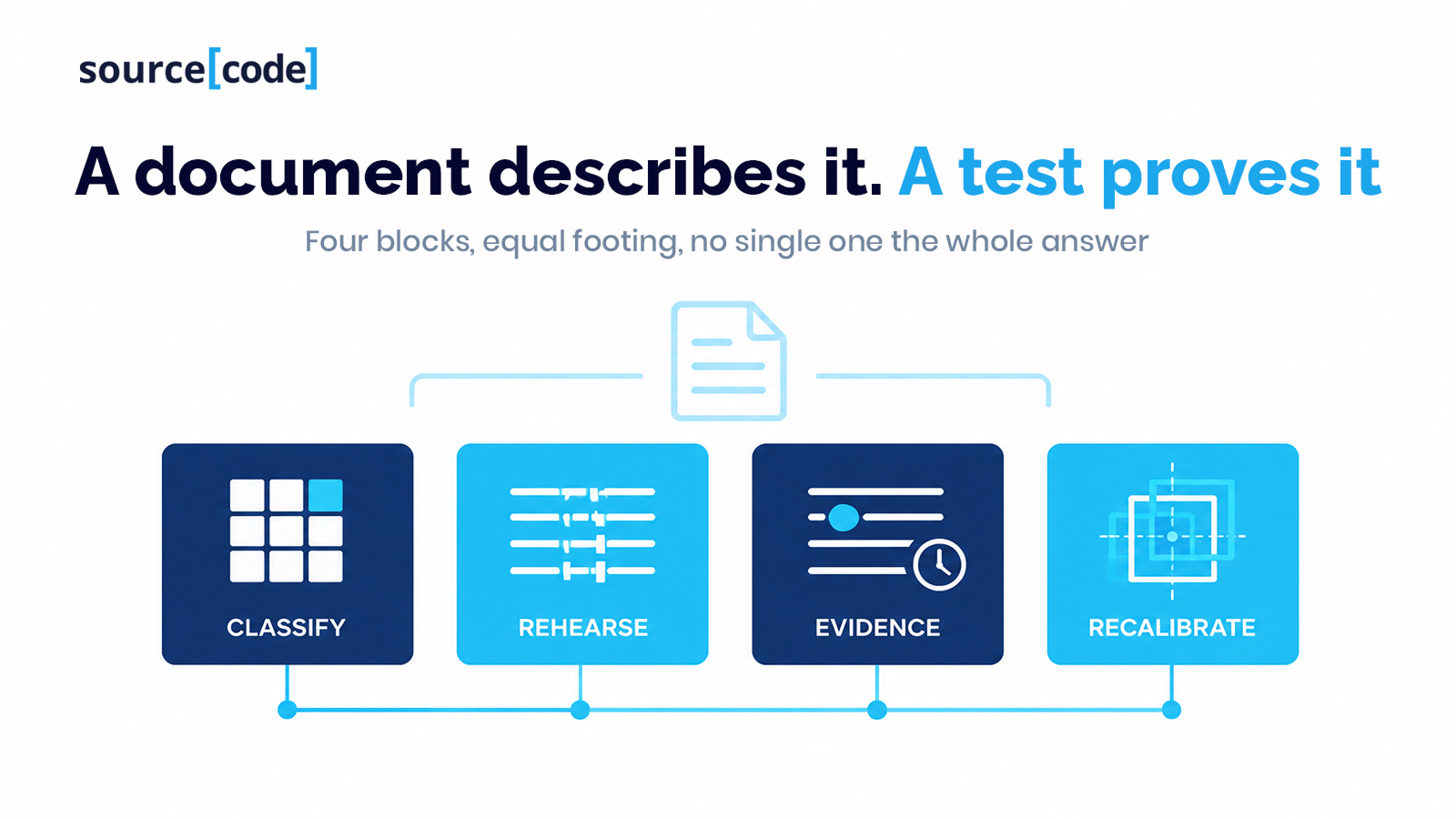
Classify sets or revisits the tolerance for a given operation against its current materiality, not the materiality it had when the tolerance was first approved.
Rehearse runs an actual test of that operation against a severe-but-plausible scenario, including disruption at the relevant material service provider, rather than folding it into one institution-wide exercise.
Evidence turns the result into a dated, operation-specific record the board, internal audit or APRA could be shown directly, not a program-level summary that the test "was completed."
Recalibrate feeds the result back into the tolerance, the contingency arrangement, or the next test date where the evidence shows a gap.
The four stages repeat on a schedule tied to criticality, so the institution is never more than one cycle from current proof on its highest-priority operations.
Conclusion
The business continuity plan still matters. It is the document that states what an institution intends to do when a critical operation is disrupted, and APRA still expects the board to approve it. What has changed, and what CPS 230's own practice guidance makes explicit, is that the plan is no longer where the compliance question ends.
The benchmark now is whether an institution can produce dated, operation-specific, tolerance-specific evidence that its critical operations actually hold under a real test - not whether the plan describing them is on file and signed off.
For risk and operations leads preparing for the next board reporting cycle or supervisory review, the question worth asking is not whether the BCP is current. It is whether the evidence behind it would survive being asked for.
FAQ
What does CPS 230 actually require beyond having a business continuity plan? APRA's CPG 230 practice guide requires the BCP to be backed by a systematic testing program covering all critical operations, including at least one annual exercise against severe-but-plausible scenarios, with breaches reported to the board and, where disruption exceeds tolerance, to APRA within 24 hours.
What are the three tolerances CPS 230 asks institutions to set for each critical operation? The maximum period of disruption, the maximum acceptable data loss, and the minimum service level maintained under contingency arrangements - each approved by the board alongside the BCP itself.
Is an annual test enough to satisfy CPS 230's testing obligation? It satisfies the stated minimum, but a single institution-wide, aggregated annual exercise often cannot produce the dated, operation-specific evidence a supervisor may ask for about one named critical operation, particularly where the underlying systems or providers have changed since the last test.
What is the Financial Services Council's GN53 guidance, and why isn't it cited directly in this article? GN53 is FSC guidance to its member firms on assessing and substantiating criticality and materiality under CPS 230. We could not retrieve its primary text through the channels available this run, so this article attributes no specific statistic or requirement to it; the testing requirements described here come from APRA's own published CPG 230 practice guide.
What is sourceCode's Tolerance Proof Cycle? sourceCode's own practitioner framework - not an independently published industry standard - for turning a one-off BCP document into a recurring, criticality-based testing cadence across four stages: classify, rehearse, evidence and recalibrate, so institutions can produce current proof rather than a plan that says a critical operation should hold.
Reference List
Australian Prudential Regulation Authority (APRA) (2023) Prudential Standard CPS 230 Operational Risk Management. Sydney: APRA. Effective 1 July 2025.
Australian Prudential Regulation Authority (APRA) (2024) Prudential Practice Guide CPG 230 Operational Risk Management. Sydney: APRA. Available at: https://www.apra.gov.au/practice-guides/cpg-230 (Accessed: 17 November 2026).
Financial Services Council (2026) GN53: CPS 230 Criticality and Materiality Guidance. Sydney: FSC. Available at: https://www.fsc.org.au/resources-category/guidance-note/2769-gn53-cps-230-criticality-and-materiality-guidance/file (Accessed: 17 November 2026).
HWL Ebsworth (2026) Not So Fast: APRA Issues AI Reminder Ahead of CPS 230 Deadline. Melbourne: HWL Ebsworth. Available at: https://hwlebsworth.com.au/not-so-fast-apra-issues-ai-reminder-ahead-of-cps-230-deadline/ (Accessed: 17 November 2026).