Key Takeaways
- Catastrophe losses have climbed enough, for long enough, that catastrophe modelling is no longer a specialist reinsurance input - it is becoming a mainstream underwriting input that Gulf and APAC property insurers are expected to use when they actually price and bind a risk, not only when they place a treaty.
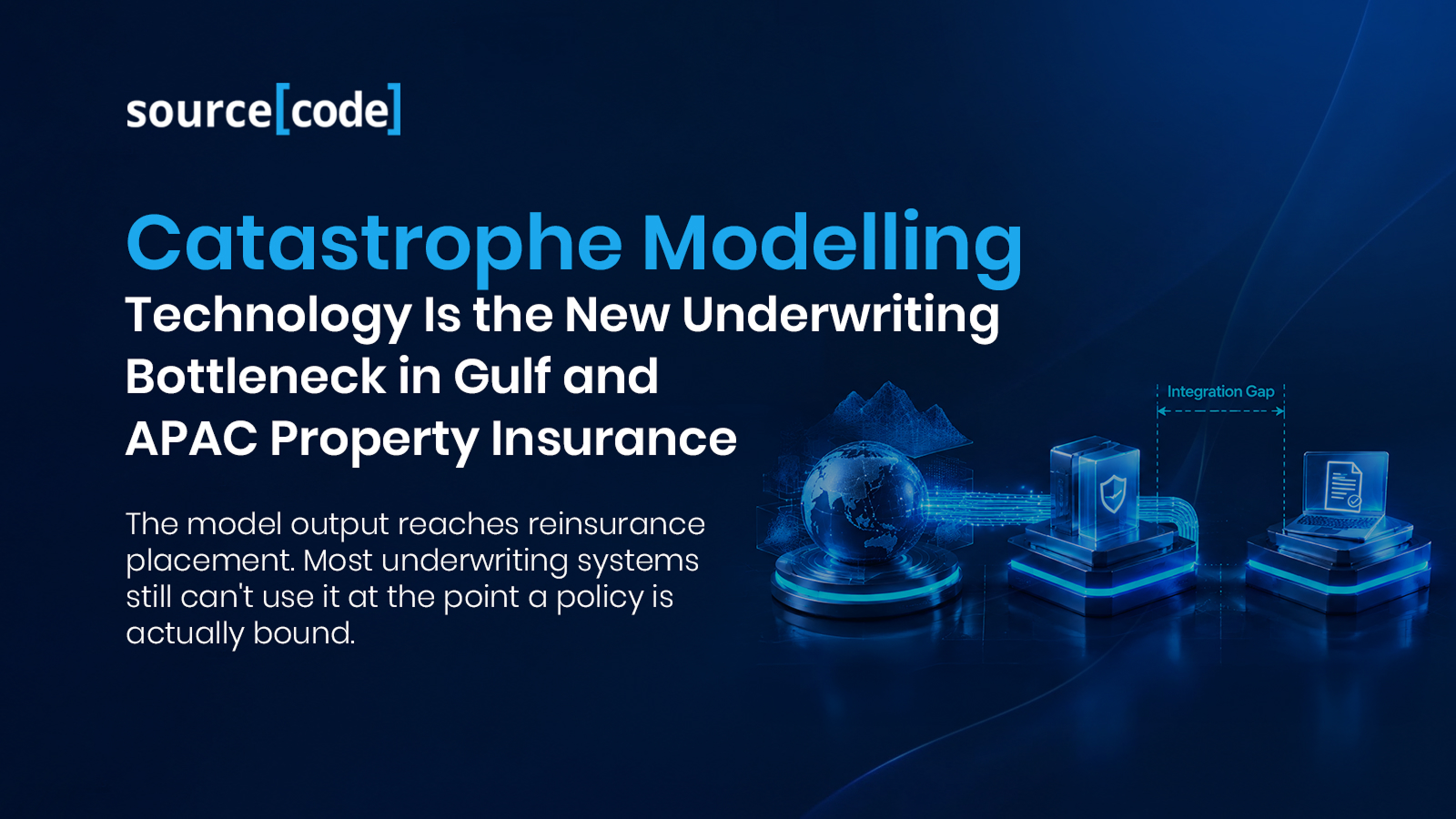
- The output most primary insurers already pay for is built for a different moment than the one it is now being asked to serve: an annual, portfolio-level view assembled for reinsurance placement, not a per-risk, real-time view available inside the underwriting workstation at the point of bind.
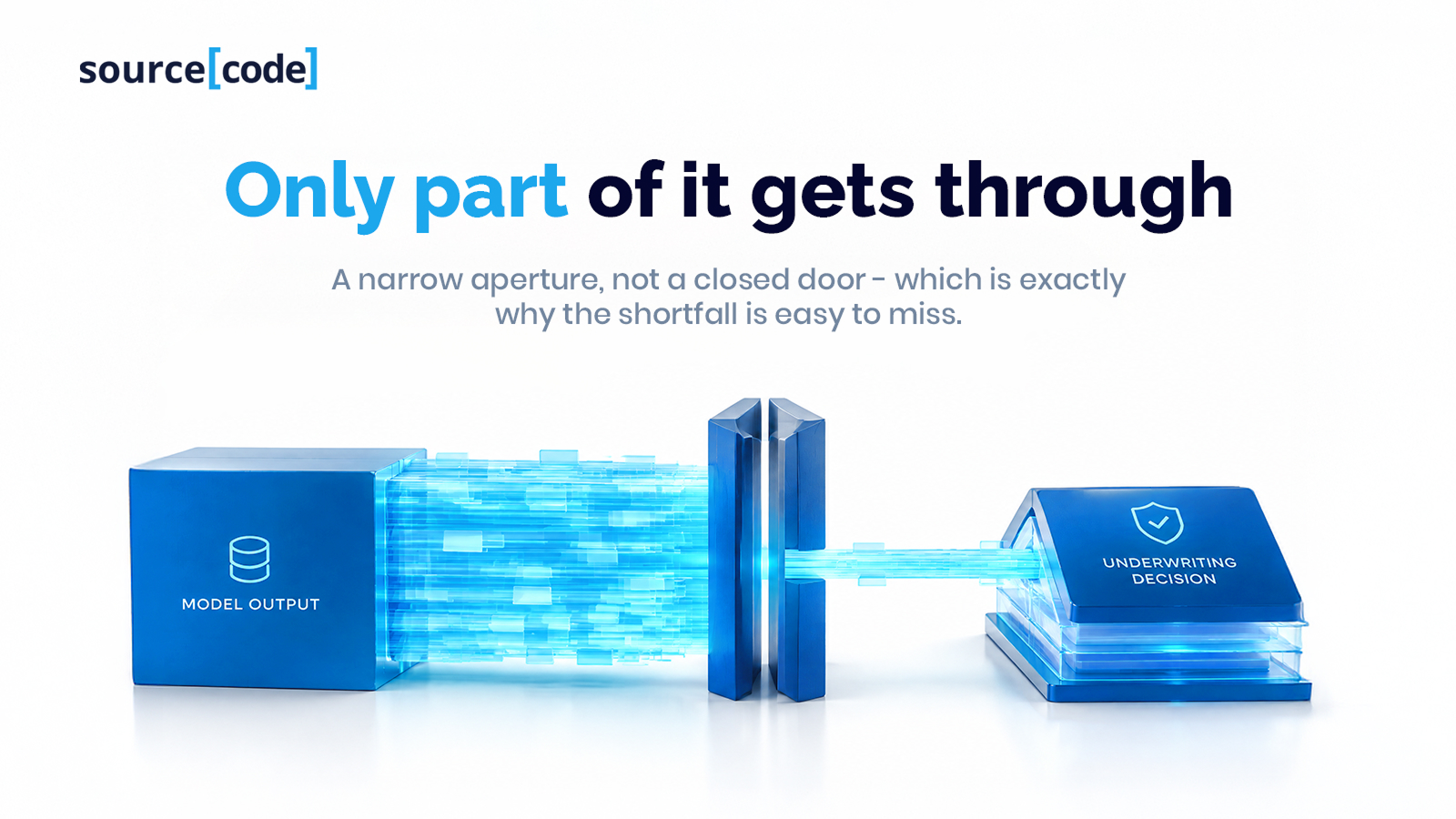
- That mismatch does not show up as a missing capability. It shows up as a capability that exists, that the organisation has already paid for, and that simply cannot reach the underwriter fast enough to change what gets bound and at what price.
- Gulf and APAC property books feel this first and worst, for structural reasons specific to each region - concentrated high-value coastal exposure and shared geography in the Gulf, and peril and vendor-model diversity across APAC's fragmented regulatory markets - that make a generic, one-size integration approach particularly unreliable.
- sourceCode's Bind-Time Model Integration Gate gives underwriting and engineering leaders a structured way to test whether catastrophe-model output can actually reach the decision at the point it is made, rather than assuming that buying a model licence and integrating it into a reinsurance submission is the same thing as integrating it into underwriting.
 Introduction
Every property insurer operating in the Gulf or APAC already buys catastrophe modelling. The licence sits in the technology budget, the vendor relationship is managed by a catastrophe risk or actuarial function, and the model's output is routine in every reinsurance renewal submission. On that measure, adoption looks mature, and in a narrow sense it is.
What is far less examined is whether that same output ever reaches the person pricing and binding an individual policy on the day it is written. In most organisations we work with, it does not - not because the model is wrong, but because its output was built, licensed and integrated to answer a portfolio-level question for a reinsurance audience once a year, while the underwriting decision it is now asked to inform happens continuously, one risk at a time, inside a different system entirely.
Rising catastrophe losses are forcing this mismatch into the open. As insurers in the Gulf and across APAC are pushed to price exposure more precisely at the point of sale, not just manage it in aggregate at renewal, the gap between what the model can produce and what the underwriting system can use becomes the binding constraint on how good that pricing can be. That is the bottleneck worth naming before the next renewal cycle, not after it.
Why a Catastrophe Model's Output Was Built to Answer a Different Question Than the One Underwriting Asks at Bind
Catastrophe models were designed, funded and refined over three decades primarily to answer a reinsurance and capital question: given a portfolio of exposures, what is the probable maximum loss at a given return period, and what does the resulting exceedance probability curve imply for how much reinsurance capacity to buy and at what price. That is a batch question, run against a portfolio snapshot, on a cycle measured in months, for an audience entirely comfortable working with aggregate output.
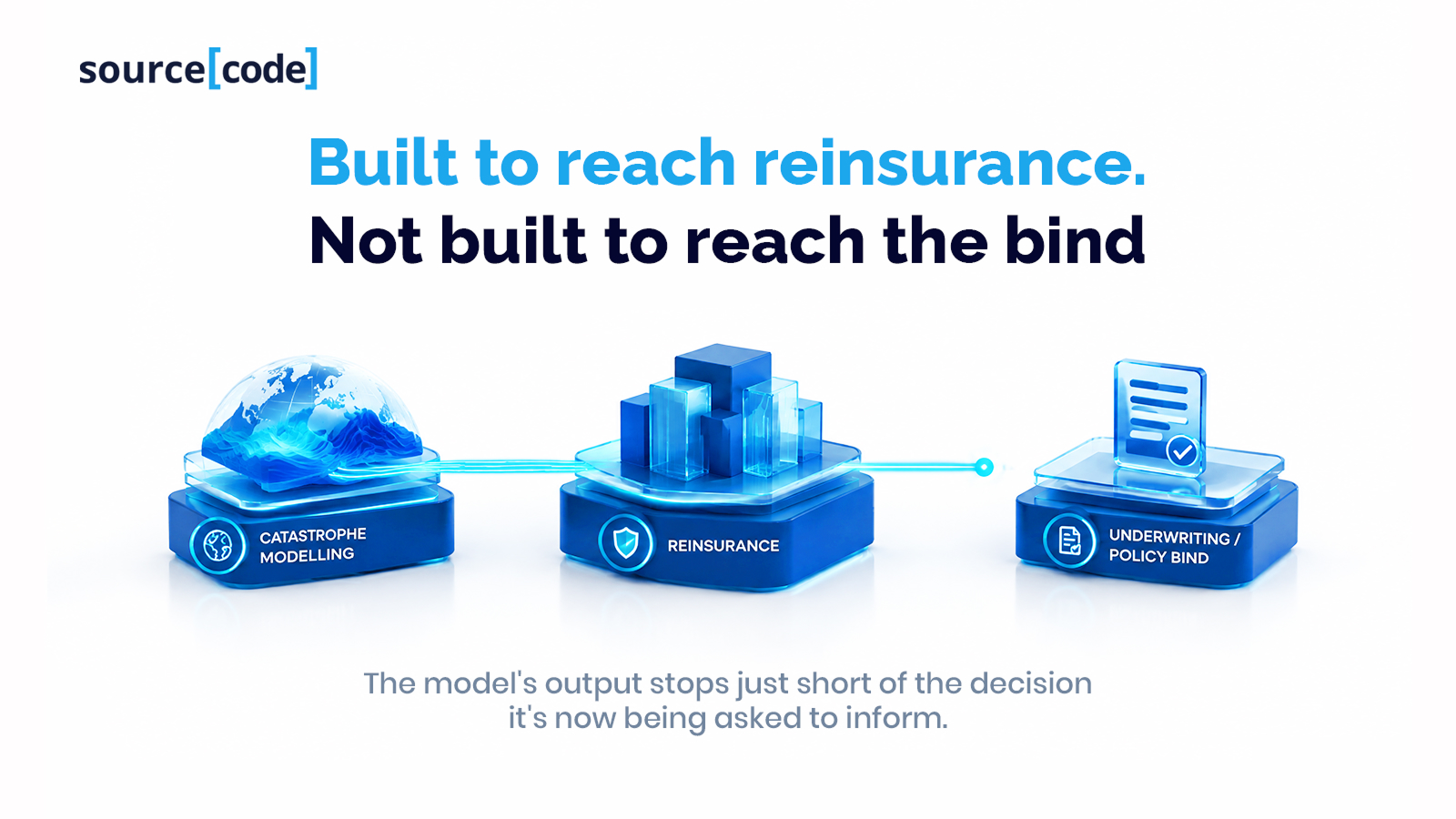 The question a property underwriter faces when a broker submits a risk for quote is different in almost every dimension that matters to a systems architecture. It is a per-risk question, not a portfolio one. It needs an answer in minutes or seconds, not months. It is asked continuously, dozens or hundreds of times a day, not once at renewal, by someone working inside a policy administration or underwriting workstation, not inside the catastrophe modelling team's own analytical environment.
None of this makes the catastrophe model wrong for its original purpose. It makes the model's existing integration - built, understandably, to serve the reinsurance submission workflow first - structurally unsuited to serve underwriting without additional engineering that most organisations never explicitly scoped, budgeted or assigned to anyone. The model output exists. The pipe that would carry a usable version of it into the underwriting system at the moment a quote is being bound, in most cases, does not.
What the Market Data Actually Shows - and Where It Doesn't Reach
There is no single, widely published, Gulf/APAC-specific benchmark quantifying how many property insurers can route catastrophe-model output into a live bind-time decision versus how many can only use it for reinsurance submissions, and we are not aware of one with a credible, disclosed methodology. That absence is itself informative: this is a question the industry has not yet been pressed to measure publicly, even as it is increasingly pressed to answer it in practice.
The closest direct evidence comes from Insurance Business's July 2026 interview with Richard Dixon, head of catastrophe research at Lloyd's syndicate manager OAK Global, who frames the operational challenge in almost exactly these terms without naming it a "bind-time" problem: insurers need systems able to embed bespoke frequency and severity adjustments into underwriting "ideally applied in real time at the point of underwriting," and model output has to reach underwriters "in an accurate, relevant and timely way" to change a decision rather than simply inform a report after the fact (Insurance Business, 2026). That is a working underwriter's own description of the gate this article names, stated as an operational requirement rather than a published statistic - and we are citing it as exactly that.
The second data point is adjacent rather than direct, and we are naming that distinction rather than eliding it. Clearwater Analytics' 2025-2026 APAC Insurance Report, surveying 150 senior executives across life insurers, general insurers and investment firms in Hong Kong, Singapore and Australia, found that 93% say legacy technology is already constraining their organisation, rising to 97% among the largest firms by assets under management (Reinsurance News, 2026). That survey covers investment and asset-management technology - data integration, cross-asset risk aggregation and regulatory reporting on the investment side - not underwriting or catastrophe modelling specifically. We use it only as evidence that APAC insurers, across a large, senior sample, already acknowledge legacy technology as a live constraint, not as a direct measurement of this article's underwriting integration gap.
Two further sources named in this piece's brief were checked independently and are scoped honestly rather than stretched. Capgemini's commentary on human-and-technology collaboration in 2026, carried by Reinsurance News, discusses catastrophe exposure as backdrop to rising market pressure and a generative-AI underwriting build at a specialty insurer - useful general context on underwriting workflows being redesigned around AI, but it does not address catastrophe-model integration or bind-time decisions, and we treat it as light background only (Reinsurance News, 2026). Arabian Business's reporting on Alpen Capital's GCC insurance M&A outlook covers market consolidation, premium growth and digitisation generally; it contains no catastrophe-modelling or underwriting-technology content at all, and we use it, if at all, only as one line of macro context that GCC consolidation is itself accelerating technology decisions at newly combined insurers - not as evidence for the bind-time gap itself (Arabian Business, 2021).
Why Gulf and APAC Property Books Feel the Integration Gap First
The integration gap is not evenly distributed, and Gulf and APAC property insurers have structural reasons to feel it earlier and more acutely than many other markets.
In the Gulf, high-value coastal and urban property is concentrated across a small number of markets that share overlapping weather systems and, in several cases, overlapping reinsurance panels. A model refreshed and reconciled against reinsurance submissions only annually leaves an insurer pricing new coastal risk all year against a concentration view that may already be stale before the next renewal corrects it - and because so much of the region's insured value sits in a small number of geographic clusters, a mispriced concentration does not stay contained to one policy.
Across APAC, the challenge is different but equally structural: peril diversity, regulatory fragmentation and vendor-model diversity across markets mean an insurer with a genuinely sophisticated model for, say, Japanese earthquake or Australian cyclone risk may run an entirely different vendor, data format and ownership structure for Southeast Asian flood risk. Each integration was typically built in isolation, for a reinsurance submission specific to that peril and market, with no common pipeline into a shared underwriting workstation. The result is not one integration gap but several, running at different maturity levels inside the same organisation - which makes "we have catastrophe modelling" a true statement that conceals how little of it reaches a bind decision consistently.
Isn't This Just a Backlog Item for the Integration Team, Not a Strategic Bottleneck?
The strongest objection to naming this a strategic bottleneck, rather than an ordinary engineering backlog item, is reasonable: every insurer has a long list of integrations waiting to be built, and prioritising this one over claims automation, policy administration modernisation or distribution technology is a resourcing call, not an obvious strategic imperative. A CTO managing a finite roadmap could fairly argue that catastrophe-model-to-underwriting integration should be scheduled like any other technical debt item, sequenced by cost and benefit, rather than elevated to a board-level concern.
 That argument holds for an insurer with low catastrophe concentration and a slow-moving book, where the cost of a stale model view at bind is genuinely marginal. It stops holding once catastrophe losses and regulatory or rating-agency scrutiny are both rising fast enough that the gap between the model an insurer owns and the model it actually uses at the point of pricing becomes visible in loss ratios, in reinsurance terms at the next renewal, or in an assessment of enterprise risk management maturity - at which point it is no longer backlog competing for sprint capacity; it is the reason the organisation's catastrophe pricing was wrong on everything bound between renewals. Treating the integration as ordinary backlog is a reasonable starting assumption. Still treating it that way after losses and regulatory attention have both escalated, with no explicit decision that it should stay there, is how the bottleneck persists by default rather than by design.
Who Is Actually Deciding This, Whether They Know It or Not
The decision about whether catastrophe-model output reaches the bind-time decision does not sit with one buyer, which is part of why it is rarely made deliberately.
The Chief Underwriting Officer owns the pricing decision itself and is usually the first to discover, informally, that the catastrophe view an underwriter is pricing against is not the one the organisation presents to reinsurers - typically because a broker questions a submission after the fact, not because an internal process flagged the gap first.
The Head of Catastrophe Risk or Chief Risk Officer owns the model licence, the vendor relationship and the portfolio-level view, and is accountable for its defensibility to a regulator or rating agency, but frequently has no visibility into whether that output ever reaches a live underwriting system at all.
The CTO or Head of Underwriting Technology owns the workstation and the integration layer around it, and is the only buyer with the engineering context to close the gap - but is rarely asked to prioritise it, because the request usually arrives as a catastrophe-risk problem rather than a technology roadmap item.
The Chief Reinsurance Officer or Head of Ceded Re, finally, feels the downside most directly at renewal, when a reinsurer's more current view of a concentrated book diverges from the primary insurer's bound pricing - by which point the gap has already cost the organisation terms, not just accuracy.
The Bind-Time Model Integration Gate
Can the underwriter see the model's output before the quote is bound, not just before the treaty is placed? Most insurers can answer this with confidence for their reinsurance submission and cannot answer it with the same confidence for an individual bind. The honest first step is establishing, risk class by risk class, whether a bind-time decision is currently made with or without a live catastrophe-model view, rather than assuming yes because the licence exists.
Is the model's per-risk output machine-readable inside the underwriting system, or does it live in a PDF, a spreadsheet or an analyst's inbox? Output that exists only as a periodic report, interpreted by an analyst and relayed informally to underwriting, is not integrated in any sense that holds up under scale - it is a manual workaround that functions until volume, turnover or time pressure breaks it.
What is the latency between a model refresh and that refresh reaching a live underwriting decision? An insurer that updates its catastrophe view annually but prices new business against that same static view for the following twelve months has a latency problem hiding inside what looks like a mature capability. The question is not whether the model is current at its last refresh, but whether decisions made since then were priced against a view already ageing.
If the answer to any of the above is "manual," "unknown" or "it depends who you ask," who owns closing that gap, and is there a date against it? Teams that have actually closed it can name the owner and the milestone. Teams that have not usually discover, when asked directly, that the gap was assumed to belong to whichever function happened to be in the room - rather than to anyone accountable for it reaching production.
The sourceCode’s Perspective
We built the Bind-Time Model Integration Gate after watching the same pattern repeat across Gulf and APAC property insurers we work alongside: a catastrophe modelling capability genuinely sophisticated on paper, reviewed and defended at every reinsurance renewal, and almost entirely disconnected from the underwriting system that actually prices and binds new business between those renewals. This is our own disclosed delivery point of view, built from the integration work we do inside underwriting and policy administration systems, not an independently published benchmark - and we are naming that distinction directly rather than presenting internal observation as external research.
The Gate is not a new catastrophe model, and it does not ask an insurer to replace a vendor relationship that already works for reinsurance purposes. It is a structured check, run against the actual bind-time workflow rather than the reinsurance submission workflow, that tells underwriting and engineering leaders exactly where existing model output stops reaching a live decision - and gives them a named owner and a timeline for closing that specific gap, risk class by risk class, rather than treating "we have catastrophe modelling" as a finished statement.
Conclusion
Catastrophe modelling technology has done its job for the audience it was originally built to serve: reinsurance placement is better informed today than it has ever been. The bottleneck now sits one step further down the workflow, where that same output is supposed to inform the price and bind decision on an individual risk, and in most Gulf and APAC property insurers it simply does not get there consistently.
As losses keep climbing and the pressure to price exposure precisely at the point of sale rises with them, the organisations that close that specific gap deliberately - rather than assuming it closed itself when the model licence was signed - will be pricing against the view they actually have, not the one they merely paid for.
FAQ
What does "bind-time" mean in catastrophe modelling and underwriting? The moment a policy is actually priced and bound - when an underwriter commits the organisation to a risk at a specific price - as distinct from the separate, usually annual, moment when a portfolio's catastrophe exposure is assembled for reinsurance placement.
Why can't most primary insurers use their catastrophe model output at the point of bind? Because the model's existing integration was typically built to serve the reinsurance submission process - a periodic, portfolio-level output for an actuarial and broker audience - rather than a real-time, per-risk feed into the underwriting workstation.
Is this specific to Gulf and APAC property insurance, or does it happen everywhere? The underlying mismatch is not unique to these regions, but concentrated coastal exposure and shared geography in the Gulf, and peril, regulatory and vendor-model diversity across APAC, make an unclosed gap's consequences more immediate and more costly in these markets specifically.
Does closing this gap mean replacing our existing catastrophe model vendor? Not necessarily. In most cases the model itself is not the problem; the absence of a defined, machine-readable, low-latency pipeline from its per-risk output into the underwriting system is. The Bind-Time Model Integration Gate is designed to diagnose and close that pipeline gap without requiring a vendor change.
Who should own fixing this inside an insurer's organisation? It needs an explicit owner, which is precisely what is usually missing. In practice it requires the Head of Catastrophe Risk, the CTO or Head of Underwriting Technology, and the Chief Underwriting Officer to agree, in writing, who is accountable for the gap closing and by when.
Reference List
Insurance Business (2026) Catastrophe models have become the starting point, not the answer. 16 July. Available at: https://www.insurancebusinessmag.com/au/news/catastrophe/catastrophe-models-have-become-the-starting-point-not-the-answer-582552.aspx (Accessed: 17 November 2026).
Reinsurance News (2026) Asia Pacific insurers step up private market allocations as technology falls behind, reports Clearwater Analytics. 24 April. Available at: https://www.reinsurancene.ws/asia-pacific-insurers-step-up-private-market-allocations-as-technology-falls-behind-reports-clearwater-analytics/ (Accessed: 17 November 2026).
Reinsurance News (2026) Redesigning how humans and tech collaborate will separate leaders from laggards in 2026 - Capgemini. 23 January. Available at: https://www.reinsurancene.ws/redesigning-how-humans-and-tech-collaborate-will-separate-leaders-from-laggards-in-2026-capgemini/ (Accessed: 17 November 2026).
Arabian Business (2021) Why mergers are likely to increase in the GCC's insurance sector. Available at: https://www.arabianbusiness.com/industries/banking-finance/why-mergers-are-likely-to-increase-in-the-gccs-insurance-sector (Accessed: 17 November 2026).