Key Takeaways
- Embedded insurance's first wave proved the commercial model on consumer transactions - BNPL checkouts, travel bookings, device purchases. Industry commentary now points to SMEs as the next phase of that growth, alongside high-value products and cyber cover, because SME customers have the same point-of-need buying pattern, at a far higher premium per policy.
- Capturing that SME opportunity requires something consumer embedded insurance did not force most insurers to build: underwriting that can run inside someone else's checkout or onboarding flow, in real time, at the moment an SME applies for a loan or a merchant account - not a quote emailed back days later.
- Practitioners speaking on the category through 2024, 2025 and into 2026 have been explicit that SME-facing software platforms are an increasingly promising distribution channel for insurers willing to meet the speed those platforms' customers expect, while warning that insurers' traditional underwriting cycles were built for a world where the insurer controlled the pace of the sale.
- Where an insurer cannot underwrite at that speed, the platform or its managed-general-agent partner fills the gap - and in a model built on an MGA or fintech managing the point-of-sale decision and the relationship, the carrier underneath increasingly becomes the balance sheet behind someone else's product, not the owner of the distribution economics.
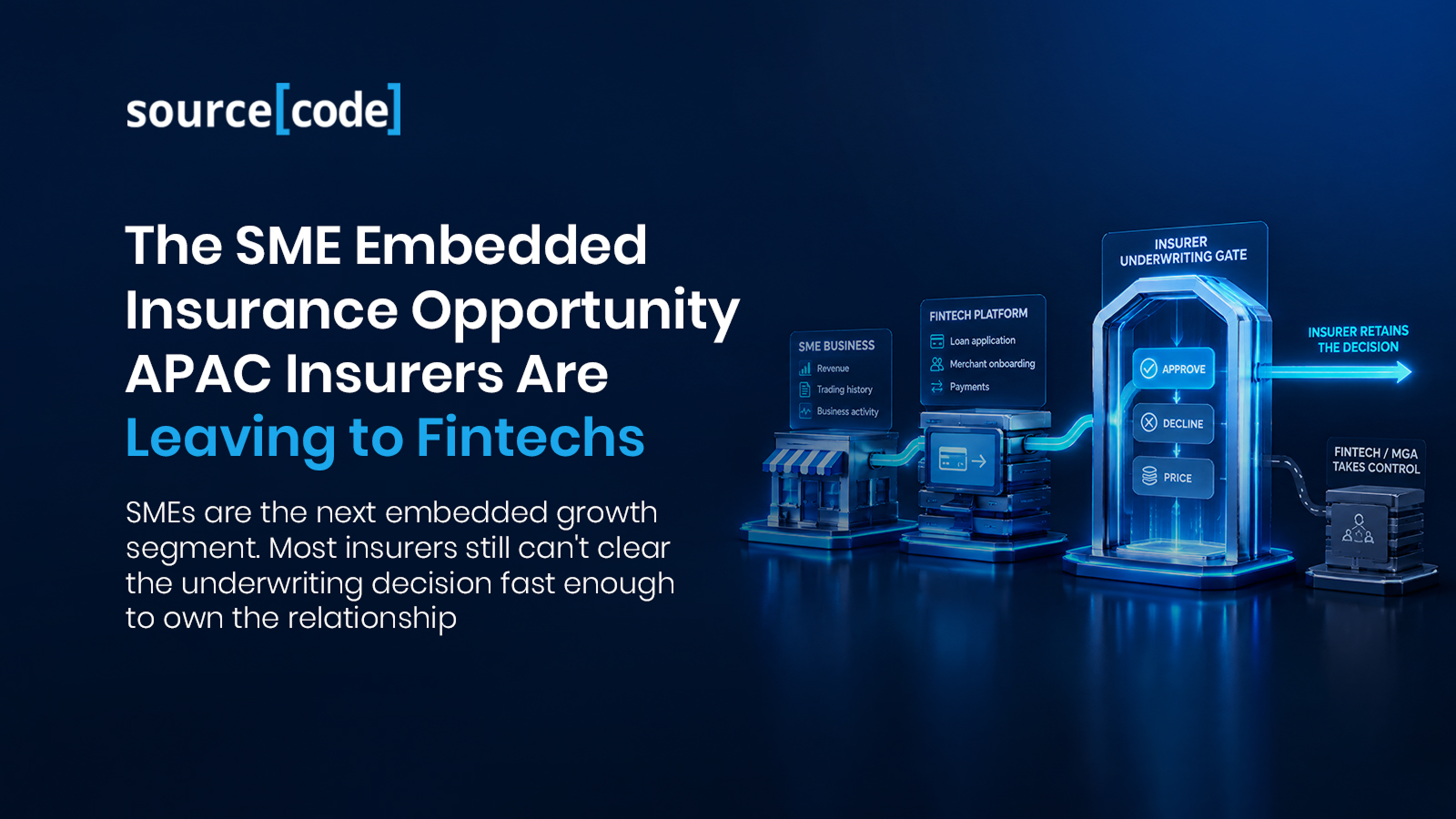
- sourceCode's Point-of-Sale Underwriting Gate sets out the minimum real-time underwriting and API capability an insurer needs to own the SME embedded relationship rather than rent it indefinitely to the BNPL and platform partners who already have that capability built.
 Introduction
Embedded insurance did not need a second act to be taken seriously. The first one - insurance sold inside a BNPL checkout, a travel booking, a device purchase - already settled whether customers will buy protection at the moment a platform offers it, provided the offer is fast, relevant and genuinely part of the transaction rather than an upsell bolted onto it. What is settling now, across the trade commentary covering the category through 2024, 2025 and into 2026, is where that pattern goes next. The answer industry voices keep converging on is SMEs: small and mid-sized business customers buying trade credit, cyber, equipment, liability or business interruption cover through the same digital rails that already sell them a loan, a merchant account or a payroll subscription.
The commercial logic is, if anything, stronger for SMEs than for consumers. A small business applying for working-capital finance or signing up for a payments platform is already disclosing exactly what an underwriter needs - revenue, transaction volume, sector, trading history - at precisely the moment it is most receptive to a bundled protection offer, and the premium per policy is materially higher than a consumer add-on. The SME segment is also chronically underserved by traditional broker-led distribution, which makes a platform-embedded channel look less like a new idea than an obvious fix to a known gap.
What is far less settled is whether the insurers eyeing this opportunity have the underwriting infrastructure to serve it on the platform's terms rather than their own. A broker-sold SME policy can take days: a site visit, a paper application, an underwriter's judgment call. A platform-embedded SME policy has to clear in the seconds a merchant spends completing an onboarding flow, or the platform will route the decision - and the relationship that comes with it - to whichever partner can say yes in real time. That partner, increasingly, is not the insurer. It is the fintech, the BNPL provider, or the managed general agent sitting between the insurer's balance sheet and the platform's checkout flow, because that is where the real-time underwriting capability has actually been built.
Why the Next Phase of Embedded Growth Runs Through SMEs, Not Consumers
The pattern insurance trade commentary has been describing is a shift in where embedded growth is expected to come from. Coverage of the category frames SMEs, high-value products, cyber and product innovation as the areas insurers are now circling for the next phase of embedded distribution - a different list from the consumer-transaction use cases (travel, device protection, BNPL purchase cover) that carried the category's first wave. The same commentary flags "embedded fatigue" as a live concern: the easy consumer use cases are approaching saturation, and SMEs represent where the next genuinely new volume sits.
 That shift shows up directly in how practitioners describe their own priorities. At a 2024 industry panel on the category's growth, Ageas Group's regional digital and tech development director described SME-facing software-as-a-service platforms as "particularly promising" embedded insurance partners - alongside bancassurance, travel, health, e-commerce and telecoms - specifically because that software already sits inside the workflows where a business owner would naturally encounter an insurance decision. On the same panel, QBE Asia's regional head of distribution pointed to the insurer's own mortgage insurance as a long-running example of point-of-sale embedded cover, while Zurich's head of retail services was the most direct about the operational tension: the shift requires insurers to move past "the traditional six-to-nine-month product launch cycles," because the platforms SMEs already use do not operate on an insurer's traditional timeline.
None of that commentary constitutes a rigorously sourced market-sizing study, and this article does not treat it as one. It is disclosed here as what it is: named practitioners, speaking at an industry forum, independently converging on the same observation - SME-facing digital platforms are where insurers are now looking for embedded growth, and the constraint is less the opportunity itself than insurers' own speed.
The Infrastructure Gap Underneath the Opportunity
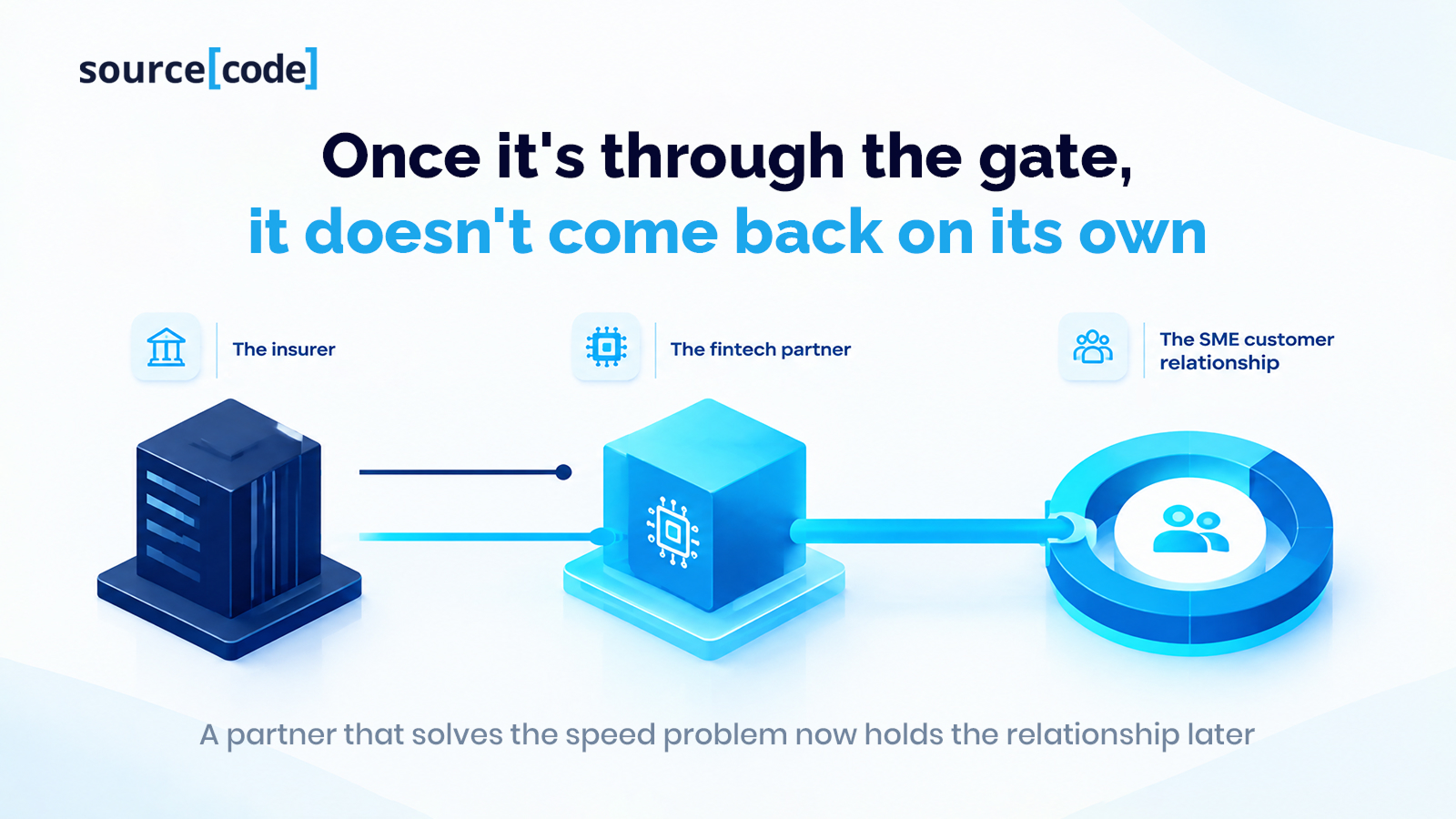
The constraint practitioners are describing has a specific shape. Separate industry research on embedded insurance technology, published by Boston Consulting Group in 2025, makes the architectural version of the same point: insurers who want to compete in embedded distribution need API-driven, modular platforms capable of real-time underwriting decisions and real-time data exchange with distribution partners - because the alternative, in BCG's framing, is a structure where a managed general agent or digital-native intermediary manages the customer interactions and the relationship with the distribution platform directly, while the carrier's role narrows to pricing and balance-sheet support behind a product someone else owns commercially.
That is the mechanism this article's thesis turns on: real-time, point-of-sale underwriting capability is not a nice-to-have feature of an SME embedded programme. It is what determines which side of the partnership ends up managing the customer relationship, and which side ends up as infrastructure behind someone else's product. A BNPL platform or SME fintech that has already built real-time decisioning for its own core product - a payment, a short-term loan, a merchant cash advance - can extend that capability to an insurance decision far more easily than most insurers can build equivalent decisioning from scratch. Where the insurer cannot clear a yes/no underwriting decision inside the platform's own transaction flow, the platform's technology partner does it instead, and the insurer's role shrinks to the balance sheet underneath.
This is not hypothetical. It is the same mechanism already visible in the BNPL-adjacent consumer embedded insurance partnerships now live across the region: the fintech or platform owns the checkout, the real-time decision and the customer relationship, and the insurer supplies underwriting capacity behind an interface it does not control. SMEs raise the stakes on that dynamic rather than introducing a new one, because the premium per policy - and therefore the margin at risk of being captured by whichever party owns the point-of-sale decision - is materially larger.
It Is Reasonable to Ask Whether Insurers Should Even Try to Own This Layer
The strongest objection to all of this is that it may simply be the wrong fight for most insurers to pick. Building and maintaining real-time, point-of-sale underwriting infrastructure specific to SME risk, across the many distribution platforms an ambitious embedded programme might eventually touch, is a genuinely large engineering commitment. Fintechs and BNPL platforms built real-time decisioning because it is core to their own product; for most insurers, it is one capability among many competing for the same technology budget. A reasonable CTO or Head of Digital could argue that renting that capability from a managed general agent or insurtech partner, and focusing the insurer's own investment on pricing, risk appetite and capital efficiency, is simply the more rational division of labour - let the platform specialists own the interface, and let the insurer own the risk.
 That argument is sound as a description of how some embedded programmes should run, and sourceCode is not arguing that every insurer must build a complete, owned underwriting stack across every SME vertical it might touch. The distinction that matters is between renting the interface and renting the decision. An insurer can reasonably rent the user-facing checkout experience and even the day-to-day servicing relationship to a partner, while still retaining enough real-time underwriting and API capability of its own to set the risk appetite, adjust pricing dynamically, and audit the decisions being made in its name. What erodes margin and relationship permanently is renting the decision itself - letting a partner's black-box engine make underwriting calls the insurer can only see after the fact, on products carrying its own balance sheet. The Point-of-Sale Underwriting Gate, below, is built around that distinction: a minimum bar, not a mandate to build everything in-house.
Who Is Actually Deciding This, Whether They Know It or Not
The decision about how much point-of-sale underwriting capability to build sits across several desks, and the fact that no single one of them owns it end to end is part of why it tends to default toward "whatever the first platform partner's integration happens to require."
The Head of Digital or Innovation usually feels the commercial pressure first, evaluating which SME platform partnerships to pursue and at what pace, and explaining when a partnership stalls at integration why the insurer could not match the platform's own decisioning speed.
The CTO or Head of Technology owns the actual build-or-buy call on real-time underwriting and API infrastructure, and is best placed to say, concretely, what the insurer's systems can and cannot clear in real time today, as distinct from what the business case assumes.
The Chief Underwriting Officer has the most to lose if the gate is set wrong in either direction: too conservative, and the insurer cannot compete on speed with platforms that already clear SME risk decisions in seconds; too permissive, and a partner's engine is making risk calls the underwriting function can no longer meaningfully audit.
The CFO eventually has to explain the economics - a programme where the platform or MGA partner owns the point-of-sale decision and the relationship is one where the insurer's share of the long-run economics is structurally smaller than its share of the capital risk, and that gap shows up in margin, not in the initial deal terms.
A Decision Framework: The Point-of-Sale Underwriting Gate
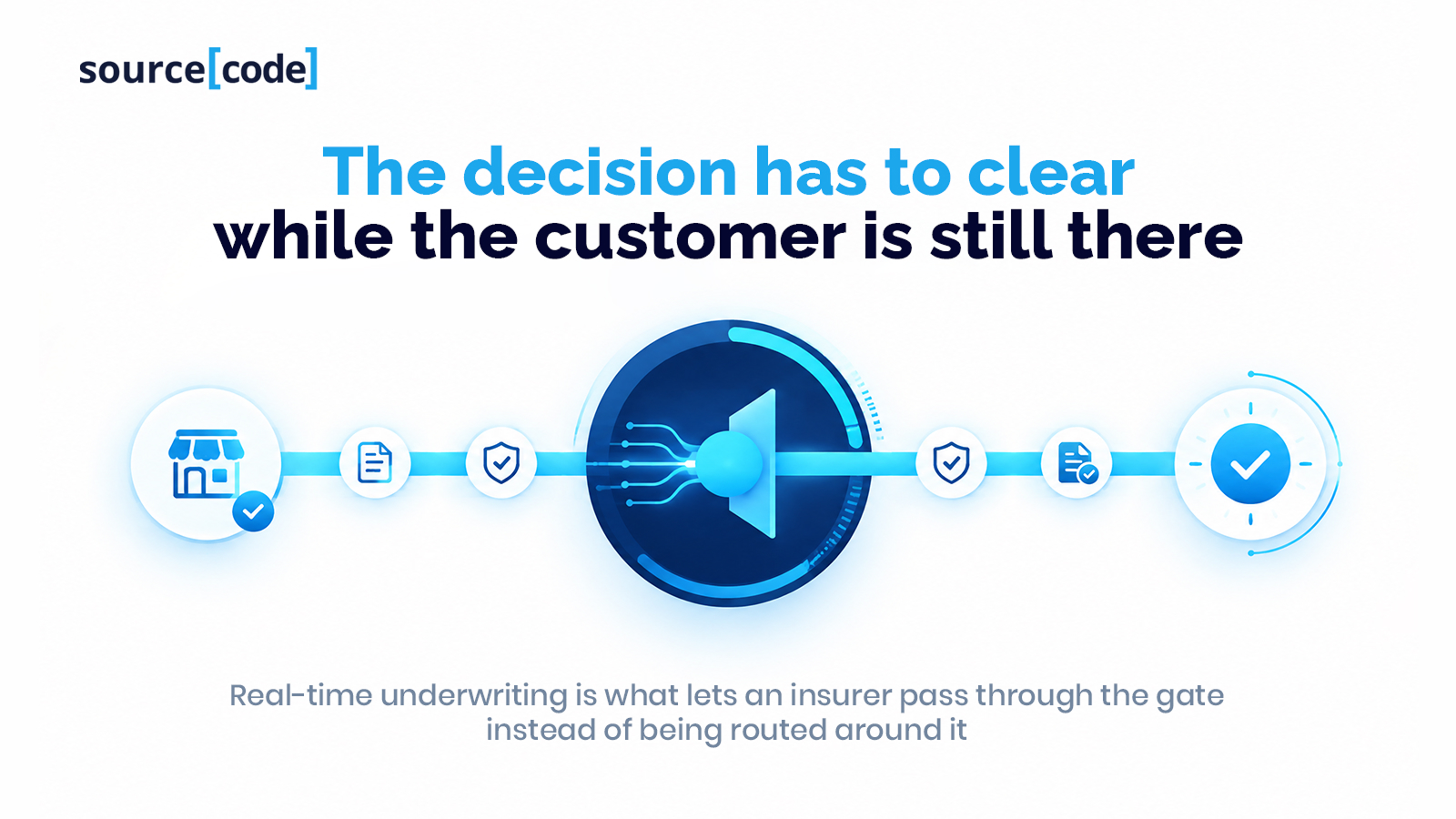
Can your underwriting engine return a real-time decision inside a partner's own transaction flow, or only after it? The test is not whether the insurer eventually approves the policy. It is whether the SME customer, inside the platform's own onboarding or checkout screen, gets a yes, a no, or a priced offer before moving to the next step - because if not, the platform routes that moment to whichever partner can answer in time, and the insurer's product becomes something the customer discovers later rather than buys there.
Which of your current or prospective embedded partnerships has you renting the interface, and which has you renting the decision? An insurer can rent a platform's checkout experience and still own the underwriting call behind it. The harder question, honestly answered partnership by partnership, is whether the insurer can see, audit and adjust the actual risk decision being made in its name, or whether it happens entirely inside a partner's system with the insurer learning the outcome after the fact.
What is your API and data-exchange capability specifically for SME risk, distinct from whatever consumer embedded integrations you have already built? SME underwriting draws on different signals than a consumer BNPL decision - trading history, revenue volatility, sector risk, existing facilities - and a real-time API built for consumer eligibility checks will not automatically extend to SME underwriting without deliberate work. Treating the two as the same integration problem is a common and expensive assumption.
If a platform partner's real-time decisioning replaces your own on a given product, what is your plan for the economics once that partner has the leverage? A partner that solves the insurer's speed problem in year one also controls the point-of-sale relationship in year two, three and beyond - and renegotiates from that position. Insurers entering SME embedded partnerships without a stated point at which they intend to bring more of the decision in-house tend to discover, later, that the option has quietly closed.
The sourceCode’s Perspective
We built the Point-of-Sale Underwriting Gate because the pattern underneath SME embedded insurance is one we have already seen play out in the earlier, consumer-facing wave of the same category: an insurer underestimates how much of the commercial relationship follows the point-of-sale decision, lets a platform or MGA partner own that decision by default, and only notices the margin and relationship it has ceded once renegotiating the split is expensive. This is our own disclosed delivery point of view, built from the pattern we see across BFSI technology engagements, not an independently published industry benchmark, and we are naming that distinction rather than presenting it as something it is not.
The Gate is not a call for every insurer to build a complete, owned underwriting stack for every SME vertical before pursuing a single partnership. It is a minimum bar: the real-time decisioning and API capability an insurer needs to retain enough visibility and control over the underwriting call itself, even while renting the interface or parts of the servicing relationship to a specialist partner. Insurers who set that bar before their first SME platform partnership, rather than after a partner has already built the decisioning layer for them, are the ones positioned to keep the economics of this growth phase rather than simply supplying the capital behind it.
Conclusion
The SME embedded opportunity that industry commentary keeps circling back to is real, and the commercial case for pursuing it is, if anything, stronger than the consumer-transaction wave that proved the category. What is not yet settled, for most APAC insurers eyeing it, is whether they can clear an underwriting decision fast enough, inside a partner's own transaction flow, to own that relationship rather than rent it indefinitely to the BNPL platforms and fintechs that have already built the capability.
The question worth asking before the next SME platform conversation is not whether to pursue the segment. It is whether the underwriting infrastructure on the other side of that partnership was built to hold the gate, or to wave everything through it.
FAQ
What does "SME embedded insurance" mean? It is insurance for small and mid-sized business customers sold inside another digital platform's transaction flow - a lending platform, a payments or merchant-services platform, or SME-facing software - rather than through a traditional broker or agent channel, following the same embedded distribution pattern already proven on consumer transactions.
Why are APAC insurers specifically targeting SMEs as the next embedded growth segment? Industry commentary on the category points to SMEs, alongside high-value products and cyber cover, as the next phase of embedded growth after the earlier consumer-transaction wave (BNPL, travel, device protection), partly because the easier consumer use cases are showing signs of saturation and partly because SME platforms already collect the underwriting-relevant data a protection decision needs.
What is "point-of-sale underwriting" and why does it matter for SME embedded insurance? It is the capability to return a real-time underwriting decision - approve, decline or price - inside the few seconds an SME customer spends in a partner platform's own onboarding or checkout flow, rather than following up afterward. Without it, the platform routes the decision, and the customer relationship that comes with it, to a partner that can decide in real time instead.
What is the "Point-of-Sale Underwriting Gate"? It is sourceCode's framework for the minimum real-time underwriting and API capability an insurer needs to retain meaningful control over the underwriting decision in an SME embedded partnership - distinguishing between renting a partner's interface or distribution reach, which is often reasonable, and renting the underwriting decision itself, which is where margin and the customer relationship tend to migrate to the partner permanently.
Does this mean every insurer needs to build its own complete SME underwriting platform before pursuing embedded partnerships? No. The framework does not call for insurers to build everything in-house before engaging the SME segment. It calls for insurers to set a deliberate minimum bar for real-time decisioning and auditability before relying on a partner's own engine to make underwriting calls on their balance sheet - a smaller, more specific commitment than building a full owned platform.
Reference List
(Re)in Asia (2024) APAC insurers eye SMEs in next phase of embedded growth. Available at: https://reinasia.com/apac-insurers-eye-smes-in-next-phase-of-embedded-growth/ (Accessed: 17 November 2026).
(Re)in Asia (2024) Insurers urged to transform embedded models or risk missing out on trillion-dollar opportunity. Available at: https://reinasia.com/insurers-urged-to-transform-embedded-models-or-risk-missing-out-on-trillion-dollar-opportunity/ (Accessed: 17 November 2026).
Boston Consulting Group (2025) Building a Tech Framework for Embedded Insurance. Available at: https://www.bcg.com/publications/2025/building-tech-framework-for-embedded-insurance (Accessed: 17 November 2026).