Key Takeaways
- Boards approving AI business cases are increasingly comfortable asking pointed internal questions - who owns this model, what is its risk tier, what happens if it fails - because regulatory guidance in multiple jurisdictions now expects exactly that line of questioning from the institution itself.
- Procurement and vendor management teams preparing the business case rarely turn that same line of questioning on the delivery partner proposing it. Pilot results, risk classification, exit terms and cost trajectory are typically taken as given, summarised in a slide, rather than demanded as evidence before the paper reaches the board.
- That asymmetry is not malicious and is rarely even noticed. It exists because the board's internal accountability expectations have moved faster than procurement's vendor-evaluation habits have caught up with them.
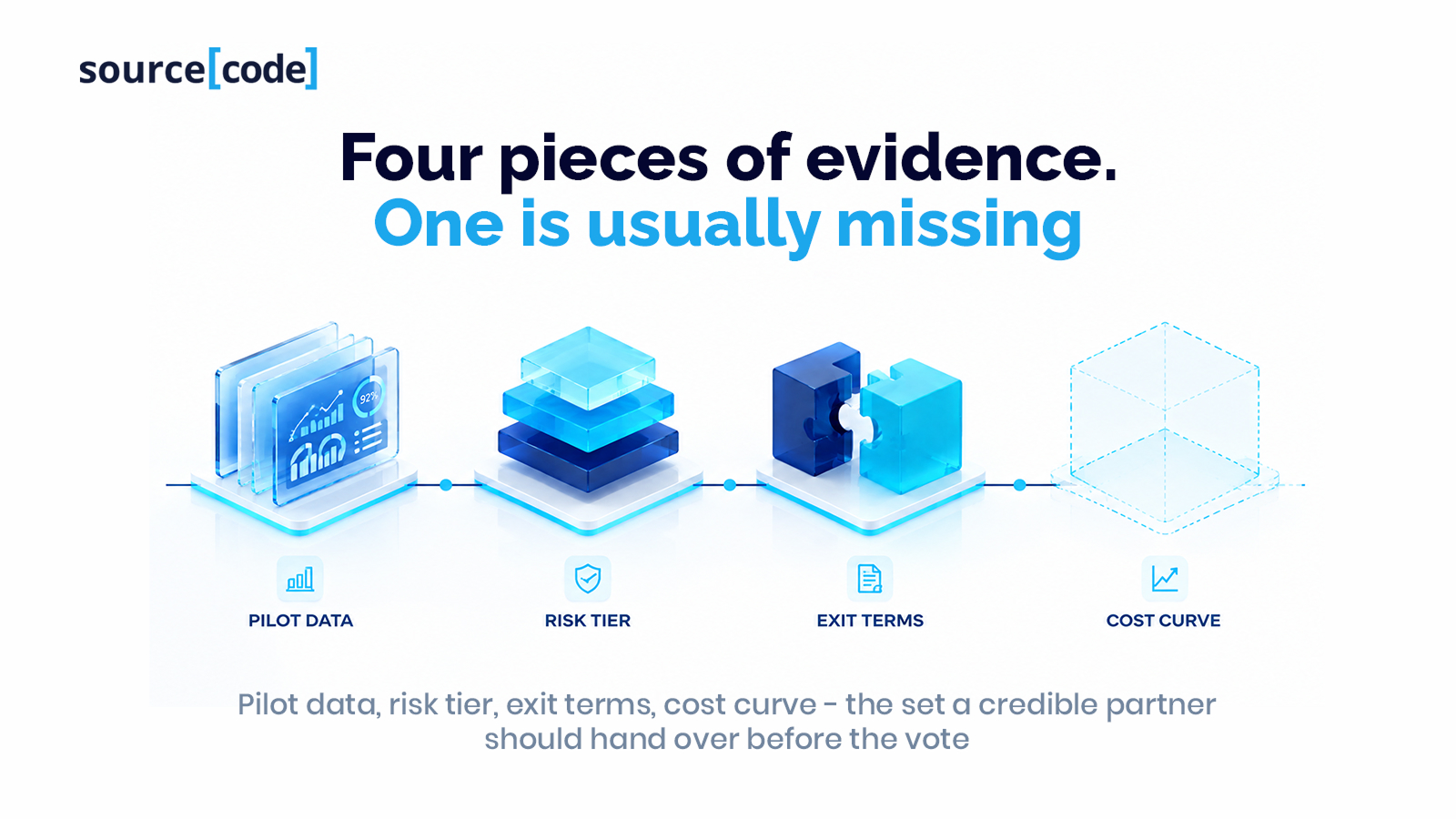
- The gap is not closed by asking a partner to "demonstrate AI maturity" in the abstract. It is closed by naming the specific artefacts a credible partner should hand over before the vote: pilot data reflecting production conditions, a stated model-risk tier, defined exit terms, and a cost curve that extends past the pilot.
- sourceCode's Board-Ready Evidence Set names those four components explicitly, as our own disclosed practitioner framework, so procurement can ask for them by name rather than discovering their absence after the board has already signed off.
 Introduction
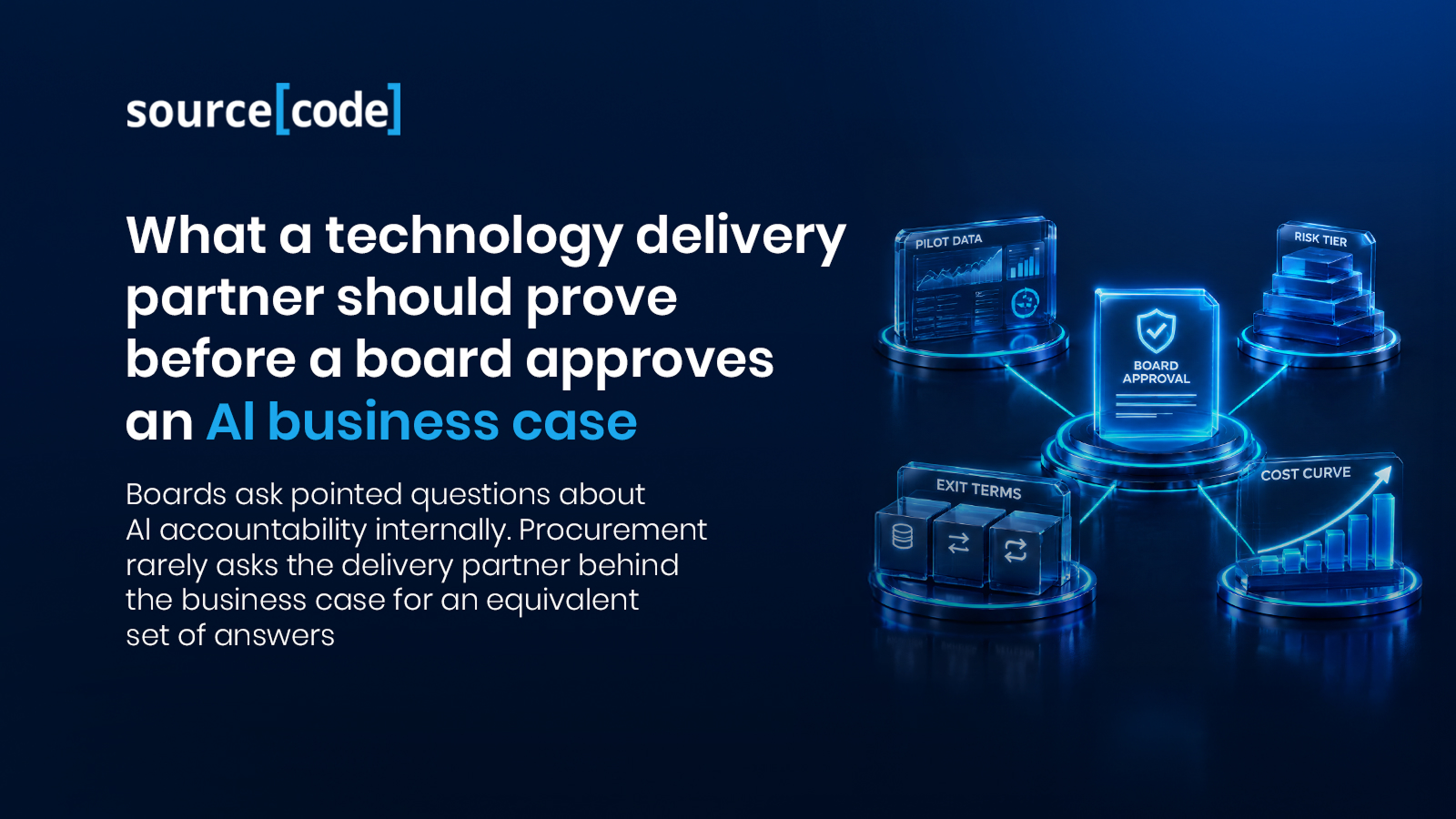
By the time an AI business case reaches a board, the institution has usually already done the harder internal work. Risk and compliance have asked what model-risk tier the system sits in. Technology leadership has been asked who is accountable if it misbehaves in production. Increasingly, someone on the board asks what happens to the model, the data and the decision if the arrangement needs to be unwound. These are no longer unusual questions for a board to ask about its own AI governance - they are becoming the expected baseline.
What is far less consistent is whether that same board ever turns those questions toward the delivery partner that built, or is proposing to run, the system the business case describes. Procurement and vendor management teams assemble that business case, and in our delivery work with Australian and broader APAC banks and insurers, the partner's own evidence is usually the thinnest part of the paper - a logo, a reference client, a pilot metric offered without much context for how it was produced, and little that would survive the scrutiny the board is about to apply to the institution's own controls.
This is not a story about vendors hiding anything. It is a story about sequencing. The business case gets built around what the partner volunteers, and most partners volunteer the evidence that makes them look best - pilot wins, feature lists - rather than the evidence a board would need to approve the case with its eyes open: how the pilot was run, what risk tier the partner itself would assign the system, what it costs to leave if the partner underperforms, and what the cost curve looks like once the pilot ends and production begins. Procurement rarely asks for that evidence as a named, structured set, because nobody has told them it should be one. That is the gap this piece addresses.
Why Boards Are Asking Harder Questions, and Why the Answers Usually Stop at the Institution's Own Walls
The regulatory direction across multiple markets is consistent on one point: institutions are expected to own the risk of AI systems they use, including ones built or operated by a third party. Singapore's MAS, in Guidelines on Artificial Intelligence (AI) Risk Management released alongside an October 2026 media statement, names board and senior-management oversight as an explicit expectation, and states that financial institutions remain responsible for AI used in their services, including AI sourced from third parties - with institutions expected to obtain sufficient assurance from providers and be prepared to limit, suspend or replace a third-party AI service if its risk falls outside their appetite (MAS, 2026).
A parallel shift is visible in US model-risk guidance. SR 26-2, which succeeded SR 11-7 in April 2026, is reported to extend model-risk obligations explicitly to AI, machine-learning and agentic systems, stating that oversight obligations follow the use case, not the origin of the model - a vendor-sourced model carries the same validation and monitoring expectations as one built in-house, and a vendor's own attestations do not substitute for the institution holding its own evidence (Openlayer, 2026, summarising SR 26-2).
Neither source is written about what a delivery partner should prove to a board before a business case is approved, and we are not presenting either as if it were. We use them only as background on why boards face rising, multi-jurisdictional pressure to demonstrate AI accountability internally, including for AI sourced outside the institution. Both make clear that the obligation to assess a third party's AI risk sits with the institution. Neither tells procurement what, specifically, to ask a delivery partner for before the business case reaches the board - that translation is the Board-Ready Evidence Set below, sourceCode's own practitioner framework, not a requirement drawn from either source.
The Evidence Gap Between What the Board Asks Internally and What Procurement Asks the Partner
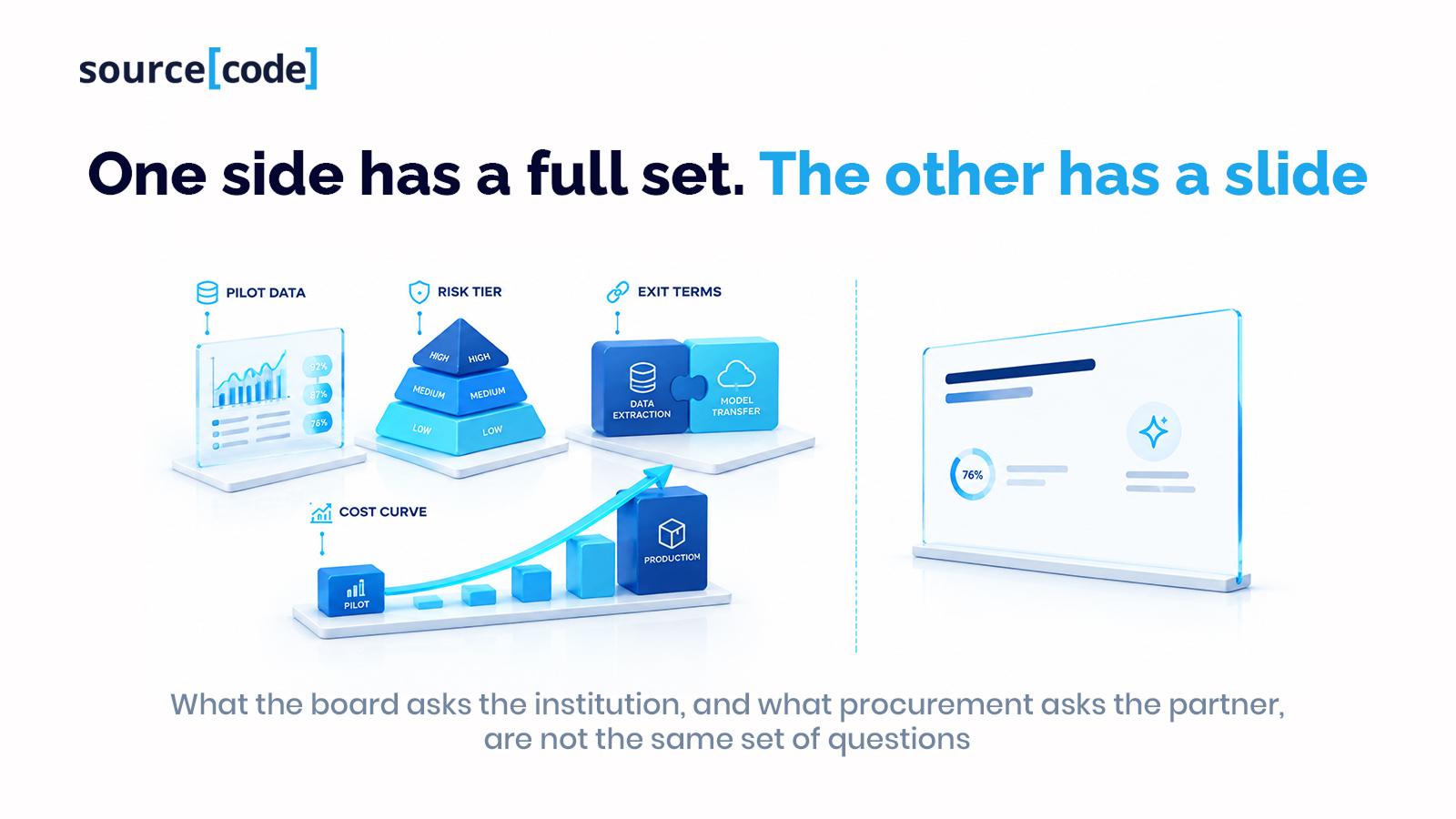
Put the two sides next to each other and the asymmetry is stark. Internally, a board approving an AI business case is increasingly used to asking what risk tier a system sits in, who is accountable for its outcomes, and what happens if the institution needs to stop using it - questions its own risk, technology and compliance functions increasingly have ready answers for, because regulatory attention has made "we don't know" uncomfortable to say in a board paper.
Procurement's questions to the delivery partner proposing the business case tend to stop well short of that standard. A typical AI vendor evaluation asks about cost, delivery timeline, reference clients and feature fit - categories that apply to almost any technology procurement. It rarely asks the partner to state, in writing, what risk tier it would assign the proposed system, what the pilot measured and under what conditions, what it would cost to leave the engagement, or what the cost curve looks like once the system moves from pilot to production scale. The business case that reaches the board, as a result, contains strong answers to the institution-side questions and thin or absent answers to the equivalent questions about the partner behind the numbers.
This gap persists for an ordinary reason: nobody owns closing it. Procurement's standard evaluation templates were largely built before AI-specific board scrutiny became routine, and updating a vendor scorecard is slower and less visible than updating a board paper's governance section. The result is a business case where the institution can answer every question the board is likely to ask about itself, while the partner behind the numbers has never been asked an equivalent set of questions at all.
"Isn't This Just More Vendor Due Diligence Paperwork?" - the Honest Counterargument
The strongest objection to formalising a Board-Ready Evidence Set is that procurement teams already run vendor due diligence, and a named four-part evidence set on top of existing security, commercial and reference checks risks becoming one more compliance exercise that slows delivery without changing the decision at the end of it. Pilots are supposed to move fast precisely because they are low-commitment; asking a pilot partner to produce a risk tier and an exit-cost schedule before the pilot has proven anything can look like demanding board-grade rigour at a stage designed to avoid exactly that overhead.
 That objection has real weight, and a version of this framework that demanded full board-grade evidence from a four-week proof-of-concept would deserve the criticism. The distinction worth holding is between a pilot's cost of entry and a business case's cost of approval. A pilot can and should stay lightweight; the four evidence components only need to exist, in reviewable form, by the point procurement is writing the paper that asks a board to commit budget and risk appetite to scaling what the pilot showed - a later, higher-stakes moment than the pilot's kickoff. A partner that cannot produce pilot data, a stated risk tier, exit terms and a cost curve by business-case stage is not being over-scrutinised early; the institution is instead asking its board to approve a case built on evidence the partner was never required to have ready.
When the Business Case Outlives the Evidence Behind It
The practical risk of skipping this evidence set is not that the pilot fails - pilots that fail cheaply and visibly tend to get caught before they reach a board. The risk is the opposite: a pilot succeeds narrowly, a business case gets built around that narrow success, and the board approves a production commitment based on evidence that was never designed to answer the question the approval actually depends on.
 Each component addresses a specific failure mode. Pilot data collected under favourable conditions does not reveal how a system behaves against messier production data or higher volumes - a gap that surfaces only once the case is approved and the system is live.
A risk tier the partner never stated means the institution assigns one itself, after the fact, without the partner's own view to compare against. Exit terms left undefined at business-case stage get negotiated from weakness later, once the institution is operationally dependent. And a cost curve covering only the pilot routinely understates what the board actually approved, since pilot-stage and production-scale unit economics for AI systems are rarely the same curve. None of this requires bad faith on the partner's part - it requires procurement to ask for the evidence before the business case is written, rather than assuming a strong pilot result stands in for all four.
Who Actually Owns Asking for This Evidence
Procurement and Vendor Management write the business case and are the only function positioned to make the Board-Ready Evidence Set a standing requirement of vendor evaluation, rather than a judgment call made differently for every engagement.
The CIO or Head of Technology carries the technical credibility of the business case in front of the board, and is usually the one who has to answer follow-up questions about risk tier and production behaviour that pilot data alone cannot support if it was never collected under representative conditions.
Risk and Compliance hold the clearest stake in the risk-tier and exit-terms components specifically, since both feed directly into the institution's own obligation - under guidance such as MAS's AI Risk Management Guidelines - to demonstrate it can assess, and if necessary limit or replace, a third-party AI service.
The CFO, reviewing the commercial case, is best placed to insist the cost curve extends past the pilot, since a production-scale cost trajectory that differs materially from the pilot's unit economics is a finance risk the board needs to see before approval, not a surprise discovered in the first production budget cycle.
The Board itself is the body this evidence set exists to serve - and a board already comfortable asking its own risk and technology functions hard questions about AI accountability should extend the same expectation to the delivery partner behind the business case in front of it.
The Board-Ready Evidence Set: Four Questions Before the Business Case Goes to the Board
What does the pilot data actually show, and under what conditions was it collected? A pilot metric presented without its conditions - data volume, data recency, how representative the test population was of real production traffic - cannot be extrapolated into a production forecast. The question to put to the partner is specific: show the data, show the conditions it was collected under, and show where those conditions differ from what production will actually look like.
What risk tier would the partner itself assign this system, and on what basis? A credible delivery partner should be able to state a proposed risk tier, grounded in the materiality of what the system decides or influences, and explain the reasoning, rather than waiting for the institution to assign one unilaterally after the fact. A partner that has never considered the question is revealing something about how seriously its own delivery process treats AI risk.
What are the exit terms, specifically, if this engagement needs to end? Not a generic termination clause, but a concrete description of what it costs, in time and money, to extract the institution's data, retrain or transfer the model, and move to a different partner or an in-house team if the engagement underperforms. Exit terms negotiated before signature are negotiated from strength; exit terms discovered mid-engagement are not.
What does the cost curve look like past the pilot, not during it? Pilot-stage cost is almost never representative of production-scale cost for an AI system, where compute, data and monitoring costs typically scale differently than a pilot's limited footprint suggests. The business case the board approves should show the curve the institution will actually be asked to fund, not the curve the pilot happened to produce.
The sourceCode’s Perspective
We built the Board-Ready Evidence Set because we sit on both sides of this conversation - as a delivery partner proposing AI business cases to BFSI boards, and as an advisor helping procurement teams evaluate partners like us. This is our own disclosed point of view, built from delivery experience rather than drawn from the MAS or SR 26-2 material referenced above, and we are naming that distinction directly rather than implying the framework is a regulatory requirement it is not.
The partners most willing to produce this evidence unprompted are usually the ones worth working with; the ones most reluctant are revealing something procurement should want to know before the business case is written, not after the board has approved it. We would rather a procurement team ask us for a stated risk tier and a real cost curve and find our answer wanting than discover the gap during a board meeting, when the only options left are to approve a case built on thin evidence or delay a decision the institution has already built momentum behind.
Conclusion
Boards are getting better, quickly, at asking hard internal questions about AI accountability - who owns the risk, what tier it sits in, what the institution does if it fails. Procurement teams preparing the business case that reaches the board are the ones positioned to make sure the delivery partner behind that case can answer an equivalent set of questions, named clearly, asked before the case is drafted rather than during the meeting where it gets approved.
The Board-Ready Evidence Set - pilot data, risk tier, exit terms and cost curve - is one way to make that evidence a standing requirement rather than a matter of which partner happened to volunteer the most.
FAQ
What is the Board-Ready Evidence Set? It is sourceCode's own practitioner framework naming four pieces of evidence a technology delivery partner should produce before an AI business case reaches a board for approval: pilot data with its collection conditions disclosed, a stated model-risk tier, defined exit terms, and a cost curve that extends past the pilot into production scale.
Is the Board-Ready Evidence Set based on MAS's AI Risk Management Guidelines or on SR 26-2? No. Both are used in this article only as background on why boards face rising, multi-jurisdictional pressure to demonstrate AI accountability internally, including for third-party AI. Neither addresses what a delivery partner should prove to a board before a business case is approved - the Board-Ready Evidence Set is sourceCode's own disclosed framework, built from delivery experience, not derived from either source.
Why doesn't procurement already ask delivery partners for this evidence? Most vendor-evaluation templates were built around cost, delivery timeline and feature fit before AI-specific board scrutiny became routine. Updating a board paper's AI-governance section has moved faster than updating the underlying vendor scorecard, leaving a gap nobody owns closing by default.
Does a fast-moving AI pilot really need all four pieces of evidence from day one? Not necessarily at pilot kickoff. The distinction that matters is between a pilot's lightweight cost of entry and a business case's cost of approval. The four components need to exist in reviewable form by the time procurement is writing the paper asking a board to commit budget and risk appetite to scaling the pilot - a later, higher-stakes moment than the pilot's start.
Who should own asking the delivery partner for this evidence? Procurement and Vendor Management are best placed to make it a standing requirement of the evaluation process, but Risk and Compliance have the clearest stake in the risk-tier and exit-terms components specifically, since both feed the institution's own obligation to assess, and if necessary limit or replace, third-party AI under guidance such as MAS's AI Risk Management Guidelines.
Reference List
MAS (Monetary Authority of Singapore) (2026) MAS sets out supervisory expectations on responsible AI adoption by financial institutions. Media release, 7 October. Available at: https://www.mas.gov.sg/news/media-releases/2026/mas-sets-out-supervisory-expectations-on-responsible-ai-adoption-by-financial-institutions (Accessed: 17 November 2026).
Openlayer (2026) SR 26-2: a model risk management guide for AI teams. Available at: https://www.openlayer.com/blog/post/sr-26-2-mrm-guide-ai-teams (Accessed: 17 November 2026).