Key Takeways
- Renewal servicing is one of the fastest-automating parts of the insurance customer journey: AI now drafts renewal notices, answers coverage questions, processes straightforward changes and closes out a growing share of renewal conversations without a human touching the file.
- That automation is being justified, funded and reported almost entirely on efficiency metrics - handle time, cost-to-serve, containment rate, straight-through-processing percentage - not on what happens to the customer relationship afterwards.
- Almost no insurer we see has a standing framework that traces, by channel, whether an AI-handled renewal retains, upsells or quietly leaks the customer at the next cycle compared with a human-handled one. The efficiency case gets measured. The retention case gets assumed.
- The available adjacent evidence on AI-driven retention in insurance is encouraging but incomplete: it shows AI can improve retention and reduce discount leakage when a carrier deliberately builds a retention-scoring layer around it, not that today's AI-handled renewal servicing is already being measured against human-handled servicing on those same outcomes.
- sourceCode's Renewal Retention Trace instruments renewal servicing end-to-end so retention and leakage are measured by channel from day one - so a carrier finds out what AI-handled renewals actually do to the book from its own data, not a year later when the lapse numbers surface on their own.
Introduction
Ask most insurance operations leaders how their AI renewal servicing is performing, and the answer arrives fast and specific: containment rate is up, average handle time is down, straight-through-processing on simple renewals has roughly doubled, and cost-to-serve on a renewal that used to need an agent now barely registers. Those numbers are real, and they are the reason the investment got approved in the first place.
Ask the same leader whether customers whose renewal went through the AI channel are more or less likely to lapse, downgrade or quietly shop the market at their next renewal than customers whose renewal went through a human, and the answer gets vague. Not wrong, necessarily - just untracked. The data that would answer it usually exists somewhere, scattered across a servicing platform, a policy administration system and a retention model built before the AI channel existed and never re-cut by how the last renewal was actually handled.
This is not a story about whether AI should handle renewal servicing. It clearly can, and the efficiency case for it is genuine. It is a story about a gap that opens quietly the moment AI starts handling a meaningful share of renewal volume: the moment a carrier can no longer assume "renewal completed" means the same thing, for retention purposes, regardless of which channel completed it - and keeps measuring as if it does.
Efficiency Metrics Are Not Retention Metrics
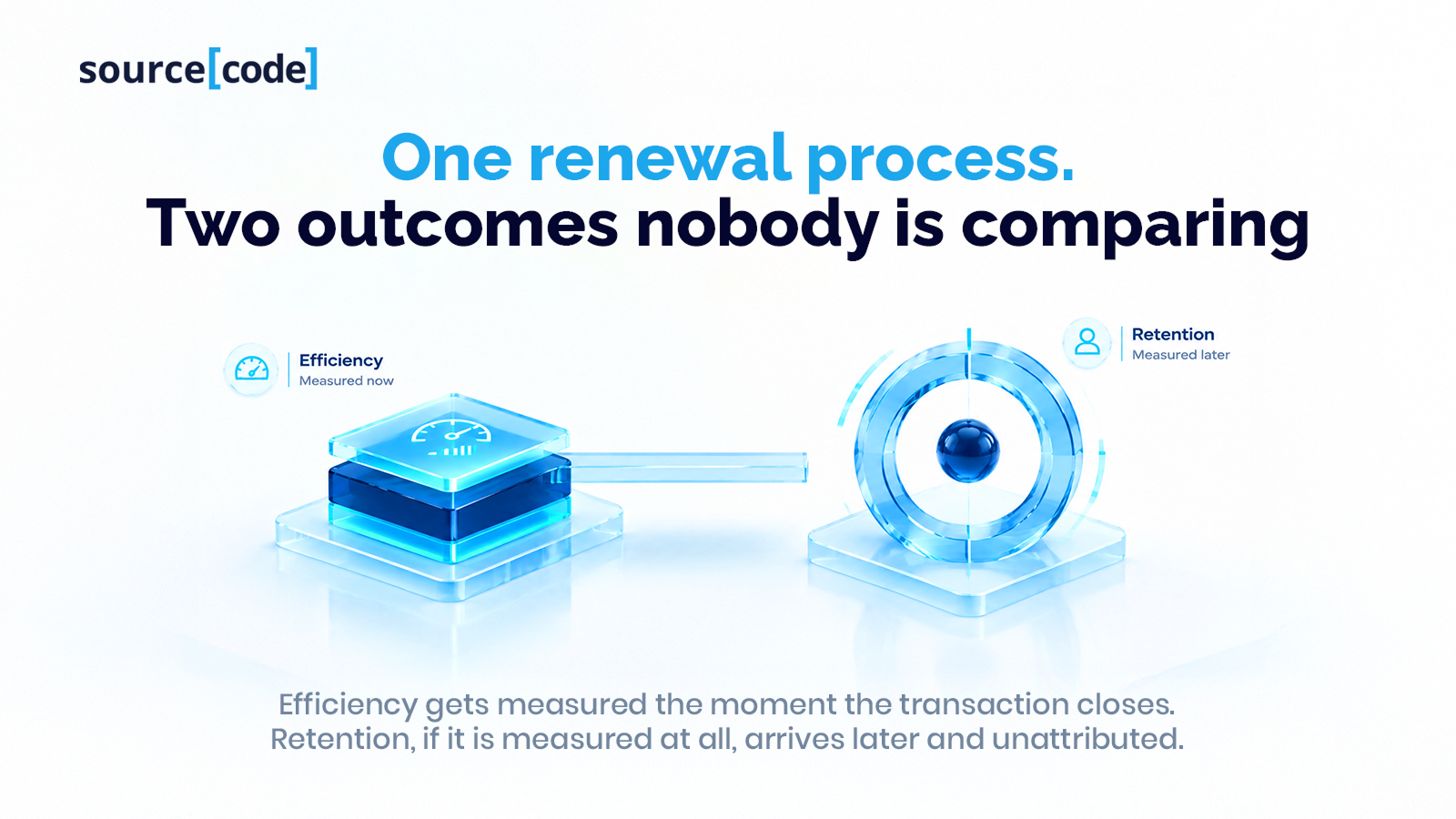
The confusion is easy to fall into because the two sets of metrics sit on the same dashboard and both trend in the same reassuring direction when an AI renewal deployment goes well. Containment rate rising and complaint volume staying flat looks, at a glance, like evidence that retention is fine too. It isn't evidence of that at all; it is evidence that the renewal transaction completed without friction, which is a precondition for retention, not a proxy for it.
The distinction matters because the two things fail on different timelines. An efficiency metric fails immediately and visibly - a chatbot that cannot answer a coverage question gets escalated within the same session, and that shows up in the containment number that day. A retention metric fails on a delay of months: a customer whose AI-handled renewal went smoothly on the surface, but whose premium increase was never adequately explained, or who simply never built the relationship a renewal conversation with a person used to create, doesn't necessarily cancel on the spot. They renew, quietly disengaged, and lapse or shop the market at the following cycle - months after the AI channel's own dashboard logged that renewal as a clean, contained success.
This is also where upsell and cross-sell get lost in the same blind spot. A human agent handling a renewal conversation routinely surfaces a coverage gap the system itself can't see; most renewal automation is built to close the transaction, not to replicate what a good agent did with the extra two minutes of unscripted conversation. If AI-handled renewals are converting less of that latent upsell opportunity, nothing in a containment-rate dashboard would show it, because containment rate was never built to look for it.
How Leakage Hides Inside a Clean Renewal Funnel
Leakage, in the sense that matters here, is not cancellation at the point of renewal - that already gets tracked, because a cancelled policy is a visible, bookable event. The leakage this piece is concerned with is the kind that doesn't happen at renewal at all: the customer who renews cleanly through whichever channel handled them, then cancels, downgrades, or quietly moves their next policy to a competitor sometime in the following cycle, in a way that is never traced back to how the prior renewal was serviced.
The mechanism is structural, not a failure of any single AI deployment. Renewal automation is typically measured and owned by whoever built the servicing flow - usually customer operations, reporting on efficiency KPIs tied to that one transaction. Retention and lapse analysis is typically owned by a different function - actuarial or pricing - looking at the book over a longer horizon, using models built before renewal channel was a variable worth including. Neither function is incentivised, or technically equipped, to join the two datasets: this renewal, through this channel, led to that outcome months later. The join is possible. It is simply not anyone's job to make it, so in most carriers we talk to, it doesn't get made.
The result is a one-way ratchet in the data available to decision-makers. Every efficiency number about AI renewal servicing is current and reported upward constantly, because the system producing the renewal interaction is the same system producing the metric. Every retention number that would tell a carrier whether that efficiency came at a cost is lagged, aggregated across all channels, and arrives - if it arrives at all - as a book-level trend rather than a channel-attributed one. A carrier can scale AI-handled renewal volume for several consecutive reporting cycles on efficiency data that looks unambiguously good, while the retention consequence of that scaling, if there is one, is still months from being visible in anyone's numbers.
What the Available Evidence Shows - and Where It Runs Out
There is encouraging adjacent evidence that AI, deliberately applied to retention rather than only to transaction completion, can move the numbers that matter. Boston Consulting Group's 2026 analysis of AI-driven retention in insurance describes carriers building a "retention intelligence engine" that scores customer value, churn risk and offer response, and reports that a one-percentage-point improvement in retention can deliver growth comparable to a 15% increase in new business - with some insurers reporting margin gains of up to 30%, 5-10% improvements in retention and a 20-30% reduction in discount leakage on policies managed through that kind of system (BCG, 2026).
That evidence needs to be read for exactly what it is and isn't. BCG's own figures are attributed to unnamed "some insurers," with no disclosed sample size, methodology or baseline comparison - a limitation BCG does not hide, and we are not going to borrow precision the source itself doesn't claim. More importantly for this piece's thesis, BCG's "retention intelligence engine" scores risk and recommends actions to sales agents and digital channels - it is evidence that AI can be built for retention outcomes, and that doing so pays off, not evidence that today's renewal-servicing deployments are already being measured against human-handled servicing on retention and leakage specifically. The channel-attributed trace this piece describes is not something BCG's piece claims to have built either; it is adjacent proof the underlying measurement is valuable, not a published example of the measurement itself.
It's Reasonable to Ask Whether This Measurement Is Premature
The fair objection here is one of sequencing: AI-handled renewal volume at most carriers is still a minority of the book, the systems needed to join servicing-channel data to retention and lapse data at the customer level are a real integration project, and building a full retention-by-channel measurement framework before AI renewal servicing has scaled far enough to matter statistically risks spending effort on a question that doesn't yet have enough data behind it to answer reliably.
That objection is correct about sequencing and wrong about what it implies should happen instead. The right response to "the AI-handled cohort is still small" is not "wait until it's bigger before you start measuring" - it is "start the trace now, while whatever it is doing to retention is still cheap to fix." A framework built before volume scales produces a statistically thin result at first, but also a clean, comparable baseline from month one - precisely what a carrier won't have if it waits until the AI-handled share of renewals is 40% of the book and the question suddenly matters. The carriers most exposed are not the ones with a small AI-handled cohort; they are the ones who scaled that cohort for two or three years on efficiency data alone and never built the join to retention data, so "is this working for retention" has no answer at the exact moment someone finally asks it.
Who Is Actually Deciding This, Whether They Know It or Not
Heads of Customer Operations or Servicing own the AI renewal channel's day-to-day performance and usually report the efficiency numbers upward - numbers that are genuinely good and genuinely incomplete - and rarely hold the retention and lapse data that would complete the picture.
Engineering and platform leaders building the renewal-servicing AI control whether channel is captured as a trackable field alongside every renewal event - a decision usually made, or skipped, at build time, long before anyone asks the retention question.
Chief Actuaries and Heads of Pricing or Retention own the book-level view of lapse and leakage, and have the analytical capability to run a channel-attributed trace - but are often the last to know how much renewal volume flows through an AI channel at all.
Risk and compliance leaders, particularly where fair-treatment-of-customers obligations or AI-governance regimes apply, increasingly need to show an automated servicing channel is not producing worse outcomes than the channel it replaced - making a retention-by-channel trace a conduct evidence artefact, not only a commercial one.
A Decision Framework: Four Questions Before the Next Renewal Automation Expansion
Do you know, today, which renewals over the last twelve months went through AI and which went through a human? Most carriers can answer this for the current reporting period, because the AI platform logs it. Far fewer can answer it a year back, joined to what happened to those customers at their next renewal - and if that join doesn't exist, it is worth building before, not after, AI-handled volume grows further.
Is retention and leakage tracked by channel at renewal, or only in aggregate across the whole book? An aggregate retention number can look stable while masking a real divergence between channels, simply because the AI-handled cohort is still a minority of the total. The point that divergence becomes visible in the aggregate number is also the point it has already cost book value.
What would quiet attrition in the AI-handled cohort look like in your data - and would current reporting catch it, or only a cancellation at the point of renewal itself? If the honest answer is "we'd see a cancellation, but not a customer who renewed and then lapsed next cycle," the gap this piece describes is not hypothetical; it is already open.
If a regulator, your board or your own CFO asked for the retention difference between AI-handled and human-handled renewals, could you produce it this quarter? Teams that have built the trace have an answer ready before they're asked. Teams that haven't usually discover the gap only when someone senior asks directly and the honest answer is "we'd need to build that."
The sourceCode’s Perspective
We built the Renewal Retention Trace because we kept seeing the same sequence across the carriers we work with: a renewal automation deployment that is unambiguously successful on its own efficiency terms, and no one in the organisation able to say with confidence what it is doing to retention, upsell conversion or quiet leakage - because the systems that would answer that question were never connected to the system running the AI channel. This is our disclosed point of view, built from our own delivery and data-integration work across BFSI customer servicing platforms, not from an independently published industry survey, and we are naming that distinction rather than presenting it as something it is not.
The Renewal Retention Trace is not a retention model and does not try to predict churn; it is the instrumentation layer underneath one - a standing pipeline that tags every renewal event with its servicing channel at the point of handling, joins that tag to the customer's outcome at the next renewal cycle (retained, upsold, downgraded or lapsed), and reports the result by channel on a rolling basis rather than as a one-off study. It replaces "the AI renewal channel looks like it's going well" with a channel-attributed answer a carrier can defend to its own actuarial function, its board or a conduct regulator - built while the AI-handled cohort is still small enough that whatever the data shows is cheap to act on.
>> Explore more about our solutions!
Conclusion
Renewal servicing automation is getting the measurement that is easy to produce - handle time, containment, cost-to-serve - because that measurement is a byproduct of the system doing the automating. It is not getting the measurement that actually matters to the business the renewal belongs to, because that requires joining two systems never built to talk to each other, and because nobody's job description currently includes making them. The efficiency case for AI-handled renewal servicing is real and needs no further defending.
The question worth asking before the next expansion of that automation is simpler and considerably less comfortable: if AI-handled renewals are quietly retaining, upselling or leaking differently than human-handled ones, would your organisation actually know - or would it find out the way most carriers do, a year later, in the lapse numbers.
FAQ
What does "renewal servicing" mean in this context? It refers to the customer-facing work of managing a policy renewal - sending the renewal notice, answering coverage and pricing questions, processing changes, and closing out the transaction - as distinct from new business sales or claims handling. This piece focuses specifically on AI's growing role in that function.
Why don't efficiency metrics like containment rate or handle time tell you whether AI-handled renewals are retaining well? Because they measure whether the transaction completed smoothly, not what the customer relationship does afterwards. A renewal can be logged as a clean success in the servicing platform, while the customer quietly disengages and lapses at the following cycle - an outcome that shows up, if at all, in a different system, months later, and rarely gets traced back to the channel that handled the prior renewal.
Is there published data proving AI-handled renewals retain worse than human-handled ones? No, and this piece does not claim there is. The point is the opposite: almost no carrier has the channel-attributed measurement in place to answer that question either way, for their own book. The available adjacent evidence, such as BCG's 2026 analysis of AI-driven retention programmes, shows AI can improve retention when deliberately built and measured for that purpose - it does not show current renewal-servicing deployments are already measuring themselves against human-handled servicing on retention outcomes.
Does a carrier need a large AI-handled renewal volume before this kind of measurement is worth building? No - the opposite case is stronger. Building the trace while the AI-handled cohort is still small produces a thin but clean baseline and makes any early divergence cheap to correct. Waiting until AI handles a large share of renewal volume means any problem that exists has already compounded across a much larger slice of the book before anyone can see it.
What is the first practical step toward closing this measurement gap? Start by confirming whether renewal events are even tagged with the servicing channel that handled them, and whether that tag can be joined to the customer's outcome at the next renewal cycle. In most organisations, that join does not currently exist between the servicing platform and the retention or lapse reporting function - making it exist is the foundation everything else in a channel-attributed retention trace is built on.
Reference List
Prádanos Niño, C., Candreia, A., Montón, G. and Hofer, T. (2026) Always on retention: how AI is rewiring insurance. Boston Consulting Group. Available at: https://www.bcg.com/publications/2026/always-on-retention-how-ai-is-rewiring-insurance (Accessed: 17 November 2026).