Reducing Policy Lapses: AI-Powered Premium Collection for Insurers
Policy lapse is one of the most persistent and expensive problems in insurance operations. It affects cash flow, increases operational burden, and quietly erodes customer lifetime value. Despite years of investment in reminder systems, call centers, and billing automation, many insurers still struggle to prevent policies from lapsing due to missed or delayed premium payments.
The underlying issue is not a lack of reminders, but a lack of timely, contextual, and actionable engagement. This is where in-conversation payment journeys, powered by AI chatbots and voice bots, are fundamentally changing Premium Collection for Insurers.

Policy lapse is a behavioral problem before it becomes a financial one
Most policy lapses do not happen because customers consciously decide to stop paying. In reality, lapse is often the result of friction, uncertainty, or inaction. Customers forget due dates, are unsure about grace periods, hesitate because they want clarification, or simply postpone payment because the process feels inconvenient at that moment.
Traditional premium collection processes assume that once a reminder is sent, the customer will take the next step on their own. This assumption ignores how people actually behave. Attention is short-lived, motivation fades quickly, and every additional step required outside the reminder channel increases the probability of delay. Policy lapse begins in this gap between reminder and action.
The critical moment insurers keep missing
In premium collection, there is a narrow window when the customer is aware, present, and emotionally ready to act. This moment occurs when they open a message, answer a call, or respond to a reminder. If the system does not allow immediate resolution during that interaction, the opportunity is lost.
In-conversation payment journeys are designed specifically to capture this moment. Instead of pushing customers to another channel, another login, or another form, payment becomes a natural continuation of the conversation itself. This shift from notification-driven to conversation-driven collection is what makes the model so effective in reducing policy lapses.
What in-conversation payment journeys really mean for insurers
In the insurance context, in-conversation payment journeys go far beyond embedding a payment link. They represent a fully integrated experience where policy data, payment status, customer intent, and system intelligence are connected in real time within a single conversational flow.
A customer can ask about their premium status, understand the implications of non-payment, choose a payment method, and complete the transaction without leaving the chat or call. Whether through an AI chatbot or an AI voice bot, the journey is designed to remove hesitation and shorten the path from awareness to completion.
The role of AI in reducing policy lapses
AI is the engine that makes in-conversation payment journeys scalable, adaptive, and effective. Unlike static reminder systems, AI-powered chatbots and voice bots can understand context, interpret customer responses, and dynamically adjust the conversation. This capability is critical in addressing the diverse reasons behind missed premiums.
AI allows the system to recognize whether a customer intends to pay, needs clarification, wants to delay, or is at high risk of lapse. Based on this understanding, the conversation changes in real time. The result is a personalized interaction that feels responsive rather than automated, which significantly increases engagement and trust.
AI chatbots as real-time premium collection assistants
AI chatbots operate within messaging environments customers already use, making them ideal for low-friction premium collection. They can proactively initiate conversations before due dates, respond instantly to questions, and guide customers step by step through the payment process.
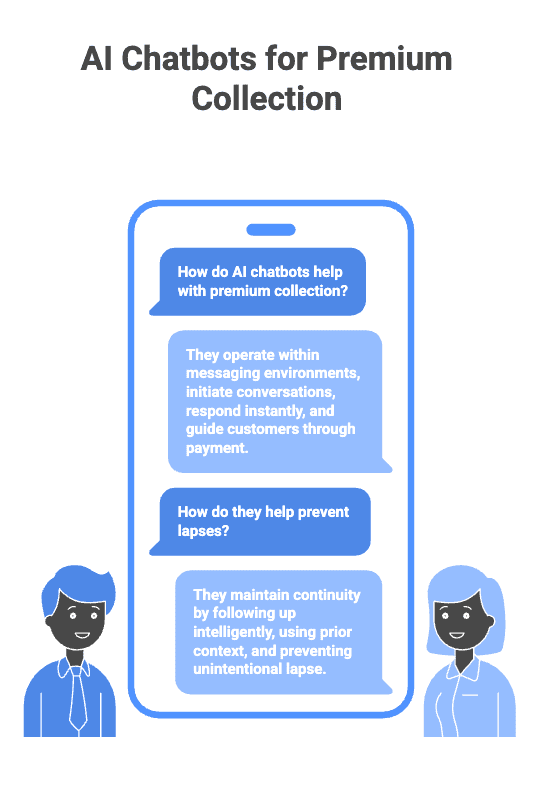
From a lapse-prevention perspective, chatbots excel at maintaining continuity. If a customer hesitates, asks for time, or abandons the conversation, the chatbot can follow up intelligently at the right moment, using prior context instead of restarting the interaction. This continuity is one of the most powerful tools for preventing unintentional lapse.
AI voice bots and the power of real-time verbal engagement
Voice bots play a critical role for customers who prefer calls or are less responsive to digital messaging. AI-powered voice bots can handle large volumes of outbound and inbound calls simultaneously while maintaining a natural conversational flow.
Unlike traditional IVR systems, AI voice bots can answer questions, respond to uncertainty, and guide customers verbally through payment options. When customers hear immediate explanations and solutions, hesitation decreases. Voice-based in-conversation payment journeys are particularly effective in time-sensitive lapse scenarios, where speed and clarity matter most.
Reducing friction is the most effective lapse-prevention strategy
Policy lapse is rarely solved by increasing pressure. Repeated reminders without resolution often frustrate customers and damage trust. In-conversation payment journeys reduce lapse by removing friction instead of adding urgency.
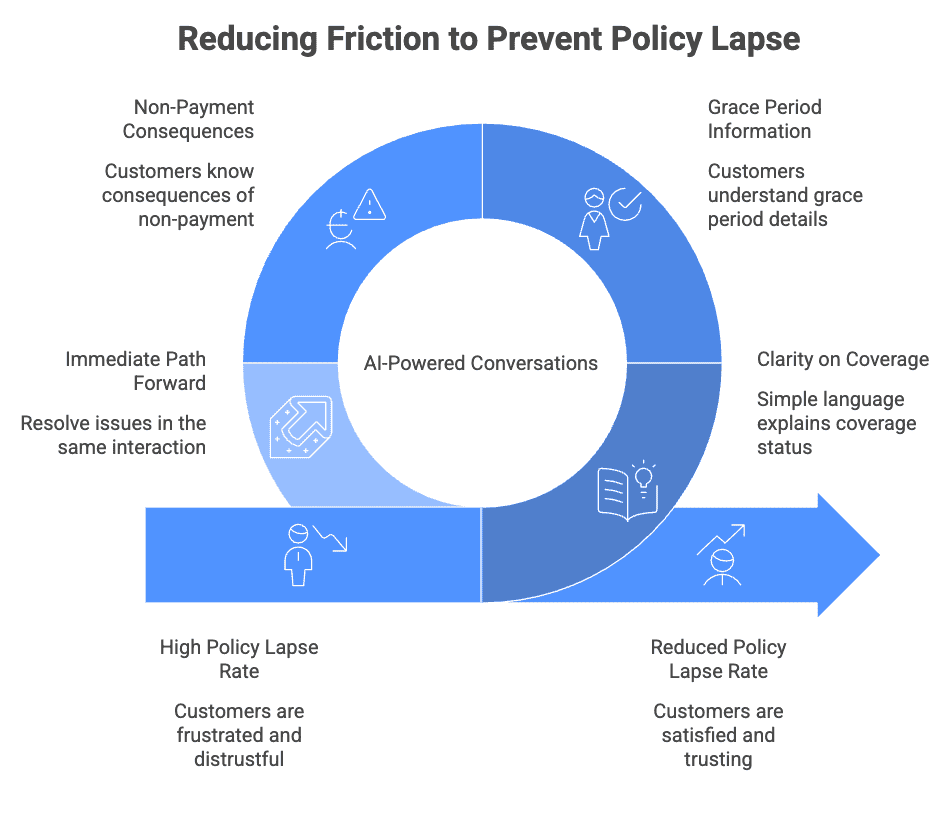
AI-powered conversations provide clarity about coverage status, grace periods, and consequences of non-payment in simple, understandable language. More importantly, they immediately offer a path forward. When customers can resolve the issue in the same interaction where the concern arises, lapse risk drops dramatically.
Operational impact: fewer escalations, faster resolution
From an operations standpoint, policy lapse creates a cascading workload. Each missed payment triggers follow-ups, manual checks, escalations, and often reinstatement processes. AI-driven in-conversation payment journeys break this cycle by resolving most cases before they escalate.
Routine interactions are handled automatically, while complex or emotionally sensitive cases are routed to human agents with full context. This human-in-the-loop model ensures operational efficiency without sacrificing service quality. Agents spend less time chasing payments and more time addressing genuine customer needs.
Data, context, and timing: why AI outperforms manual processes
One of AI’s greatest advantages in Premium Collection for Insurers is its ability to combine data with timing. AI systems can assess lapse risk based on behavior patterns, payment history, and response signals, then adjust outreach accordingly.
Instead of treating all overdue premiums equally, AI prioritizes interventions where they matter most. This precision improves collection rates while reducing unnecessary contact, which in turn protects customer experience and brand perception.
Compliance and trust in AI-driven payment conversations
In highly regulated insurance environments, trust and compliance are non-negotiable. AI chatbots and voice bots can be designed to capture consent explicitly, log every interaction, and maintain detailed audit trails.
Compared to manual notes or fragmented call records, AI-driven conversations offer greater transparency and consistency. This not only reduces compliance risk but also strengthens internal governance and dispute resolution capabilities.
Reframing premium collection as a conversational experience
Reducing policy lapses with in-conversation payment journeys is not about adding more technology for its own sake. It is about redesigning the premium collection experience around how customers actually behave. AI makes this redesign possible at scale, without increasing operational complexity.
When payment becomes part of a natural, guided conversation, customers are more likely to act, insurers are more likely to collect on time, and policy lapse becomes the exception rather than the norm. For insurers looking to improve cash flow, reduce operational strain, and strengthen long-term customer relationships, AI-powered in-conversation payment journeys are no longer optional. They are becoming a strategic necessity.
Get in Touch
Stay Connected with sourceCode To receive regular updates on industry insights and expert perspectives, make sure to Follow sourceCode on LinkedIn now! For collaboration opportunities, cutting-edge tech solutions, or to explore career possibilities with us, please visit our website: sourcecode.com.au